
JJM 2.0: Can You Guess the Most Ignored Component in India's Rs 8.69 Lakh Crore Water Mission?
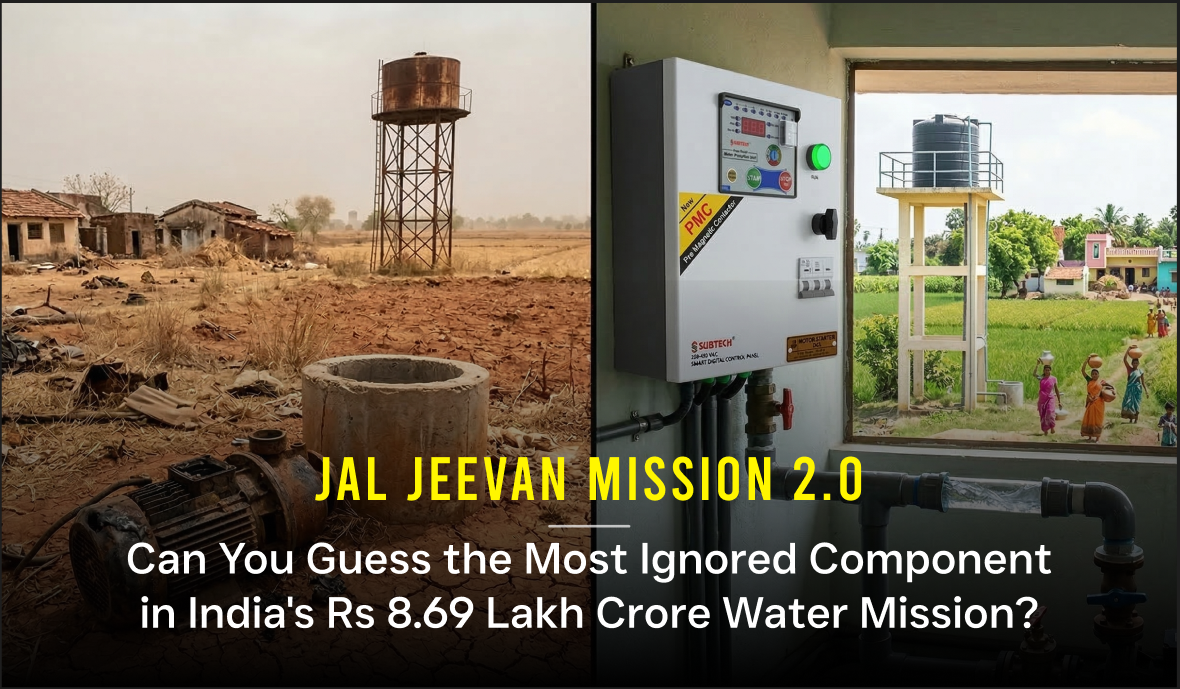
Jal Jeevan Mission 2.0 Has 19 Crore Pump Houses. Nobody Is Asking Who Protects the Pumps.
Rs 8.69 lakh crore. 19 crore rural households. Lakhs of pump houses being built across every district in India.
Everyone is talking about Jal Jeevan Mission 2.0. Pipes. Pumps. Treatment plants. EPC contractors. Infrastructure companies. Stocks rallying 20 percent in a single day.
But nobody is asking the most important question.
Who protects the pump?
Not the pipe. Not the treatment plant. Not the overhead tank. The pump. The submersible motor sitting at the bottom of a borewell in a village in Rajasthan, running 10 to 16 hours every day, in conditions that would destroy most electrical equipment within a season.
This article is about that question. And about why the answer matters more than anyone in the JJM conversation is currently acknowledging.
To understand how motor protection works in pump applications, start here: What Is a Motor Starter? Function, Types and Working
What Jal Jeevan Mission 2.0 Is Actually Building
The Jal Jeevan Mission was launched with one goal: Har Ghar Jal. Tap water to every rural household in India. JJM 1.0 covered infrastructure creation at a massive scale. JJM 2.0 shifts focus from building to delivering: making water actually flow, every day, reliably, in every village that now has the pipes and tanks in place.
This is where the mission becomes operationally complex.
Every JJM pump house has at least one submersible or booster pump. That pump runs on an electric motor. That motor runs anywhere from 8 to 16 hours a day depending on village demand and supply schedules.
Under JJM 2.0, Gram Panchayats are now required to certify that their water systems are actually running before they can declare "Har Ghar Jal." The infrastructure is only as good as the pump that pushes water through it. And the pump is only as good as the protection system keeping it alive.
This is the gap nobody is talking about.
What Happens to a Pump Motor in a Rural Indian Village
Sitting in a Delhi office looking at JJM budget allocations, it is easy to think of a pump motor as a simple, reliable piece of equipment. Put it in. Connect it. Water flows.
In the field, the reality is completely different.
A submersible pump motor in rural India operates in some of the most punishing electrical conditions in the world. Here is what that motor faces every single day:
Voltage drops to 160-180V during peak agricultural hours. When neighboring farmers run their tube well motors simultaneously, feeder voltage drops significantly. A motor rated for 220-240V running at 160V draws much higher current than normal. Over hours of operation, this excess current burns the motor winding.
Power cuts happen 8 to 12 times a day. Every time power cuts and resumes, there is a voltage spike. Repeated voltage spikes damage motor insulation over time. Without proper protection, each power cut takes a little more life out of the motor.
Dry run is common, especially in summer. Borewells run dry in peak summer when the water table drops. A submersible pump running without water heats up rapidly. Without dry run protection, a motor can burn within minutes of the borewell going dry. In JJM villages, where the operator may not be present 24 hours a day, dry run events can go undetected until the motor is already destroyed.
Single phasing happens during storms. A broken overhead line, a blown fuse on one phase, a loose connection at the feeder pole. One phase is lost. The motor tries to run on two phases, drawing dangerously high current on the remaining phases. Without proper single phasing protection, the motor burns within 2 to 4 minutes. At 2 AM, in a village where nobody is monitoring the pump house, this happens silently.
One dry run event: motor burn. Cost Rs 1.5 lakh to Rs 2 lakh.
One voltage spike: dead winding. Cost Rs 1.5 lakh to Rs 2 lakh.
One single phasing event at night: seized motor. Cost Rs 1.5 lakh to Rs 2 lakh.
Multiply this across lakhs of pump houses running without adequate protection, and the operational cost of JJM 2.0 becomes enormous. Not because of poor infrastructure. Because of inadequate motor protection at the last metre of the mission.
The Most Ignored Component in India's Water Mission
A smart motor protection panel that prevents all of the above failure modes costs Rs 10,000 to Rs 15,000 for a typical JJM pump application.
The pump itself costs Rs 40,000 to Rs 1,50,000 depending on HP rating and depth.
The civil work for the pump house costs several lakhs.
The pipeline connecting the pump house to the village costs tens of lakhs.
The motor protection panel, the component that keeps all of this investment running reliably, is often the last item on the specification list and the first item to be value-engineered out to meet budget targets.
This is the fundamental problem with how motor protection is treated in large infrastructure projects.
The pump house gets built. The pump gets installed. A basic starter gets connected. And the project gets signed off as complete.
Then summer arrives. The borewell runs dry. The motor burns. The Gram Panchayat calls the contractor. The contractor says the warranty period is over. The Panchayat has no budget for motor replacement. The village has no water for 3 to 6 weeks while a replacement is arranged.
"Har Ghar Jal" becomes "Kuch Dino Ke Liye Nahi" - and nobody in the JJM reporting system captures this as a mission failure, because the infrastructure is technically still in place.
Also read: 7 Mistakes Electricians Make While Installing a Motor Starter Panel (No. 6 Is Literally Illegal in India)Â - the installation errors that silently shorten motor life in pump houses across India.
What Proper Motor Protection for JJM Applications Must Include
A motor protection panel for a JJM pump house is not the same as a basic motor starter. The operating conditions are too demanding. The consequences of failure are too severe. And the supervision is too limited for basic protection to be adequate.
Here is what every JJM pump motor protection panel must include as a minimum:
Dry run protection. The panel must detect loss of pump load (which happens when the borewell runs dry) and cut power to the motor within seconds. This single protection feature prevents the most common and most expensive motor failure in borewell applications. Without it, every dry summer is a guaranteed motor replacement.
Single phasing protection with fast response. Not thermal relay-based protection that responds in minutes. Electronic or microcontroller-based phase monitoring that cuts the motor within seconds of a phase loss. In rural feeder conditions where single phasing events are common, this is not optional protection. It is the difference between a motor that lasts a decade and one that burns in a monsoon storm.
Under-voltage and over-voltage protection. The panel must monitor supply voltage continuously and cut the motor when voltage drops below the safe operating range or spikes above it. With rural Indian feeders regularly supplying 160-180V during peak hours, this protection must be both sensitive and reliable. It must work correctly at the very voltage levels it is designed to protect against.
Wide input voltage range for the control circuit. The protection system itself must operate correctly at 130V to 280V input. If the control circuit requires stable 220V to function, it will fail at the same time as the supply voltage drops, leaving the motor unprotected at the moment it needs protection most.
Auto-restart with start delay. When power resumes after a cut, the panel should not restart the motor immediately. A programmable start delay allows supply voltage to stabilize before the motor starts, protecting against the voltage spikes that occur in the seconds immediately after power restoration. In areas with 8 to 12 power cuts per day, auto-restart with start delay is essential for unattended operation.
Remote monitoring capability. JJM pump houses are often unmanned. A panel with GSM or GPRS-based remote monitoring allows the Gram Panchayat or the operating agency to know in real time whether the pump is running, what the supply voltage is, and whether any fault has triggered. Without remote monitoring, a motor can sit burned for days before anyone notices the water has stopped.
Also read: Nobody Talks About This Hidden Defect in Indian Motor Starters - the protection gaps that most starter manufacturers will never tell you about.
Also read: Best Motor Starter for Submersible & Water Pumps in India - a practical guide to choosing the right motor starter for borewell and water supply pump applications.
Why This Is the Real Hidden Opportunity in JJM 2.0
Everyone chasing the JJM opportunity is looking at the same things. Pipes. Pumps. Civil construction. Treatment plants. Overhead tanks.
The real hidden opportunity is operational reliability.
JJM 2.0 has shifted from infrastructure creation to service delivery and operations and maintenance. Gram Panchayats are now responsible for ensuring water actually flows. State governments are under pressure to show that JJM villages have functional water supply, not just installed infrastructure.
This creates demand for a completely different category of product than what was needed in JJM 1.0.
Not just pumps. Pumps that run reliably for 10 years.
Not just starters. Protection panels that prevent motor failures under real Indian village conditions.
Not just installation. Remote monitoring that tells the Panchayat when something is wrong before the village runs out of water.
Every campus. Every township. Every factory. Every housing society with a pump room. Every JJM village. Motor protection panels are the most ignored and most essential component of India's water supply infrastructure.
Pipes deliver water. Pumps push water. Panels keep the pumps alive.
The real hidden opportunity in India's Rs 8.69 lakh crore water mission is not in what everyone is talking about. It is in what nobody is discussing.
Subtech's Role in India's Water Infrastructure
Subtech has been manufacturing Smart Motor Control Panels in Greater Noida since 1998. In over 25 years of field deployment across India, our panels have protected pump motors in some of the most demanding conditions the country has to offer: remote agricultural installations, municipal water supply systems, high-rise residential complexes, and government infrastructure projects.
Our panels are already deployed with Delhi Jal Board, UP Jal Nigam, PHED Rajasthan, NTPC, GAIL, Indian Railways, and over 100 industrial clients across India. These are organizations that cannot afford pump failures. Their experience with Subtech panels across years of field operation is the most credible proof of performance we can offer.
Every Subtech Smart Motor Control Panel includes the MPU (Motor Protection Unit), our proprietary microcontroller-based protection system that provides accurate overload protection regardless of ambient temperature. Unlike thermal relays that malfunction in Indian summer heat, the MPU's electronic current sensing works identically at 25 degrees Celsius and at 55 degrees Celsius. It provides comprehensive protection against overload, single phasing, phase unbalance, reverse phasing, under-voltage, over-voltage, and dry run.
The PMC (Pre-Magnetic Contactor), Subtech's proprietary switching technology, operates on a 20-28V DC coil regardless of supply voltage. It functions correctly from 140V to 480V AC input, making it specifically suited to the voltage fluctuation conditions of rural Indian feeders. The PMC coil carries a 5-year warranty against burning, the single most common contactor failure in high-voltage-variation environments.
For JJM applications specifically, Subtech panels are available with optional 4G GSM remote monitoring, allowing real-time status visibility for unmanned pump houses. Motor running status, supply voltage, current draw, fault codes, and run hours are all accessible remotely, enabling proactive maintenance before failures occur.
Our design principle: "Na Motor Jale, Na Starter."
In the context of JJM 2.0, this principle has a larger meaning: na pump jale, na pani band ho.
Contact Subtech to discuss motor protection solutions for JJM pump houses, municipal water supply systems, and agricultural pump installations.
Frequently Asked Questions
What type of motor starter is recommended for JJM submersible pump applications?
A Smart Motor Control Panel with microcontroller-based protection is the recommended choice for JJM pump applications. It must include dry run protection, single phasing protection with fast electronic response, under-voltage and over-voltage protection with a wide operating range (130-280V), auto-restart with programmable start delay, and ideally remote monitoring capability via GSM or GPRS. A basic thermal relay starter is inadequate for the operating conditions of rural Indian pump houses running unattended for 8 to 16 hours daily.
Why do borewell pump motors burn so frequently in JJM villages during summer?
The primary causes are dry run (borewell water table drops in summer, motor runs without water load and overheats), low voltage from overloaded feeders (motor draws excess current at reduced voltage), and single phasing from storm-damaged overhead lines. All three of these failure modes are preventable with proper motor protection panels. In villages using basic starters without these specific protections, summer motor failures are not a question of if but when.
How does remote monitoring help in JJM pump house operations?
Most JJM pump houses are unmanned. Without remote monitoring, a motor failure or a power fault goes undetected until village residents notice the water has stopped. By that point, the motor may already be beyond repair, and the village may be without water for days or weeks. Remote monitoring via GSM allows the operator or Gram Panchayat to receive instant alerts when a fault occurs, monitor supply voltage and motor current in real time, and schedule maintenance proactively based on run hours and performance data rather than waiting for failures.
What is the typical lifespan of a properly protected pump motor versus an unprotected one?
A submersible pump motor with proper protection in a well-maintained installation should last 8 to 15 years under normal operating conditions. Motors running without adequate protection in Indian rural conditions typically require rewinding or replacement within 2 to 4 years, sometimes within a single season if a major fault event occurs. The cost difference between proper protection and no protection, measured over the lifetime of the pump installation, is typically 10 to 20 times the cost of the protection panel itself.
Suggested Posts
View all

Leave a Comment
Your email address will not be published.