
What Is a Motor Starter? Function, Types & Working
Why Every Motor Needs a Starter And Why Most People Get It Wrong
Walk into any Indian factory, pump house, or construction site and you will find electric motors running fans, pumps, compressors, conveyors, and dozens of other machines. These motors are the workhorses of industry. But here is something most people do not realise: when you switch on a motor directly, it draws 5 to 7 times its normal running current in the first few seconds.
That massive inrush current can damage the motor windings, trip your MCB or MCCB, cause voltage dips across the facility, and even burn out cables. This is exactly why every motor above a certain rating needs a motor starter a device that controls how the motor receives power during start-up, protects it during operation, and safely shuts it down when needed.
In this guide, we will explain what a motor starter is, how it works, the different types used in Indian industries, and how to choose the right one for your application.
What Is a Motor Starter?
A motor starter is an electrical device designed to safely start, stop, and protect an electric motor. Think of it as the brain between your power supply and your motor. It does three critical jobs: it controls the flow of electrical current to the motor during start-up, it protects the motor from faults like overload, single phasing, or short circuit, and it provides a way to start and stop the motor either manually or automatically.
Unlike a simple switch that just connects or disconnects power, a motor starter includes protective components like contactors (electromagnetic switches that handle heavy current) and overload relays (devices that monitor the current and disconnect the motor if it exceeds safe limits).
In simple terms, a switch can only turn a motor ON or OFF. A motor starter can turn it ON safely, keep it running safely, and turn it OFF safely while protecting it from damage throughout.
Motor Starter Kya Hota Hai? (Hindi Mein Samjhein)
Motor starter ek electrical device hai jo motor ko safely start, stop aur protect karta hai. Jab koi bhi motor directly switch se chalate hain, toh starting mein bahut zyada current aata hai (5 se 7 guna). Isse motor jal sakti hai, cable garam ho sakti hai, aur MCB trip ho jaata hai. Motor starter is problem ko solve karta hai yeh current ko control karke motor ko dheere-dheere start karta hai aur overload, single phasing, ya short circuit se bachata hai.
How Does a Motor Starter Work?
The working principle of a motor starter is straightforward, though the components involved can vary depending on the type. Here is the basic sequence that happens when you press the START button:
Step 1 Start command received: When you press the start button (or a PLC sends an auto command), the control circuit energises the coil inside the contactor.
Step 2 Contactor closes: The energised coil creates a magnetic field that pulls the contactor's main contacts closed. This connects the 3-phase power supply (typically 415V AC in India) to the motor terminals.
Step 3 Motor starts: Current flows to the motor stator windings, creating a rotating magnetic field that turns the rotor. The motor begins to accelerate.
Step 4 Protection monitors continuously: While the motor runs, the overload relay continuously monitors the current flowing through each phase. If the current exceeds the set limit for a sustained period, the relay trips and disconnects the motor automatically.
Step 5 Stop command: When you press STOP, the coil de-energises, the contactor opens, and power to the motor is cut off safely.
In more advanced starters like soft starters or VFDs, the process includes additional steps such as gradually ramping up voltage or controlling frequency, but the fundamental principle remains the same controlled power delivery with continuous protection.
Types of Motor Starters Used in Indian Industries
Not every motor needs the same type of starter. The choice depends on the motor's HP rating, the application, and the level of control you need. Here are the main types used across Indian factories, pump houses, and infrastructure projects.
1. DOL Starter (Direct On-Line)
The DOL starter is the simplest and most common type. It connects the motor directly to the full supply voltage. When you press START, the motor gets full 415V immediately. This is perfectly fine for small motors, typically up to 7.5 HP (5.5 kW) in most Indian applications. Beyond this, the high starting current (6-8 times the rated current) can cause problems.
Best for: Small water pumps, workshop machines, exhaust fans, single-phase submersible pumps up to 3 HP, and small 3-phase motors. A typical L&T MK1 DOL starter costs around ₹2,000 to ₹6,000 depending on the HP rating.
2. Star-Delta Starter
For motors above 7.5 HP, the Star-Delta starter is the most popular choice in India. It reduces the starting current to roughly one-third of the DOL starting current by initially connecting the motor windings in a star (Y) configuration at reduced voltage, and then automatically switching to delta (Δ) configuration for full voltage operation after the motor reaches about 70-80% speed. The switchover is controlled by a timer, typically set between 5 to 15 seconds.
Best for: Motors from 7.5 HP to 150 HP used extensively in rice mills, cold storage compressors, water supply pump houses, industrial conveyors, and air compressors across India. Pricing for a good quality star-delta starter panel ranges from ₹8,000 to ₹60,000+ depending on the HP rating and panel features.
3. Soft Starter
A soft starter uses solid-state electronics (thyristors or SCRs) to gradually increase the voltage supplied to the motor over a programmed ramp-up time, usually 2 to 30 seconds. This gives the smoothest possible start with minimal mechanical stress. There is no sudden jerk, no high inrush current, and no momentary voltage dip in your facility.
Best for: Pumps where water hammer is a concern, conveyor belts with loaded starts, escalators, large HVAC systems, and any application where smooth acceleration matters. Commonly used for motors from 15 HP to 500 HP.
4. VFD (Variable Frequency Drive)
A VFD is the most advanced motor control method. It converts the incoming AC power to DC and then back to AC at a variable frequency. Since motor speed is directly proportional to frequency, changing the frequency gives you precise speed control from 0 to full speed. A VFD inherently provides soft starting as a bonus, but its main purpose is speed control and energy saving.
Best for: Applications where the motor speed needs to change based on demand cooling tower fans, booster pumps, irrigation systems, sugar mill drives, and HVAC systems. A VFD can save 20-40% energy in variable-load applications compared to running a motor at full speed with a valve or damper for flow control.
5. Auto-Transformer Starter
This type uses a step-down transformer to apply a reduced voltage during starting, typically 60-80% of the supply voltage. It provides better starting torque than a Star-Delta starter at a similar reduced current. However, it is larger, heavier, and more expensive.
Best for: Large motors (above 100 HP) in applications that need higher starting torque, such as crushers, ball mills, and heavy-duty industrial machinery.
Quick Comparison: Which Starter for Which Motor?
Up to 7.5 HP: DOL Starter simple, low cost, full voltage start.
7.5 HP to 150 HP: Star-Delta Starter reduced current start, most popular in India.
15 HP to 500 HP (smooth start needed): Soft Starter gradual voltage ramp, no mechanical jerk.
Any HP (speed control needed): VFD variable speed, energy saving, precise control.
Above 100 HP (high torque needed): Auto-Transformer Starter reduced voltage with better torque.
Key Functions of a Motor Starter
A good motor starter is not just a start-stop device. It performs several critical functions that protect your motor, your equipment, and your operations.
Safe starting: Controls the inrush current to prevent damage to motor windings, cables, and connected equipment during start-up.
Safe stopping: Cuts off power cleanly, preventing arcing at contacts and allowing the motor to coast down safely.
Overload protection: Monitors running current and trips if the motor is drawing too much current for too long, preventing overheating and winding burnout.
Short circuit protection: In combination with MCCBs or fuses in the panel, disconnects the motor instantly during a short circuit fault.
Single phasing protection: Detects if one of the three phases is missing (a very common problem in rural India and industrial areas) and stops the motor before the windings burn.
Under and over voltage protection: Monitors supply voltage and disconnects the motor if voltage drops too low or rises too high, which is especially important in areas with unstable grid supply.
Dry-run protection: In pump applications, detects when the pump is running without water and shuts it down to prevent bearing damage and seal failure.
Applications of Motor Starters in Indian Industries
Motor starters are used virtually everywhere an electric motor operates. Here are the most common applications across Indian sectors:
Agriculture and irrigation: Submersible pump starters (single-phase and 3-phase), borewell motor starters with dry-run protection, and GSM-based remote motor control panels that let farmers start and stop their pump from their phone.
Water supply (government projects): Tube-well starters, booster pump panels, sump pump automation panels for Jal Jeevan Mission, AMRUT, and state water supply schemes. These projects often need GSM/4G remote monitoring and centralised control from a command centre.
Real estate and townships: Sump pump starters, fire-fighting pump panels, STP motor panels, and elevator machine room starters. A single residential township may use 20-50 motor starters of different types.
Factories and manufacturing: Conveyor motor starters, compressor starters, lathe machine motors, grinding machines, and HVAC system motors. A medium-sized factory typically uses MCC (Motor Control Centre) panels that house multiple starters in a single assembly.
Cold storage and food processing: Compressor motor starters with AMF integration, so the compressor restarts automatically when DG power kicks in during a power cut. Motor failure in cold storage can mean lakhs worth of spoiled goods.
Technical Specifications to Consider
When selecting a motor starter for Indian conditions, pay attention to these specifications:
Motor rating (HP/kW): The starter must be rated equal to or higher than the motor it controls. Never use an under-rated starter it will overheat and fail. For example, a 10 HP motor needs a starter rated for 10 HP or above.
Supply voltage: In India, the standard industrial supply is 415V AC, 3-phase, 50 Hz. Single-phase motors run on 230V AC. Ensure your starter matches your supply.
Contactor rating (AC3 duty): For motor starting applications, the contactor should be rated for AC3 duty, which means it is designed for the high inrush currents during motor starting. Do not confuse this with AC1 rating, which is for resistive loads.
Overload relay range: The thermal overload relay should have an adjustable range that covers the motor's full-load current. Check the motor nameplate for FLA (Full Load Amps) and set the relay accordingly.
Enclosure protection (IP rating): For outdoor or dusty environments (very common in Indian factories and pump houses), choose IP54 or higher enclosures. Standard IP42 enclosures are fine for clean indoor environments.
Relevant standards: Look for starters designed as per IS/IEC 60947 (for low voltage switchgear) and tested by labs like CPRI or ERTL for reliability.
Installation and Maintenance Tips
Install on a flat, vibration-free surface wall-mounted starters should be fixed securely with all four mounting points. Vibration loosens terminals over time, causing heating and eventual failure.
Ensure proper cable sizing undersized cables cause voltage drop, heating, and nuisance tripping. Always use cable sizes recommended for the motor's full-load current as per IS 3961.
Set the overload relay correctly set it to the motor nameplate FLA, not higher. Many electricians in the field set it higher to "avoid tripping" this defeats the purpose of protection and can burn the motor.
Check connections quarterly tighten all terminal connections every 3-4 months. Loose connections are the single biggest cause of panel heating and fires in Indian conditions.
Keep the enclosure door closed open panels invite dust, moisture, insects, and even lizards. Lizard entry through open cable gaps is one of the most common causes of starter burnouts across India.
Always consult a certified electrician for installation, commissioning, and any internal modifications to the starter panel.
How to Choose the Right Motor Starter
Selecting the right starter involves matching several factors to your specific application:
Step 1 Identify your motor details: HP/kW rating, voltage, current (FLA), number of phases (single-phase or 3-phase), and whether it is a submersible, openwell, or surface-mounted motor.
Step 2 Determine your starting method: If your motor is below 7.5 HP and the application is simple, a DOL starter is sufficient. For 7.5 HP and above, you need either Star-Delta, soft starter, or VFD depending on your needs.
Step 3 List the protections you need: At minimum, every motor starter should have overload protection and short circuit protection. For critical applications, add single phasing protection, dry-run protection, under/over voltage protection, and reverse phasing protection.
Step 4 Consider the environment: Is the starter going outdoors? Is it in a dusty factory? Is it near a water source? Choose the appropriate IP-rated enclosure.
Step 5 Think about remote control: For distant pump houses, borewells, or distributed water supply networks, consider starters with GSM/4G remote control capability so you can monitor and control the motor from your phone or a central dashboard.
Common Mistakes to Avoid When Buying a Motor Starter
Mistake 1 Buying under-rated starters to save money: Many cheap starters sold as "10 HP" in the market are actually built with components rated for 7.5 HP or less. The starter overheats, trips repeatedly, and eventually the motor gets damaged. Always verify the contactor and relay ratings independently do not just trust the label.
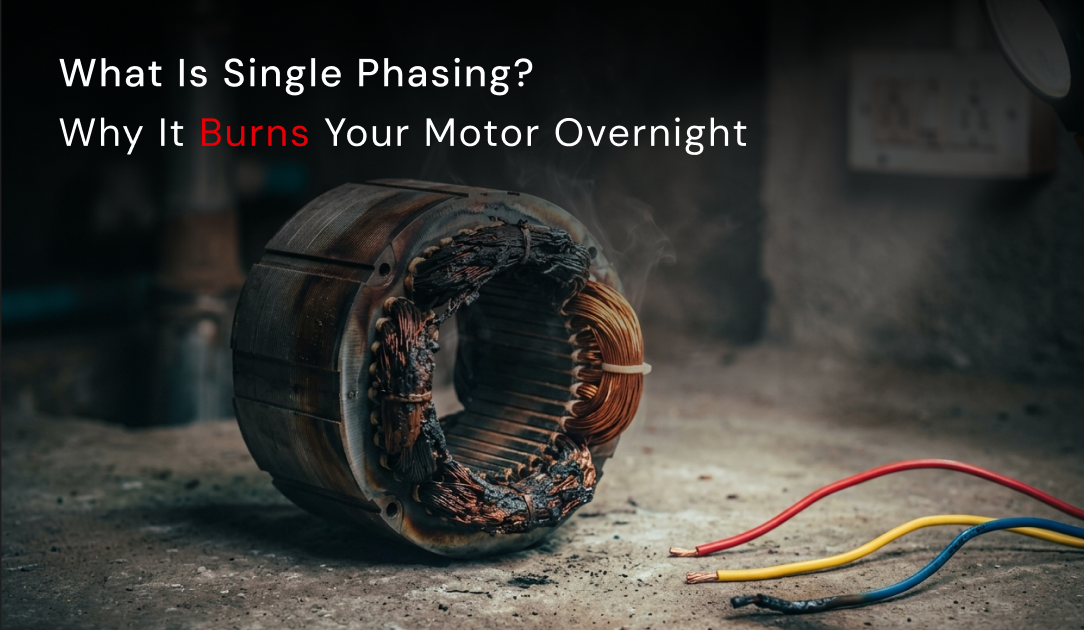
Mistake 2 Ignoring single phasing protection: Single phasing (loss of one phase from the supply) is extremely common in rural and semi-urban India. Running a 3-phase motor on 2 phases causes severe overheating and burns the windings within minutes. Never install a starter without single phasing protection.
Mistake 3 Choosing starters that need neutral to operate: Many starters depend on a stable neutral line for their control circuit. In Indian villages and industrial zones, the neutral is often loose, shared, or fluctuating. If your starter needs neutral and the neutral fails, the protections stop working exactly when you need them most.
Mistake 4 Neglecting build quality: Cheap starters use thin copper wiring, narrow busbars, and low-grade sheet metal that starts rusting within one monsoon season. The panel looks fine on day one but degrades rapidly. Check the sheet metal thickness (minimum 14-16 gauge CRCA/GPSP), copper cross-section, and powder coating quality before buying.
Mistake 5 No maintenance after installation: Even the best starter will fail if you never tighten the terminals, clean the contacts, or check the overload settings. Schedule quarterly maintenance inspections.
Why Subtech Builds Smart Motor Control Panels, Not Just Starters
At Subtech, we believe that simply starting a motor is not enough. If that were the only job, a simple switch could do it. But a motor is one of the most critical and expensive assets in any system when it fails, production stops, water supply stops, or the entire process collapses.
That is why Subtech does not make ordinary "motor starters." We manufacture Smart Motor Control Panels that protect the motor, monitor the conditions, and control its operation intelligently. Our design philosophy is simple: "Na Motor Jale, Na Starter" No Motor Damage, No Panel Failure.
Every Subtech Smart Motor Control Panel comes with comprehensive protection against overload, single phasing, reverse phasing, dry-run, under and over voltage, unbalance voltage, and short circuit. We use our proprietary MPU (Motor Protection Unit) technology that replaces 6 separate traditional components with one intelligent microcontroller-based unit fewer parts means fewer failure points, less wiring, and more reliable operation.
Our panels are built with GPSP/GI sheet metal with professional powder coating for rust-free long life, heavy-duty copper wiring and busbars for cool operation, and IP54-inspired sealed enclosures with rubber gaskets that keep out dust, moisture, and even lizards.
Subtech panels are trusted by NTPC, Delhi Metro, Indian Railways, Indian Air Force, Honda, Reliance, Aligarh Muslim University, and 100+ institutions across India.
Frequently Asked Questions (FAQs)
Motor starter kya kaam karta hai?
Motor starter ka kaam hai motor ko safely start karna, chal rahe motor ko protect karna (overload, single phasing, short circuit se), aur zarorat padne par safely band karna. Yeh motor mein jaane wale current ko control karta hai taaki motor ya cable ko koi nuksan na ho.
DOL starter aur Star-Delta starter mein kya fark hai?
DOL starter motor ko seedha full voltage deta hai yeh choti motors (7.5 HP tak) ke liye theek hai. StarDelta starter pehle kam voltage par start karta hai aur phir full voltage par switch karta hai yeh badi motors (7.5 HP se upar) ke liye zaroori hai taaki starting current kam rahe.
What is the difference between a soft starter and a VFD?
A soft starter only controls the voltage during startup and stop. Once the motor reaches full speed, it runs at full voltage and fixed speed. A VFD controls both voltage and frequency continuously, giving you variable speed control throughout operation. If you need speed control, choose a VFD. If you just need smooth starting, a soft starter is more costeffective.
Starter motor aur motor starter mein kya fark hai?
Industrial context mein dono terms same meaning mein use hoti hain motor ko start karne wala device. "Starter motor" term zyada automobile/car industry mein use hoti hai (engine start karne ke liye), jabki "motor starter" industrial electrical panels ke liye correct technical term hai.
How much does a motor starter cost in India?
Pricing depends on the type and HP rating. A basic DOL starter costs ₹2,000 to ₹6,000. A stardelta starter panel ranges from ₹8,000 to ₹60,000+ depending on HP and features. Soft starters and VFDs cost more but offer better protection and energy savings. Always compare based on build quality and protection features, not just price.
Conclusion
A motor starter is not a luxury it is a necessity for any motor installation. Choosing the right type (DOL, StarDelta, Soft Starter, or VFD) and ensuring it has proper protection features can save you from costly motor burnouts, production downtime, and safety hazards. Pay attention to build quality, correct HP rating, protection features, and enclosure quality rather than just the price tag.
For expert guidance on selecting the right motor control panel for your factory, pump house, township, or government project, contact Subtech at www.subtech.in or call our technical team. With 25+ years of experience, proprietary PMC and MPU technology, and clients from Honda to Indian Air Force, Subtech delivers panels you can trust.
Suggested Posts
View all

Leave a Comment
Your email address will not be published.