
7 Mistakes Electricians Make While Installing a Motor Starter Panel (No. 6 Is Literally Illegal in India)
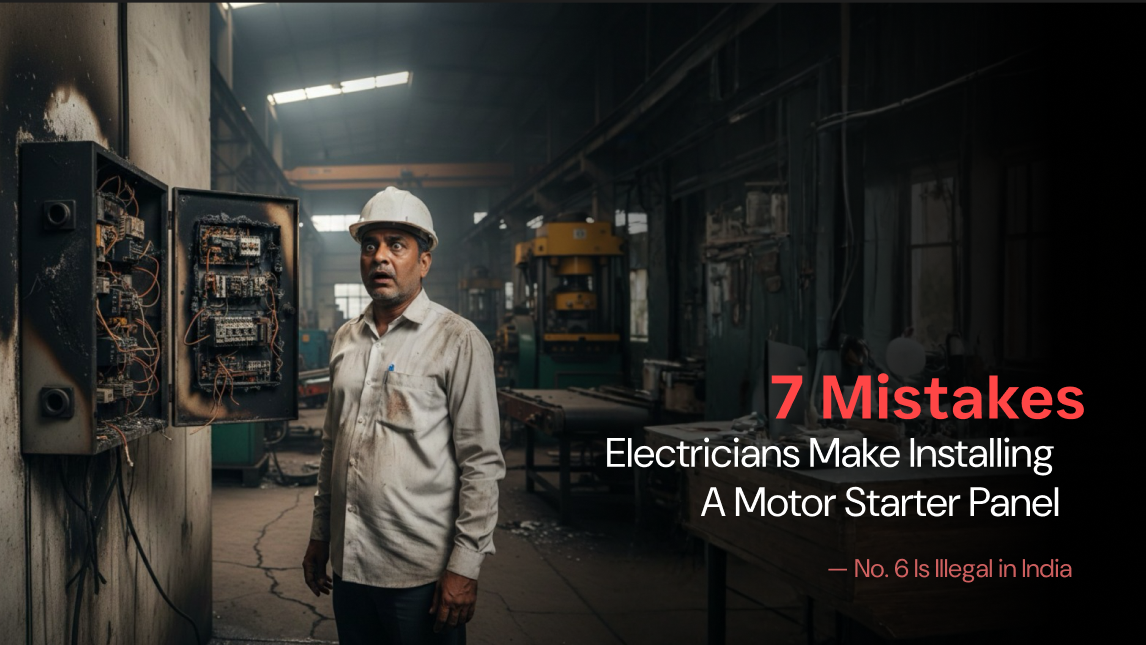
You just got a brand-new motor starter panel installed. The electrician packed up his tools, said "sab theek hai," and left. You trusted him. Why wouldn't you?
But three months later your motor burns. Or your panel trips every morning. Or worse, one of your workers gets a shock near the panel.
Here's the truth that nobody in the electrical industry wants to say out loud: most motor starter installation problems are not caused by bad panels they are caused by bad installation.
As a factory owner or plant manager, you are not expected to know how to wire a panel. But you ARE expected to know what questions to ask and what red flags to watch for.
We've seen hundreds of installations across UP, Haryana, Rajasthan, and Maharashtra. These are the 7 most common and most damaging mistakes electricians make while installing motor starter panels in India.
Mistake No. 1 Wrong Cable Size for the Motor Load
This is the most common mistake, and it silently destroys motors over months.
Every motor draws a specific amount of current (measured in Amperes). The cable connecting the panel to the motor must be thick enough to carry that current comfortably. When an electrician uses an undersized cable to cut cost or because he doesn't have the right size available, here's what happens:
- The cable heats up under load
- Voltage drops at the motor terminals
- The motor draws more current to compensate
- Overload relay trips or worse, the motor burns before the relay can react
What to check: Ask your electrician to show you the cable specification sheet. For a 10 HP (7.5 kW) three-phase motor at 415V, the minimum cable size should be 4 sq mm copper. For 20 HP 6 sq mm minimum. If he's using less, stop the installation.
- Related Reading: What Is a Motor Starter? Function, Types & Working
Mistake No. 2 Overload Relay Not Set to Motor's FLA
Every motor has a Full Load Ampere (FLA) rating printed on its nameplate. The overload relay in your starter panel must be set to match this value not the maximum range of the relay, not a guessed number.
In practice, most electricians set the overload relay to the highest value "just to avoid nuisance tripping." This is like disabling the safety valve on a pressure cooker so it doesn't whistle and then wondering why it exploded.
When the overload is set too high:
- The motor can run at dangerous current levels without tripping
- Winding insulation degrades fast in heat
- Motor burns and your overload relay "worked fine" because it never tripped
What to check: Ask to see the motor nameplate. Match the FLA value (or the "Full Load Current" value) to what's set on the overload relay. They should be within 5–10% of each other.
- Related Reading: 5 Shocking Reasons Why Your Motor Fails Again & Again
Mistake No. 3 No Earth (Ground) Connection to the Panel Body
Earthing is not optional. It is not a "nice to have." It is the one thing that stands between a live panel body and a worker getting electrocuted.
And yet in a shocking number of installations across India the panel body earth connection is either missing, loosely connected, or connected to a neutral wire instead of a proper earth pit.
Here's why this is so dangerous: if there is an internal fault in the panel and the body becomes live, the only path that electricity will take is through the body of the person who touches the panel.
What to check: Look for a green/yellow wire going from the panel body to an earth terminal. Pull it gently it should be firm. Ask the electrician to show you where the other end goes. It must go to a proper earth pit, not the neutral bar.
Mistake No. 4 Star Delta Timer Set Incorrectly
If you have a Star Delta starter (typically used for 10 HP motors and above), there is a timer inside that controls how long the motor runs in "Star" mode before switching to "Delta." This timing is critical.
Set the timer too short motor switches to Delta before it gains enough speed causing a massive current spike that can damage the motor windings and the contactor simultaneously.
Set the timer too long motor runs in Star for too long, drawing excess current, overheating the windings.
The correct timer setting depends on the motor's full load speed and load type. For most standard industrial motors in India, the Star-to-Delta transition time should be between 5 to 15 seconds. But many electricians leave it at whatever it was set to from the factory which may not match your motor at all.
What to check: After installation, observe the first few starts of the motor. You should NOT hear a loud thud or see a current spike on the ammeter at the moment of Star-to-Delta transition. If you do the timer needs adjustment.
- Related Reading: What is a Soft Starter? Complete Beginner's Guide
Mistake No. 5 Control Wiring Done Without Ferrule (Wire) Numbering
This one doesn't burn motors immediately. But it will cost you serious time and money when something goes wrong later.
Ferrule numbering means every single wire inside the panel is tagged with a number that corresponds to a wiring diagram. Without this, when a fault occurs six months later, a new technician opening your panel will see a jungle of wires with zero documentation.
Result: troubleshooting takes 3–4 hours instead of 20 minutes. You pay for extra labor. Your production line stays down longer. And mistakes during blind troubleshooting can create new problems.
What to check: Open the panel after installation and look at the wires inside. Each wire should have a small numbered plastic sleeve (ferrule) at both ends. Ask for a matching wiring diagram. If the electrician cannot provide one insist before making final payment.
Mistake No. 6 Using Substandard or Non-ISI Marked MCBs & Components (This Is Illegal in India)
This is the one that shocks most factory owners because they had no idea.
Under the Bureau of Indian Standards (BIS) Act and the Electricity Act 2003, certain electrical components used in industrial installations including MCBs (Miniature Circuit Breakers), cables, and switchgear must mandatorily carry the ISI mark (IS certification). Using non-certified components in a commercial or industrial installation is a violation of Indian electrical safety regulations.
Many budget electricians source cheap, non-ISI marked MCBs and components to reduce their material cost without telling you. These components:
- Do not interrupt fault current reliably
- May not trip at the rated current values printed on them
- Can cause fires or electric shocks during fault conditions
- Will void your panel's warranty and your factory's electrical compliance certificate
If there is a fire or accident and an inspection finds non-ISI marked components in your panel you, as the factory owner, can be held liable.
What to check: Look for the ISI mark on every MCB, contactor, and cable inside your panel. Ask your electrician to show you purchase invoices for the components. Reputable panel manufacturers like Subtech's use only ISI/IS certified components and document them.
Mistake No. 7 No Protection Against Single Phasing and Voltage Fluctuation
In most of India especially in UP, Bihar, MP, Rajasthan, and rural areas the power supply is highly unreliable. Voltage fluctuates between 160V and 460V. Single phasing (when one of the three phases goes missing) is extremely common.
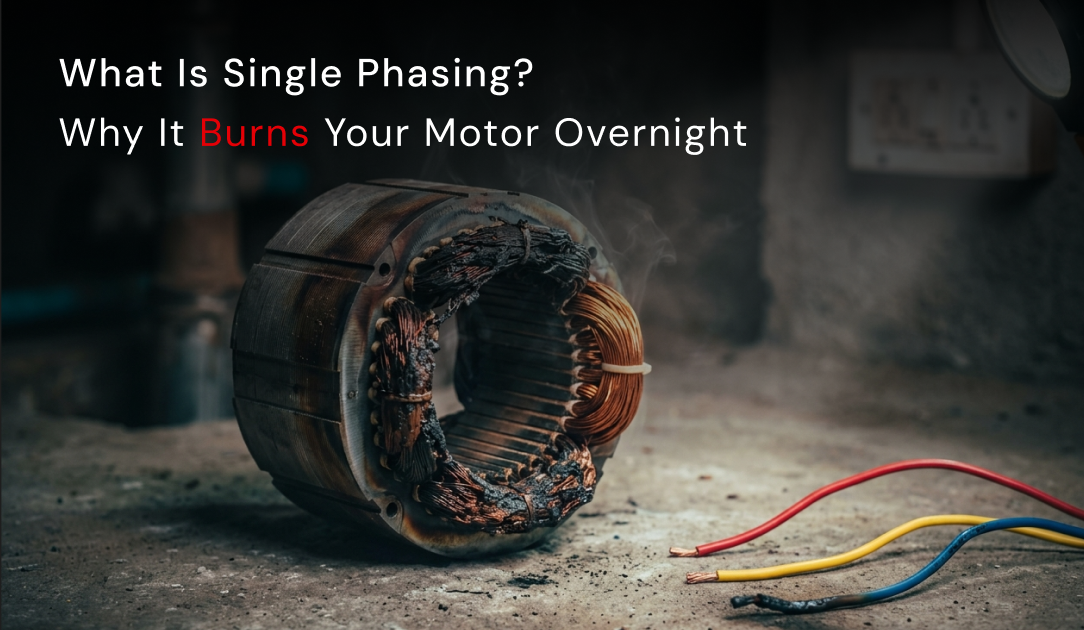
Running a three-phase motor under single phase conditions is one of the fastest ways to burn it. The motor draws 173% of its normal current on the remaining two phases and burns within minutes.
Yet many electricians install basic panels with only thermal overload relays which are designed for overload protection, not single phasing or voltage fluctuation protection.
A proper motor control panel in Indian conditions must have:
- Single phasing protection
- Over-voltage and under-voltage protection
- Phase reversal protection
- Voltage unbalance protection
Subtech's Smart Motor Control Panels come built-in with all of these protections through the MPU (Motor Protection Unit) a microcontroller-based protection device that monitors your motor 24/7 and trips instantly the moment any abnormal condition is detected.
This is why Subtech's panels carry the promise: "Na Motor Jale, Na Panel."
- Related Reading: Best Motor Starter for Submersible & Water Pumps in India
What Should You Do as a Factory Owner?
You don't need to become an electrician. But these three steps will protect you from 90% of installation problems:
- Always ask for a wiring diagram before the electrician leaves the site.
- Check for ISI markings on key components MCBs, cables, contactors.
- Insist on a panel with built-in motor protection not just a basic overload relay.
If you're in the market for a motor starter panel that's designed to work correctly in Indian power conditions with full voltage, overload, single phasing, and dry run protection built in Subtech's Smart Motor Control Panels are manufactured right here in Greater Noida and have been protecting industrial motors since 1998.
Contact Subtech today for a free consultation: Consult Now
Suggested Posts
View all

Leave a Comment
Your email address will not be published.