
PM-KUSUM Solar Pump Motor Burn: 5 Causes and Prevention
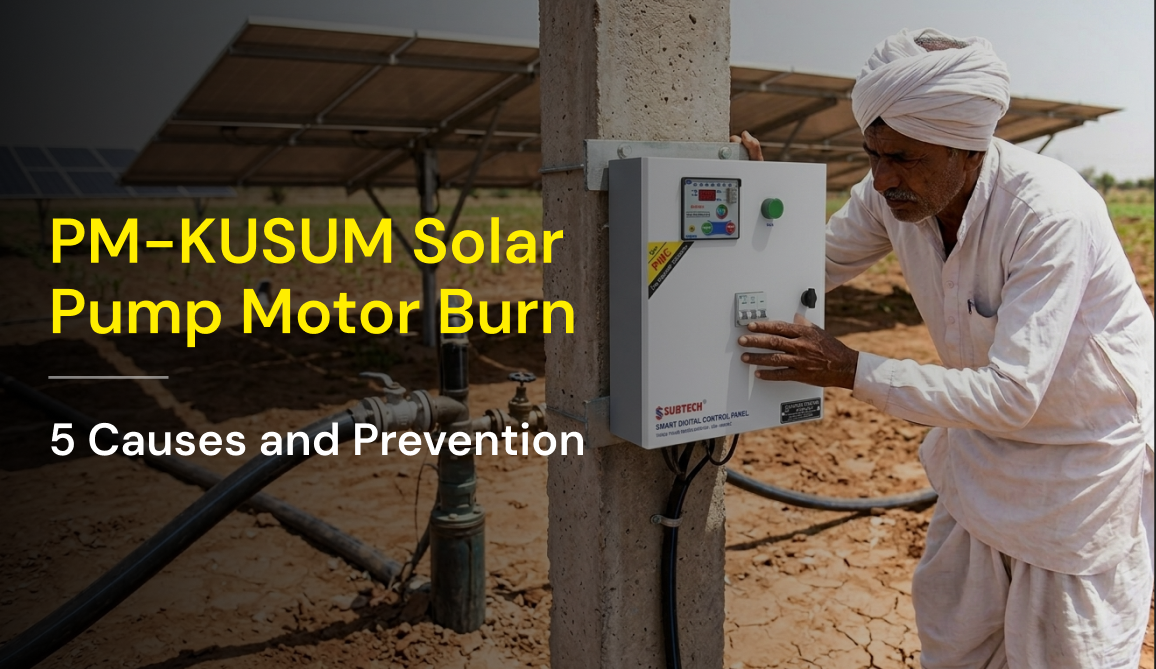
Solar Pump Motor Protection: 5 PM-KUSUM Risks Farmers Miss
Ramesh Yadav, a kisan from Banda district in Bundelkhand, waited three years for his PM-KUSUM solar pump. When it finally arrived in 2023, he cried. No more diesel bills. No more begging the electricity board for an agricultural connection. His 5 HP submersible pump ran beautifully for seven months. Then, one May morning, it went silent. The motor had burned. The repair quote was Rs 26,000. PM-KUSUM does not cover motor replacement. The dealer said the solar pump controller warranty does not include motor damage from external electrical faults. Ramesh's subsidy benefit, worth nearly Rs 1.8 lakh, had vanished because of one missing component: a solar pump motor protection panel.
Across UP, Rajasthan, Maharashtra, and Madhya Pradesh, this story is repeating itself thousands of times every summer. The fault is not with PM-KUSUM. The fault is with an information gap that no one has filled until now.
What Is Solar Pump Motor Protection and Why Most Farmers Skip It
PM-KUSUM, the Pradhan Mantri Kisan Urja Suraksha evam Utthaan Mahabhiyaan, was launched by the Ministry of New and Renewable Energy to reduce farmer dependency on diesel and grid electricity. Under Component-B, the scheme targets installation of 14 lakh standalone solar pumps across India, with central financial support of Rs 34,422 crore. Component-C targets solarisation of 35 lakh grid-connected pumps. The scheme has now reached its March 2026 implementation deadline.
A standard PM-KUSUM installation includes solar PV panels, a solar pump controller (sometimes marketed as a solar VFD), a submersible or surface pump set, and wiring. What it does NOT typically include: a dedicated solar pump motor protection panel at the output side of the controller.
This is the gap Subtech is talking about. The solar pump controller manages DC-to-AC conversion and basic speed control. It is the brain of the system. But it is not the bodyguard of the motor. A motor protection panel monitors what is actually reaching the motor terminals, including voltage levels, phase balance, current draw, and flow conditions, and trips the motor the moment anything goes outside safe limits.
Think of it this way. The solar pump controller is the engine management system in a car. The motor protection panel is the airbag, ABS, and seatbelt combined. You would not drive without safety systems. You should not run a solar pump without motor protection.
How Solar Power Creates Hidden Motor Risks (The Technical Reality)
Grid power, for all its fluctuations in India, delivers a relatively stable voltage band. Solar power is fundamentally different. Its output changes with every cloud shadow, every dust layer on panels, and every shift in the sun angle across the day. This variability creates five specific risks that most farmers and even many electricians are not aware of.
Voltage spikes during irradiance transitions. When a dense cloud suddenly clears, solar panel output can jump from 300 W/m2 to over 900 W/m2 within seconds. The solar pump controller's output spikes momentarily. Repeated daily, these micro-spikes degrade motor winding insulation over months.
Undervoltage operation in early morning and late afternoon. Low sun angle means low solar output. Motors running below rated voltage draw higher current to maintain torque. This sustained overcurrent slowly overheats the windings. A conventional thermal overload relay is not sensitive enough to catch this slow-burn pattern. A digital MPU (Motor Protection Unit) detects it in real time.
Phase imbalance in three-phase solar pump systems. Three-phase solar pump controllers can develop uneven output across phases under partial shading or panel mismatch conditions. Even a small phase imbalance sustained over weeks causes accelerated heating in motor windings.
Dry run in summer. Water tables in UP, Rajasthan, and Vidarbha drop sharply between April and June. In a diesel pump, you hear and feel the difference immediately when water runs out. A solar pump is silent. Without a dry run detection system integrated into the protection panel, the pump runs without water for minutes before the motor windings burn irreversibly.
No fault history. Most basic solar pump controllers do not store or display error codes. When the motor eventually trips or burns, there is no way to know whether it was dry run, overvoltage, or single-phase loss. Without this history, the same fault will repeat.
Types of Motor Protection for Solar Pump Applications
| Protection Type | How It Works | Solar Pump Relevance |
|---|---|---|
| Thermal overload relay | Bimetallic strip opens circuit on overcurrent | Low: Calibration drifts in 45 degree C summer heat |
| Digital MPU | Microprocessor monitors current, voltage, phase in real time | High: Temperature-independent, millisecond response |
| Dry run protection | Current or pressure drop triggers trip within seconds | Critical: Solar pumps run silently; no audible warning |
| Phase loss protection | Trips on loss of any phase at input or output side | High: Solar VFD output can drop a phase under fault |
| Undervoltage / overvoltage | Monitors voltage band and trips outside safe limits | High: Solar irradiance varies throughout the day |
For PM-KUSUM solar pump installations, the combination of digital MPU plus dry run sensing plus phase monitoring at the output side provides the highest level of protection. This is exactly what a Subtech solar pump motor protection panel delivers.
Real-World Impact: What a Burnt Solar Pump Motor Costs a Farmer
Let us do the maths that the dealer quotation does not show you upfront.
A PM-KUSUM Component-B standalone solar pump installation has an approximate benchmark cost of Rs 1.5 lakh to Rs 3 lakh depending on HP rating and state, of which 60 to 90 percent is subsidised by central and state governments combined (exact percentage varies by state; verify with your state nodal agency). The balance is borne by the farmer, typically through a bank loan linked to the scheme.
After installation, the motor becomes the farmer's sole maintenance responsibility. There is no repeat subsidy for motor damage caused by electrical faults.
Motor replacement cost for a 3 to 7.5 HP submersible motor: approximately Rs 18,000 to Rs 40,000, depending on HP rating and market rates at the time of damage. Motor rewinding (partial repair): Rs 7,000 to Rs 15,000, with no guarantee of original performance or insulation quality after rewinding.
Crop revenue impact during pump downtime: In UP's Bundelkhand region, a 5-bigha wheat crop can lose significant yield if irrigation fails during the grain-filling stage between March and April. In Rajasthan's summer vegetables, downtime of even 10 days can destroy an entire crop cycle worth Rs 20,000 or more to a marginal farmer.
Total cost of one solar pump motor burn event for a small farmer: easily Rs 40,000 to Rs 80,000 when all losses are accounted for. This can exceed the farmer's entire contribution under the PM-KUSUM scheme.
A Subtech motor protection panel for solar pump applications starts from approximately Rs 7,000. The ROI argument does not require a spreadsheet.
How Subtech's Motor Protection Technology Solves This Problem
Subtech's pump protection panels are built around two proprietary technologies designed specifically for India's challenging power conditions.
The MPU (Motor Protection Unit). Where a conventional thermal overload relay uses a bimetallic strip that shifts calibration when ambient temperature crosses 40 degrees Celsius (rendering it unreliable through UP and Rajasthan summers), the Subtech MPU is fully digital. It uses a microprocessor to monitor current draw, voltage levels, and phase balance simultaneously, in real time, regardless of ambient temperature. Response time is measured in milliseconds. When the MPU trips the panel, it shows an error code on a digital display. Our field data shows approximately 90 percent of faults are diagnosed and resolved over the phone using these error codes, saving farmers both the cost and the three-day wait for a technician visit.
Double Single-Phase Protection. Standard protection panels check for phase loss only at the input terminals, the power coming into the panel. Subtech also monitors the output terminals, at the motor terminals themselves. In a solar pump installation where wiring runs 50 to 200 metres across open fields, output-side wire cuts and connector faults are far more common than panel-side faults. Detecting this before it reaches the motor is the difference between a five-minute reset and a Rs 30,000 motor replacement.
For submersible borewell installations specifically, Subtech integrates dry run protection that stops the pump within seconds of detecting a no-flow condition based on current monitoring. When the water table drops in May and June, this single feature can save the motor.
Explore Subtech's full range of pump protection panels at subtech.in, and learn how our technology compares to conventional overload relays on the product comparison section of our website.
How to Choose the Right Protection Panel for Your Solar Pump
Before choosing a protection panel for a solar pump installation, answer these five questions:
- What is the HP rating of the pump motor? This determines the overload relay sizing inside the panel.
- Is the solar pump system single-phase or three-phase at the motor terminals? Most 1 to 3 HP solar pumps are single-phase. 5 HP and above are typically three-phase.
- Is the pump a submersible borewell type or a surface monoblock pump? Submersible pumps in borewells carry the highest dry run risk and should always include dry run detection.
- How far is the pump from the control panel? Cable runs beyond 50 metres increase voltage drop and output-side fault risk significantly.
- Is remote monitoring required? Subtech's Command Center IoT platform allows real-time panel status monitoring and alert logging for farms where the pump operates unattended.
| Motor HP | System Type | Recommended Subtech Configuration |
|---|---|---|
| 1 to 3 HP | Single-phase solar | Single-phase protection + dry run + overload |
| 5 to 7.5 HP | Three-phase solar | MPU panel + three-phase monitoring + dry run |
| 10 HP and above | Three-phase solar | Advanced MPU panel or VFD panel with full monitoring |
Contact a Subtech dealer or visit subtech.in for a personalised recommendation based on your exact pump specifications.
Common Mistakes Farmers and Electricians Make with Solar Pumps
Mistake 1: Using a conventional grid starter on a solar pump output. Solar power is not grid power. A standard DOL starter designed for grid voltage is not calibrated for the variable output of a solar pump controller. It will not protect against the specific undervoltage and phase imbalance risks described above. Cost of this mistake: Rs 20,000 to Rs 40,000 per motor replacement event.
Mistake 2: Relying on the solar pump controller warranty to cover motor damage. Read the warranty document carefully before installation. Solar pump controller warranties cover controller component failures, not motor damage caused by dry run, phase loss, or voltage faults that pass through the controller. Motor damage is excluded in virtually all manufacturer warranties. Protect the motor separately.
Mistake 3: Skipping dry run protection because someone will check manually. Manual checks work when someone is present at the pump throughout the day. Most PM-KUSUM solar pumps operate unattended. Water tables can drop suddenly during May. No one is inspecting the pump at noon in 45-degree heat. Without automatic dry run sensing, the motor can burn within 10 to 15 minutes of running dry.
Mistake 4: Using a thermal overload relay without checking its temperature rating. Most thermal relays sold in rural electrical markets are calibrated at 20 to 25 degrees Celsius. At 45 degrees Celsius ambient (common in pump houses in Rajasthan and UP during summer), the relay's trip curve shifts. It may either trip falsely under normal load or fail to trip fast enough under actual overload. A digital MPU has no such limitation.
Mistake 5: Not recording fault codes after a trip event. Every trip event is data. A motor that trips on overload three times in one week is signalling a developing problem: a clogged impeller, a dropping water table, or a wiring fault. Subtech's MPU-based panels display fault codes that, if photographed and shared with a Subtech Soldier network electrician, allow remote diagnosis before the problem escalates into a full motor burn.
Why Subtech: The Technology Difference
Subtech Automation Pvt Ltd was founded in Greater Noida in 2010 with a single engineering mission: na motor jale, na starter. In 15 years, that mission has grown into a Rs 22 crore business with over 220 active dealers across India, serving customers from individual farmers to GAIL, NTPC, DMRC, Indian Railways, Air Force installations, and multiple IITs.
Our product philosophy is built on what we call the 4 Inside Secrets: the industry practice of under-rating components (selling a 10 HP starter built with 7.5 HP parts), using thin copper to cut cost, allowing neutral-related faults to go undetected, and using low-grade sheet metal that begins rusting within two monsoons. Every Subtech panel is built to reject all four of these compromises.
The PMC (Pre-Magnetic Contactor) inside Subtech panels operates on DC power, which eliminates the humming and coil burning that plague conventional AC-operated contactors in rural pump installations. The PMC carries a 5-year coil burning warranty and a claimed 50-year lifespan under normal operating conditions.
Our Soldier App gives licensed electricians in Subtech's network direct access to error code diagnosis, technical support, and cashback incentives per installation, creating a service network that reaches into districts where branded after-sales support has historically been absent.
Subtech carries ISO 9001, ISO 14001, ISO 45001, and ISO 50001 certifications, ZED Silver rating from the Ministry of MSME, and CPRI tested panels. Honda India recommends Subtech panels to their generator dealer network.
For solar pump applications, Subtech delivers VFD-level motor protection at starter panel prices, making advanced protection accessible to the farmers who need it most.
Always consult a certified electrician for panel installation and wiring. Motor protection specifications vary by model. Refer to the Subtech product datasheet for exact electrical values applicable to your installation.
PM-KUSUM has put solar power in the hands of India's farmers. Now it is time to protect that investment with the technology layer every solar pump installation is missing. Subtech's motor protection panels are available through 220+ dealers across India, with free technical guidance on the right configuration for your HP rating and application. Visit subtech.in to explore our pump protection range, or contact your nearest Subtech dealer for a customised panel recommendation before summer peak season begins.
Suggested Posts
View all

Leave a Comment
Your email address will not be published.