
How to Evaluate a Motor Control Panel Specification in a Government Tender
How to Evaluate a Motor Control Panel Specification in a Government Tender
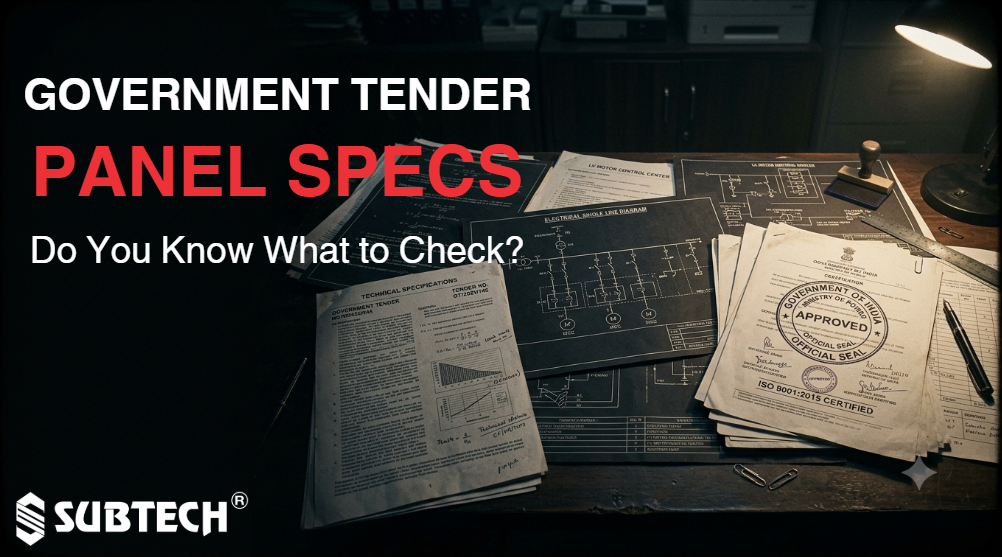
You received a government tender for a pump house, water treatment plant, or irrigation scheme. The technical specification runs twenty pages. Page seven starts with motor control panel requirements. And somewhere between IS 8623, IP54, Type 2 coordination, and draw-out construction, you stopped reading.
This is the most common problem for contractors, electrical consultants, and panel manufacturers bidding on government tenders in India. The specification exists to protect the end user. But if you cannot read it correctly, you either overbid by including unnecessary items, underbid by missing mandatory requirements, or worse, supply a panel that fails inspection and gets rejected at the time of commissioning.
This guide explains every major motor control panel specification clause you will encounter in Indian government tenders, what each clause actually means, and what questions to ask your panel manufacturer before submitting your bid.
Why Government Tender Specifications Are Stricter Than Commercial Orders
A factory owner buying a motor starter panel for his own use bears the risk of a bad decision himself. If the panel fails, he loses money and he learns. A government tender is different. Public money is being spent. The panel will serve thousands of citizens for twenty to thirty years. The engineer who approves the specification is accountable to an audit committee, a vigilance department, and sometimes a court.
This is why government specifications for motor control panels in India, whether from Jal Nigam, PHED, CPWD, Railways, or defence departments, are significantly more detailed and stringent than what a private buyer typically specifies. Understanding each clause is not optional. It is the difference between winning the order and being disqualified at technical evaluation.
Clause 1: IS Standard Compliance
Almost every government tender for motor control panels in India requires compliance with IS 8623 Part 1 and Part 2 (identical to IEC 61439-1 and IEC 61439-2). This is the Indian Standard for Low Voltage Switchgear and Controlgear Assemblies.
What this means in practice: the panel manufacturer must have type test certificates from an accredited laboratory like CPRI (Central Power Research Institute) or ERDA proving that the panel design meets IS 8623 requirements for temperature rise, short circuit withstand, dielectric strength, and mechanical endurance.
What to check: Ask your panel manufacturer for their IS 8623 type test certificate. Verify the certificate is from CPRI or ERDA, not a self-certification. Verify the certificate covers the panel rating (voltage, current, short circuit level) specified in the tender. A certificate for a 400A panel does not cover a 630A panel.
Subtech holds CPRI and ERTL type test certificates for motor control panels. These certificates are available on request for tender submissions.
Clause 2: IP Rating
IP stands for Ingress Protection. Government tenders for outdoor pump houses, open substations, and field installations almost always specify IP54 or IP55. Tenders for indoor panel rooms may specify IP42 or IP31.
What this means in practice: IP54 means the panel enclosure is dust-protected (no harmful dust ingress) and protected against water splashing from any direction. IP55 adds protection against water jets. The enclosure manufacturer must test and certify this rating.
What to check: Ask whether the panel manufacturer has tested enclosures to IP54 or whether they are claiming IP54 based on enclosure design alone. A proper IP54 certification requires a water spray test on the actual enclosure. For tender submissions requiring IP54, ask for the IP test certificate or the enclosure manufacturer's IP rating documentation.
Common mistake: Many contractors specify IP54 panels in their tender bid but procure standard panels without verifying actual IP rating. During commissioning inspection, government engineers check this. Rejection at this stage means costly rework and delay penalties.
Clause 3: Short Circuit Withstand Rating (Icu and Ics)
Government tenders always specify a short circuit withstand rating for the panel, typically expressed in kA (kiloamperes). Common values in Indian tenders are 10 kA, 16 kA, 25 kA, and 50 kA depending on the fault level at the installation point.
What this means in practice: If a short circuit occurs inside or downstream of the panel, the panel busbars, connections, and protective devices must withstand the fault current for the time it takes the upstream breaker to clear the fault, without catastrophic failure. A panel that cannot withstand its rated short circuit current will explode during a fault, causing fire and injury.
What to check: Verify that the incoming circuit breaker (ACB or MCCB) in the panel is rated for the specified short circuit current. Verify that the busbar cross-section is sized for the fault level. The IS 8623 type test certificate will include short circuit withstand test results. Match the tested fault level against the tender requirement.
Clause 4: Type of Construction (Fixed vs Draw-Out)
Government tenders, especially for water treatment plants, pump houses under JJM 2.0, and AMRUT projects, increasingly specify draw-out construction for MCC panels. Some tenders specify fixed construction for simplicity.
What this means in practice: Draw-out construction means each motor starter module can be physically withdrawn from the panel without de-energizing the entire panel or adjacent modules. This allows maintenance and replacement of faulty modules without production stoppage. Fixed construction means all components are fixed inside the panel and cannot be withdrawn independently.
What to check: If the tender specifies draw-out construction, verify that your panel manufacturer actually builds draw-out panels and not fixed panels disguised as draw-out with loose hinged doors. Genuine draw-out panels have a defined withdrawal mechanism, shutters that close over the busbar stabs when the drawer is withdrawn, and a standardized drawer interface.
Clause 5: Type 1 vs Type 2 Coordination
This is one of the most misunderstood clauses in Indian tender specifications. Type 1 and Type 2 coordination refer to the behavior of the contactor and overload relay after a short circuit fault.
Type 1 coordination: After a short circuit, the contactor and overload relay may be damaged and need replacement before the motor can be restarted. The panel is still safe but components may need servicing.
Type 2 coordination: After a short circuit, the contactor and overload relay must be capable of continued service with no damage other than minor contact welding that can be separated. No component replacement should be needed.
Government tenders for critical applications (water supply, hospitals, defence) almost always specify Type 2 coordination. This requires the circuit breaker, contactor, and overload relay to be selected as a coordinated set tested together for Type 2 coordination.
What to check: Ask your panel manufacturer specifically for Type 2 coordination certificates for the contactor and overload relay combinations used in the panel. This is not a blanket claim. It must be verified for each HP rating in the panel against the specific circuit breaker used.
Clause 6: Motor Protection Specifications
Government tenders increasingly specify digital motor protection relays instead of standard thermal overload relays. Specifications may list required protection functions using relay industry codes.
Common protection functions specified in Indian tenders:
Overload protection (49): Trips the motor if current exceeds the set level for a specified time. Thermal overload relays provide this but inaccurately at high ambient temperatures. Digital relays provide accurate protection at any temperature.
Single phasing protection (46): Trips the motor if one of the three supply phases is lost. Basic starters only protect against input-side phase loss. Quality panels protect against both input-side and output-side phase loss.
Under voltage protection (27): Trips the motor if supply voltage drops below a set threshold. Prevents motors from running in low-voltage overloaded condition.
Over voltage protection (59): Trips the motor if supply voltage rises above a set threshold. Prevents insulation damage from sustained overvoltage.
Phase reversal protection (47): Prevents the motor from starting if the phase sequence is incorrect.
Earth fault protection (51N): Trips the motor if leakage current to earth exceeds a safe level.
What to check: Match each protection function listed in the tender against what the panel manufacturer's protection relay actually provides. Do not assume. Ask for the relay datasheet and verify function by function.
Subtech's MPU digital protection unit provides overload, single phasing (input and output both), under voltage, over voltage, phase reversal, and dry run protection as standard. The digital display shows the exact fault code when any protection trips, enabling fast diagnosis.
Clause 7: Enclosure Material and Finish
Government tenders typically specify enclosure material as cold rolled steel (CRS or CRCA), hot rolled steel, or stainless steel for specific environments. Powder coating thickness is often specified as a minimum value in microns.
What this means in practice: CRCA cold rolled steel with minimum 60 micron powder coating is the standard for most government pump house and water treatment panel installations. For coastal or highly corrosive environments, tenders may specify stainless steel enclosures or hot-dip galvanized steel.
What to check: Ask your panel manufacturer for the powder coating thickness certificate and the steel grade used. Measuring powder coating thickness requires a coating thickness gauge. Some government inspection teams carry these gauges during commissioning inspection.
Subtech uses CRCA steel with 60 to 80 micron powder coating as standard on all motor control panels.
Clause 8: Cable Entry and Gland Plates
Government tenders specify bottom cable entry with removable gland plates in most cases. Some tenders specify top cable entry for underground cable installations.
What to check: Confirm that the panel has gland plates of the correct size for the cable diameters specified in the tender. Verify that gland plates are removable without disturbing internal components. Verify that unused knockouts are sealed to maintain IP rating.
Clause 9: Busbar Material and Rating
Tenders specify busbar material (copper or aluminium), minimum cross-section or current rating, and sometimes the busbar coating (bare, tin-plated, or heat-shrink insulated).
What to check: Verify busbar cross-section against the tender specification. Verify that the busbar current rating matches the connected load plus the 125% safety margin required by IS 8623. Tin-plated copper busbars are preferred over bare copper for corrosion resistance.
Clause 10: Mandatory Certifications for Tender Submission
Most government tenders require the following certificates to be submitted with the technical bid:
IS 8623 type test certificate from CPRI or ERDA. ISO 9001 quality management certificate for the manufacturer. IP rating certificate for the enclosure. BIS license if applicable for specific components. Previous supply orders to government departments as proof of experience. Factory inspection facility declaration.
Missing even one of these certificates can result in technical disqualification before the financial bid is even opened.
Subtech holds ISO 9001, ISO 14001, ZED Silver, CPRI, and ERTL certifications and has supplied panels to GAIL, NTPC, DMRC, Delhi Jal Board, UP Jal Nigam, Indian Railways, and the Indian Air Force. All certification documents are available for tender submission within 24 hours of request.
Common Mistakes Contractors Make in Tender Evaluation
Accepting manufacturer self-certification instead of third-party test certificates. Type test certificates must be from CPRI, ERDA, or another accredited laboratory. Self-certification has no value in a government tender inspection.
Mismatching IP rating. Specifying IP54 in the bid but procuring a standard panel without IP certification. Government engineers check this during commissioning.
Ignoring Type 2 coordination requirement. Supplying a panel with uncoordinated contactor and relay combinations when Type 2 is specified. This is identified during inspection when the inspector asks for the coordination certificate.
Undersizing busbars to reduce cost. Busbar sizing can be checked by a qualified engineer during inspection. Undersized busbars are a ground for rejection and potential blacklisting.
Not reading the warranty clause. Government tenders specify warranty periods of 12 to 36 months from commissioning. Some tenders require performance bank guarantees during warranty. Read this clause carefully before bidding.
How Subtech Supports Government Tender Bids
Subtech has been supplying motor control panels to government departments since 1998. We understand government tender specifications and can support your bid in the following ways.
Technical compliance statement: We provide a point-by-point compliance statement against the tender specification, confirming compliance or noting deviations, within 48 hours of receiving the specification document.
Certificate package: All required certificates including IS 8623 type test, ISO 9001, IP rating, and previous supply orders are compiled and provided in a tender-ready format.
Single-line diagram: We prepare a single-line diagram of the proposed panel for inclusion in the technical bid.
Factory inspection support: Our Greater Noida facility is open for pre-dispatch inspection by government engineers. We provide inspection reports and test certificates for every panel before dispatch.
Share your tender specification with our engineering team. We will review it, confirm compliance, and give you a quotation with full technical documentation within 48 hours.
Na Motor Jale. Na Starter.
Disclaimer: Tender specifications vary by department, state, and project. Always read the complete tender document carefully. Consult a qualified electrical engineer for project-specific compliance verification. Subtech's technical team is available to review your specific tender requirements.
Frequently Asked Questions
1.What is IS 8623 and why is it required in government tenders?
IS 8623 is the Indian Standard for Low Voltage Switchgear and Controlgear Assemblies, equivalent to IEC 61439. It defines requirements for design, construction, testing, and performance of LT panels including MCC panels and motor starter panels. Government tenders require IS 8623 compliance because it ensures the panel has been independently tested and certified to perform safely under specified electrical and environmental conditions.
2.What is the difference between Type 1 and Type 2 coordination in motor starters?
Type 1 coordination means the contactor and overload relay may need replacement after a short circuit fault. Type 2 coordination means they must be capable of continued service after a short circuit with no component replacement needed. Government tenders for critical applications specify Type 2 coordination because it ensures the motor can be restarted quickly after a fault without waiting for spare parts.
3.Which certifications does a panel manufacturer need for government tender supply in India?
The minimum certifications required are IS 8623 type test certificate from CPRI or ERDA, ISO 9001 quality management certificate, IP rating certificate for the enclosure, and proof of previous government supply experience. Some tenders additionally require BIS license, ZED certification, or MSME registration depending on the procuring department.
4.How do I check if a panel manufacturer's type test certificate is valid for my tender?
Verify that the certificate is issued by an accredited laboratory (CPRI, ERDA, or NABL accredited lab), not self-certified. Verify the certificate date is within the validity period specified in the tender (usually 5 years). Verify that the panel rating in the certificate matches or exceeds the tender requirement for voltage, current, and short circuit withstand level. If any of these do not match, the certificate may not be accepted during technical evaluation.
"A panel that passes inspection on paper but fails on site is not a panel. It is a liability."
Suggested Posts
View all
Leave a Comment
Your email address will not be published.