
What Is an MCC Panel and Why Large Factories Cannot Run Without It
What Is an MCC Panel and Why Large Factories Cannot Run Without It
Walk into any large factory, water treatment plant, cement unit, or steel mill in India and you will find one thing in common: a large grey or blue enclosure mounted against a wall with dozens of switches, indicators, and cable entries. This is the Motor Control Center, commonly called an MCC panel. It is the nerve center of every industrial motor operation.
Yet most buyers, contractors, and even experienced electricians have a vague understanding of what an MCC panel actually is, how it differs from a standard motor starter panel, and when a facility actually needs one. This guide explains everything clearly so you can make the right decision for your plant or project.
What Is an MCC Panel?
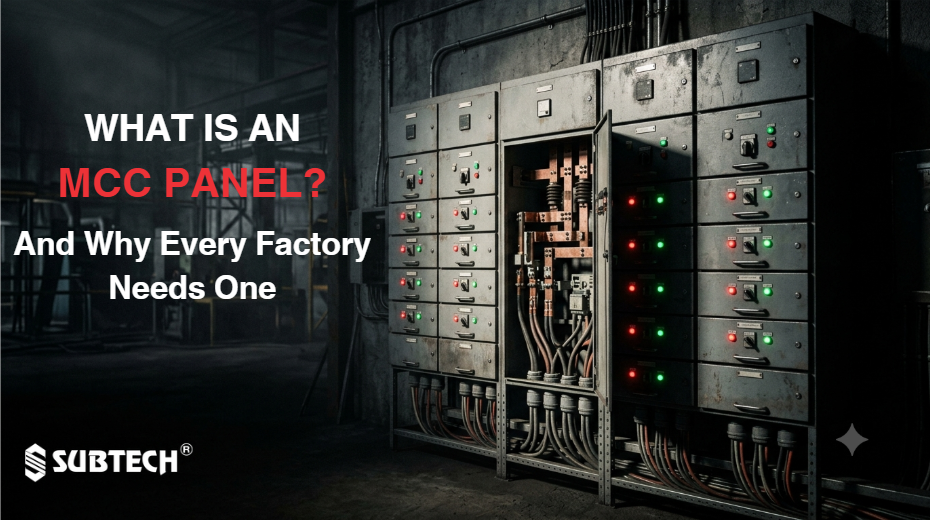
MCC stands for Motor Control Center. An MCC panel is a centralized enclosure that houses multiple motor starter units, protection devices, control circuits, and busbars in a single assembled structure. Instead of having separate individual starter panels for each motor scattered around a facility, an MCC panel brings all motor control into one organized, accessible, and safe location.
A typical MCC panel contains several individual compartments called drawers or modules. Each drawer controls one motor circuit and contains a circuit breaker or fuse, a contactor, an overload relay or protection unit, control wiring terminals, and indicator lamps. All drawers share a common busbar system that distributes the incoming power supply to each motor circuit.
MCC panels are used wherever a facility has multiple motors that need to be controlled, monitored, and protected from a single location. Water treatment plants, cement factories, textile mills, pharmaceutical units, food processing plants, steel rolling mills, and large commercial buildings all use MCC panels as their primary motor control infrastructure.
How Does an MCC Panel Work?
Incoming three-phase power enters the MCC panel through a main incomer, typically a circuit breaker or an air circuit breaker rated for the total connected load. From the incomer, power flows to the horizontal busbar running across the top or back of the panel structure.
Vertical busbars branch off from the horizontal busbar and run down each vertical section of the panel. Each drawer connects to the vertical busbar through its own isolating mechanism. When the drawer is plugged in, it receives power from the busbar. When the drawer is withdrawn for maintenance, it is physically isolated from the busbar without affecting any other motor circuit in the panel.
The control circuit inside each drawer receives a start or stop command from push buttons mounted on the drawer face, from a remote push button station near the motor, or from a PLC or SCADA system connected to the panel. When a start command is received, the contactor inside the drawer closes and the motor starts. When a stop command is received or a fault is detected, the contactor opens and the motor stops.
All fault conditions are indicated by lamps on the drawer face and can be wired to a central alarm annunciator panel or to a supervisory control system so the control room operator can see the status of every motor from a single screen.
What Is the Difference Between an MCC Panel and a Standard Motor Starter Panel?
This is the most common question buyers ask. The key differences are scale, organization, and accessibility.
A standard motor starter panel controls one motor. It is a standalone enclosure with one contactor, one overload relay, one set of indicators, and one cable entry. It is mounted near the motor it controls. When you have ten motors in a facility, you have ten separate panels in ten different locations.
An MCC panel controls multiple motors, typically anywhere from 4 to 100 or more motor circuits, all within a single structured enclosure. All motors are controlled from one location. All fault indications are visible from one place. All maintenance is done at one panel instead of hunting across the facility for individual starter boxes.
The other critical difference is the draw-out or plug-in design of MCC drawers. In a standard panel, replacing a faulty contactor or overload relay means working live or shutting down the motor completely. In an MCC panel, the faulty drawer can be withdrawn from the panel structure and a spare drawer inserted in its place within minutes, restoring the motor to service without touching the busbar or affecting other motor circuits.
Types of MCC Panels Used in India
There are three main types of MCC panels based on the construction of the individual motor compartments.
Fixed type MCC panels have motor starter components mounted directly inside fixed compartments. Components cannot be removed without de-energizing the entire section. This is the simplest and lowest-cost type, suitable for installations where downtime for maintenance is acceptable.
Draw-out type MCC panels have each motor starter built into a drawer that can be physically pulled out of the panel structure after isolating it. The drawer disconnects from the busbar automatically when withdrawn. A spare drawer can be inserted immediately to restore service. This type is preferred for critical processes where motor downtime must be minimized.
Intelligent or smart MCC panels integrate digital protection units, communication modules, and remote monitoring capability into each drawer. Motor current, voltage, run hours, and fault history are accessible remotely via Modbus, Profibus, or Ethernet communication. Smart MCC panels are increasingly specified for large water treatment projects, government schemes like JJM 2.0, and modern industrial automation projects.
What Are the Key Components Inside an MCC Panel?
Every MCC panel, regardless of size, contains the following core components.
The main incomer is the primary protection and isolation device for the entire panel. It is typically an air circuit breaker or moulded case circuit breaker rated for the total connected load of all motors in the panel.
The busbar system is the copper or aluminium conductor that distributes incoming power to all motor compartments. Busbar sizing is critical: undersized busbars overheat under full load and are a common quality compromise in cheap MCC panels. Subtech uses correctly rated copper busbars in all MCC panels, sized for actual connected load, not the next size down.
Motor starter drawers or modules contain the contactor, protection device, control transformer if required, control terminals, and indicators for each motor circuit. The quality of components inside each drawer determines the reliability of that motor circuit.
The control circuit wiring connects push buttons, selector switches, indicator lamps, and remote control inputs to each motor starter. In large MCC panels this wiring runs into hundreds of connections. Clean, labeled, ferruled wiring is a mark of a quality MCC panel. Unlabeled and poorly routed wiring is the mark of a cheap one.
Protection devices in each drawer can range from a simple bimetallic overload relay in a basic MCC to a digital motor protection relay or MPU in a quality MCC. Subtech MCC panels use MPU digital protection units in place of standard thermal overload relays, giving accurate protection at any ambient temperature across Indian operating conditions.
When Does a Facility Need an MCC Panel?
The general rule used by Indian electrical engineers and consultants is that an MCC panel is justified when a facility has five or more motors that need to be controlled and monitored together. Below five motors, individual starter panels are typically more economical. Above five motors, the cost of an MCC panel is offset by the savings in installation time, cable costs, maintenance effort, and operational efficiency.
Government projects under Jal Jeevan Mission, AMRUT, and Smart Cities Mission routinely specify MCC panels for all pump houses above a certain connected load. Industrial projects that require IS 8623 or IEC 61439 compliant switchgear assemblies must use properly designed MCC panels from certified manufacturers.
If your facility faces any of the following situations, an MCC panel is the right solution: multiple motors spread across a large floor area that are difficult to monitor individually; frequent motor faults that require identifying and isolating individual circuits quickly; a requirement for centralized remote monitoring via SCADA or PLC; government or insurance requirements for centralized motor control documentation; and expansion plans that will add more motors in the future.\
What Should You Check Before Buying an MCC Panel in India?
MCC panels vary enormously in quality and the difference is not always visible from the outside. Here are the key things to verify before placing an order.
Busbar sizing: Ask for the busbar rating calculation. The busbar should be sized for 125% of the total connected load as per IS 8623. Many cheap panel manufacturers undersize busbars to save copper cost. Undersized busbars run hot, accelerate insulation degradation, and are a fire risk.
Contactor and protection device brand and rating: Verify that the contactors inside each drawer are correctly rated for the motor HP they control. Ask specifically whether digital protection units or thermal overload relays are used. Digital protection is significantly more reliable in Indian ambient temperature conditions.
Enclosure standard: MCC panels for industrial use should meet IS 8623 or IEC 61439-2 standards. Ask for the type test certificate. Panels supplied to government projects under JJM 2.0, AMRUT, or other central schemes must carry proper type test certificates.
Wiring quality: Ask to see the internal wiring before dispatch. All wires should be ferruled and numbered. Terminal blocks should be labeled. Cable routes should be organized in cable trays. Poor wiring inside an MCC panel is the single biggest cause of intermittent faults that take days to diagnose.
Spare drawer availability: Ask whether spare drawers of the same rating are available off the shelf. If a drawer fails at 2 AM and the manufacturer cannot supply a replacement for two weeks, your production stops for two weeks.
Why Subtech for Your MCC Panel?
Subtech has been manufacturing MCC panels since 1998. Our panels are installed at GAIL, NTPC, DMRC, Delhi Jal Board, UP Jal Nigam, Indian Railways, and the Indian Air Force. We hold ISO 9001, ISO 14001, CPRI, and ERTL certifications.
Every Subtech MCC panel uses correctly rated copper busbars, MPU digital motor protection units, PMC DC-operated contactors with 5-year coil warranty, ferruled and numbered wiring, and powder-coated CRCA steel enclosures. Our panels are type tested and compliant with IS 8623 and IEC 61439 standards.
Our digital display on each drawer shows motor current, voltage, run hours, and fault codes. When a fault occurs, the operator reads the code and calls our Soldier network helpline. Ninety percent of faults are diagnosed and resolved over the phone without waiting for a service engineer.
Whether you need a 4-drawer MCC for a small pump house or a 60-drawer MCC for a large industrial plant, Subtech engineers will design, manufacture, test, and commission the panel to your exact specifications. Share your motor list and load details with our team and we will send you a detailed single-line diagram and quotation within 48 hours.
Na Motor Jale. Na Starter.
Disclaimer: MCC panel design, installation, and commissioning must be carried out by qualified electrical engineers and licensed electricians. Always verify panel specifications against IS 8623 and IEC 61439 standards for your application. Consult Subtech engineering team for project-specific requirements.
Frequently Asked Questions
1.What does MCC stand for in electrical panels?
MCC stands for Motor Control Center. It is a centralized enclosure that houses multiple motor starter units, protection devices, and control circuits in a single structured assembly. MCC panels are used in factories, water treatment plants, and industrial facilities where multiple motors need to be controlled and monitored from one location.
2.What is the difference between MCC and PCC panels?
PCC stands for Power Control Center. A PCC panel receives incoming power from the utility or generator and distributes it to downstream panels including MCC panels, lighting panels, and other distribution boards. An MCC panel receives power from the PCC and uses it to control and protect individual motor circuits. In a typical industrial installation, PCC feeds MCC, and MCC feeds individual motors.
3.How many motors can an MCC panel control?
An MCC panel can control anywhere from 4 to 100 or more motor circuits depending on the panel size and drawer configuration. The number of motors is limited by the incoming busbar rating and the physical size of the panel enclosure. Subtech designs MCC panels for any number of motor circuits based on the customer motor list and load schedule.
4.What standard does an MCC panel need to meet in India?
MCC panels in India should comply with IS 8623 and IEC 61439. Government projects under JJM 2.0, AMRUT, and similar schemes require type-tested panels with proper certification. Always ask your panel manufacturer for the type test certificate before accepting delivery.
Ten motors. Ten separate panels. Ten problems.
One MCC panel. One solution
Suggested Posts
View all


Leave a Comment
Your email address will not be published.