
Why Your Motor Starter Hums and What It Is Costing You
Why Your Motor Starter Hums and What It Is Costing You
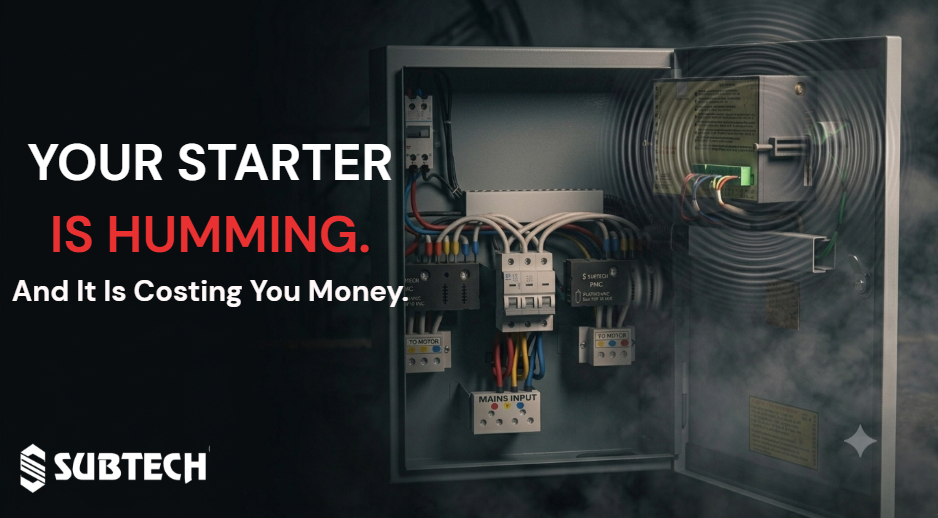
You have heard it a hundred times. That low constant humming sound coming from the motor starter panel. Buzz. Buzz. Buzz. All day. All night. You assumed it was normal. Your electrician said every starter hums. You ignored it and moved on.
It is not normal. It is not harmless. And it is costing you money every single day it continues.
That humming sound is your contactor telling you something is wrong. Left unaddressed, a humming contactor leads to premature coil burnout, welded contacts, motor tripping, and eventually a complete starter panel failure. This guide explains exactly why motor starters hum, what it costs you, and what technology permanently eliminates the problem.
What Is a Contactor and Why Does It Hum?
A contactor is the main switching device inside every motor starter panel. When you press the start button, the contactor coil gets energized, the core pulls in magnetically, and the main contacts close to connect the motor to the power supply. When you press stop, the coil de-energizes, the core releases, and the contacts open to disconnect the motor.
Standard contactors used in India run on AC coils. The coil is energized by alternating current at 50Hz. This means the magnetic force that holds the contactor core closed is not constant. It pulsates 100 times per second as the AC supply alternates between positive and negative half cycles. At every zero crossing of the AC wave, the magnetic force drops to zero for a fraction of a second before building back up.
During these zero crossings, the contactor core is not held fully closed. It vibrates very slightly, 100 times per second. This vibration is what creates the humming sound you hear. The technical term is AC contactor chatter and it is a fundamental limitation of every standard AC-operated contactor.
Why Is the Humming Getting Louder Over Time?
A new contactor hums at a low level that is barely noticeable. But over time the humming gets louder and the vibration gets worse. This happens for several reasons.
The shading ring is a small copper ring embedded in the contactor core face. Its job is to create a phase-shifted magnetic flux that fills in the zero crossing gaps and reduces vibration. When this shading ring cracks or corrodes, the compensation disappears and the contactor starts vibrating much more aggressively. A cracked shading ring is the single most common cause of sudden loud humming in an old contactor.
Dust and debris accumulation on the core face prevents the two core halves from mating flush. Even a thin layer of dust creates an air gap that increases vibration. In agricultural pump panels and outdoor industrial installations across UP, Rajasthan, and MP, dust accumulation inside the panel accelerates this problem significantly.
Voltage fluctuation also worsens humming. When supply voltage drops below the coil rated voltage, the magnetic force weakens and the core vibrates more. In rural areas where voltage regularly drops to 340V or below during peak irrigation season, contactors that hummed quietly at 415V start vibrating loudly at 340V.
What Does Contactor Humming Actually Cost You?
Most panel owners treat contactor humming as a minor annoyance. The actual financial cost is significant and comes from three directions.
First, coil burnout. A contactor core that vibrates continuously generates heat in the coil windings through mechanical energy dissipation. This heat accelerates insulation breakdown in the coil wire. A contactor coil that should last 5 to 7 years under normal operation burns out in 1 to 2 years when the contactor hums continuously. Contactor coil replacement costs Rs 500 to Rs 2,000 depending on rating. But the downtime during replacement costs far more in lost production or lost irrigation hours.
Second, contact welding. Every time the contactor core bounces during zero crossing, the main contacts also bounce slightly. This contact bounce causes micro-arcing between the contact surfaces. Over thousands of operating cycles, this micro-arcing erodes and pits the contact surface. Eventually the contacts weld together in the closed position. A welded contactor cannot open when you press stop. The motor runs continuously, cannot be stopped normally, and if a fault occurs the protection cannot disconnect the motor. Contact welding is a serious safety hazard.
Third, noise-related fatigue in the panel structure. Continuous vibration from a humming contactor loosens screws, terminal connections, and busbar clamps over time. Loose terminal connections create high-resistance joints that generate heat. In a panel with multiple contactors all humming simultaneously, this vibration-induced loosening accelerates across every connection in the panel.
For a factory running three shifts with five motor starter panels all humming, the combined cost of premature coil replacements, contact erosion, and loose connections over five years easily exceeds Rs 1,00,000. For a cost that was completely preventable.
When Is Humming a Sign of Immediate Danger?
Not all humming is equally serious. Here is how to judge the urgency.
Low constant hum that has been present since installation is standard AC contactor behavior. Still worth addressing but not an emergency.
Humming that has suddenly become louder than before indicates a cracked shading ring or debris on the core face. This needs attention within days, not weeks. The contactor is approaching the end of its reliable service life.
Humming accompanied by visible vibration of the panel enclosure means the core is severely damaged or the voltage supply is very low. This is urgent. The contactor can fail to hold closed under load, causing the motor to drop out unexpectedly during operation.
Humming accompanied by a burning smell means the coil insulation is already breaking down from heat generated by excessive vibration. This is an emergency. Switch off the panel, isolate the supply, and replace the contactor before restarting.
How to Diagnose Why Your Starter Is Humming
Before replacing the contactor, check these four things in order.
Check supply voltage first. If voltage is below 380V, the magnetic force is weakened and humming will be louder than normal. If voltage returns to 415V and humming reduces, the contactor itself may be fine and the real problem is supply quality.
Clean the core face. Switch off and isolate the panel. Open the contactor and gently clean both core face surfaces with a dry cloth. Do not use oil or lubricant on the core face as this attracts more dust. If humming reduces after cleaning, debris was the cause.
Inspect the shading ring. Look at the core face for a small copper ring embedded in a slot. If it is cracked, broken, or missing, the shading ring needs replacement. Some manufacturers supply replacement shading rings. Others require full contactor replacement.
Check coil voltage rating. Every contactor coil is rated for a specific voltage: 230V AC or 415V AC typically. If a 230V coil is accidentally connected to a 415V supply, it will overheat, hum loudly, and burn out quickly. Verify the coil voltage rating matches your control circuit voltage.
The Permanent Solution: DC-Operated Contactors
Every solution described above is a patch on a fundamental problem. AC-operated contactors hum because of the physics of alternating current. You can reduce the humming with maintenance and cleaning but you cannot eliminate it completely as long as the contactor operates on AC.
The permanent solution is a DC-operated contactor. Instead of an AC coil that pulses 100 times per second, a DC-operated contactor uses a coil energized by direct current. DC current does not alternate. The magnetic force it creates is constant, with no zero crossings and no pulsation. The result is a contactor core that is held firmly closed with absolutely zero vibration.
Zero vibration means zero humming. Zero contact bounce. Zero vibration-induced loosening of connections. DC-operated contactors are significantly quieter, last longer, and cause far less wear on panel components than equivalent AC contactors.
Subtech's PMC (Pre-Magnetic Contactor) is a DC-operated contactor developed specifically for Indian motor starter applications. The PMC operates on DC and produces zero humming noise under any supply condition. It works silently at 340V when grid voltage is low during peak irrigation season. It works silently at 480V when voltage surges after load shedding ends. The coil never overheats from vibration-induced heat dissipation.
Subtech provides a 5-year coil warranty on PMC contactors. This warranty is only possible because DC operation eliminates the vibration-induced coil degradation that kills standard AC contactors in 1 to 2 years. Every Subtech motor starter panel uses PMC contactors as standard, not as an optional upgrade.
What to Tell Your Electrician
Most electricians in India are trained on standard AC contactors. When you report humming, their default response is to clean the core, check the shading ring, and if the problem persists, replace the contactor with another standard AC unit. This solves the immediate problem but not the underlying cause.
Ask your electrician specifically about DC-operated contactors. Ask whether the replacement contactor has a shading ring that can crack again. Ask about the coil warranty. If the answers are unsatisfactory, it may be time to consider upgrading to a panel built with DC-operated contactors from the ground up.
Subtech's Soldier network electricians are trained on PMC installation and troubleshooting. If your existing panel has a chronic humming problem that standard maintenance has not resolved, our team can assess whether a PMC upgrade is suitable for your application.
Na Motor Jale. Na Starter.
Disclaimer: Electrical panel maintenance and contactor replacement should be carried out only by a qualified electrician with the panel isolated from power supply. Verify product specifications with the datasheet before purchase.
Frequently Asked Questions
1.Is it normal for a motor starter to hum?
indicates the contactor core is vibrating due to AC supply alternation. While many electricians consider it normal, continuous humming causes premature coil burnout, contact erosion, and loose connections over time. DC-operated contactors eliminate humming completely.
2.Why did my motor starter suddenly start humming louder than before?
Sudden increase in humming usually indicates a cracked or broken shading ring inside the contactor core, dust or debris accumulation on the core face, or supply voltage dropping significantly below rated voltage. Check and clean the core face first. If humming persists, inspect the shading ring and replace the contactor if the ring is damaged.
3.Can a humming contactor damage my motor?
Yes, indirectly. A severely humming contactor can experience contact welding. A welded contactor cannot open when commanded to stop, meaning the motor cannot be disconnected normally. If a fault occurs with a welded contactor, the protection system cannot isolate the motor, which can lead to motor damage or fire.
4.What is a DC-operated contactor and how is it different from a standard contactor?
A DC-operated contactor uses a direct current coil instead of an alternating current coil. DC current does not alternate or create zero crossings, so the magnetic force holding the core closed is constant with no pulsation. This eliminates core vibration and humming completely. Subtech's PMC is a DC-operated contactor with a 5-year coil warranty, compared to 1 to 2 year coil life typical of standard AC contactors under Indian operating conditions.
"Every starter hums. Not every motor survives it."
Suggested Posts
View all

Leave a Comment
Your email address will not be published.