
Copper Busbar vs Aluminium Busbar: Which One Should You Choose for an Electrical Panel?
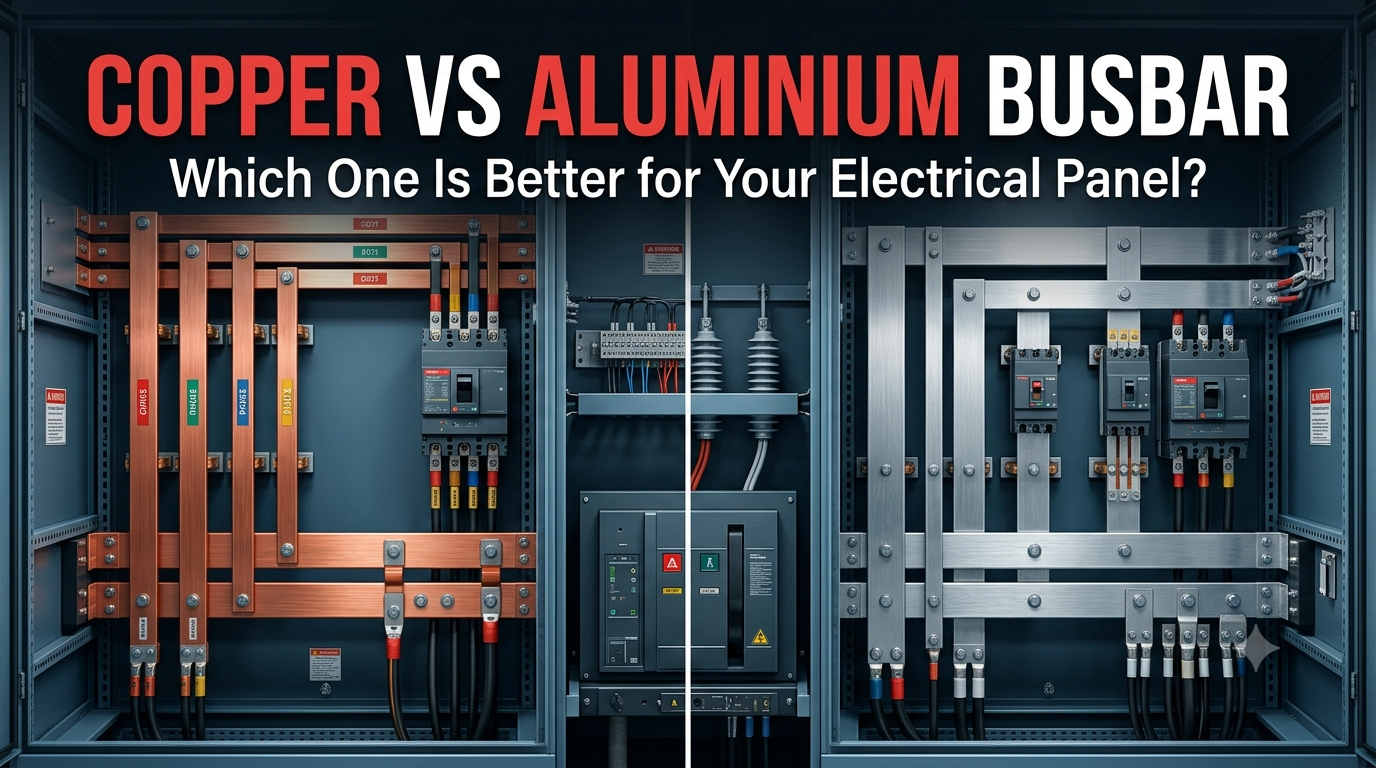
Copper Busbar vs Aluminium Busbar: Which One Should You Choose for an Electrical Panel?
Open any large PCC panel, MCC panel, APFC panel, LT distribution panel, or industrial switchboard and you will find thick metallic strips running inside the enclosure. These strips carry electrical power from the incoming circuit breaker to different outgoing feeders and panel sections.
These conductors are called busbars.
Busbars are normally manufactured using copper or aluminium. Both materials can distribute electrical power, but they differ significantly in conductivity, size, weight, cost, joint reliability, heat performance, and maintenance requirements.
The choice between copper and aluminium should not be based only on price. A poorly selected or undersized busbar can overheat, damage insulation, weaken joints, create voltage drop, and reduce the operating life of the entire electrical panel.
This guide explains the difference between copper and aluminium busbars and helps buyers, consultants, contractors, and engineers select the right material for their application.
What Is a Busbar in an Electrical Panel?
A busbar is a metallic conductor used to collect and distribute electrical power inside an electrical panel.
Instead of connecting every outgoing feeder directly to the incoming supply using separate cables, the incoming power is connected to a common busbar system. Different circuit breakers, contactors, capacitor feeders, motor feeders, and distribution circuits then receive power from this common busbar.
A typical three-phase electrical panel may contain:
R phase busbar
Y phase busbar
B phase busbar
Neutral busbar
Earth busbar
In large panels, the busbar system may include a horizontal main busbar and several vertical distribution busbars.
The busbar must be designed to carry the required current continuously without excessive heating. It must also withstand the mechanical and thermal stress produced during a short-circuit condition.
Why Does Busbar Material Matter?
The busbar is one of the most important current-carrying components inside an electrical panel.
Its material directly affects:
Current-carrying capacity
Required cross-sectional area
Panel size
Temperature rise
Voltage drop
Mechanical strength
Weight
Joint performance
Maintenance requirement
Manufacturing cost
Long-term reliability
Copper and aluminium can both be used successfully, but their dimensions and jointing methods cannot be treated as identical.
An aluminium busbar usually requires a larger cross-sectional area than a copper busbar for the same current. Aluminium also requires careful joint preparation because an oxide layer can form on its surface.
Copper provides higher conductivity and compact construction, but it is more expensive and heavier.
What Is a Copper Busbar?
A copper busbar is a power distribution conductor made from high-conductivity copper.
Copper busbars are widely used in industrial electrical panels where compact size, reliable joints, high current density, and long operating life are important.
They are commonly installed in:
MCC panels
PCC panels
APFC panels
LT distribution panels
Synchronization panels
Generator control panels
Automatic transfer panels
Industrial switchboards
High-current motor control systems
Copper busbars usually have a reddish-brown metallic appearance unless they are tin-plated or covered with heat-shrink sleeves.
Advantages of Copper Busbars
Higher Electrical Conductivity
Copper has higher electrical conductivity than aluminium.
This means a copper busbar can carry the required current using a smaller cross-sectional area. This is useful when panel space is limited or when a compact enclosure is required.
Compact Panel Design
Because copper requires less physical cross-section for a given current, it allows manufacturers to design smaller and more compact electrical panels.
This is particularly useful in MCC panels, draw-out panels, machine control panels, and installations where floor space is limited.
Strong and Reliable Joints
Copper provides good mechanical strength and stable bolted connections.
Properly designed copper busbar joints generally remain reliable under repeated heating and cooling cycles when correct torque, washers, contact surfaces, and jointing practices are used.
Better Mechanical Strength
Copper busbars are mechanically stronger than aluminium busbars of similar size.
This can improve resistance to deformation and short-circuit forces, especially in high-fault-level panels.
Suitable for High-Current Applications
Copper is commonly preferred for high-current industrial panels, critical processes, compact switchboards, and installations where reliability is more important than initial cost.
Lower Space Requirement
The smaller required cross-section reduces the space needed for busbar chambers, supports, and clearances.
This can simplify panel layout and provide more space for switchgear, wiring, and cable termination.
Limitations of Copper Busbars
Higher Cost
Copper is significantly more expensive than aluminium. Its price can also fluctuate depending on market conditions.
In large panels, the cost difference can be substantial because the busbar system may use a large quantity of metal.
Higher Weight
Copper is heavier than aluminium.
Large copper busbar systems increase the total panel weight, which affects transportation, lifting, installation, and structural support requirements.
Theft Risk
Because copper has a high resale value, it may be more attractive for theft at unattended project sites or construction locations.
What Is an Aluminium Busbar?
An aluminium busbar is a power distribution conductor manufactured using electrical-grade aluminium.
Aluminium busbars are commonly selected for projects where lower weight and lower material cost are important.
They are frequently used in:
Large LT distribution panels
Cost-sensitive industrial projects
Utility distribution systems
Large bus ducts
Outdoor distribution installations
Projects with sufficient panel space
High-current systems where weight reduction is important
Aluminium busbars have a silver-grey appearance and generally require a larger cross-sectional area than copper for carrying the same current.
Advantages of Aluminium Busbars
Lower Material Cost
Aluminium is usually more economical than copper.
This makes aluminium attractive for large panels and high-current systems where the total busbar quantity is substantial.
Lower Weight
Aluminium is much lighter than copper.
Lower weight makes the busbar easier to handle during fabrication, transportation, and installation. It can also reduce the total structural load of the panel or bus duct.
Suitable for Large Installations
Aluminium can be suitable for large distribution systems where sufficient space is available and the design has been properly calculated.
Cost-Effective for Non-Compact Panels
When panel size is not a major limitation, aluminium can provide a practical and economical solution.
Limitations of Aluminium Busbars
Larger Cross-Section Required
Aluminium has lower conductivity than copper.
Therefore, a larger aluminium busbar cross-section is normally required to carry the same current. This increases the size of the busbar chamber and may increase the overall panel dimensions.
Oxide Layer Formation
Aluminium naturally forms an oxide layer on its surface.
This oxide layer can increase contact resistance if busbar joints are not properly cleaned, treated, assembled, and protected.
More Careful Joint Preparation
Aluminium busbar joints require proper surface preparation, suitable joint compound where required, correct washers, suitable hardware, and controlled tightening torque.
Improper joints can heat up and deteriorate over time.
Greater Thermal Expansion
Aluminium expands and contracts more than copper when its temperature changes.
Repeated heating and cooling cycles can affect joint tightness if the design and installation practices are poor.
More Panel Space
Because a larger cross-sectional area is required, aluminium busbars normally need more space inside the enclosure.
This may not be suitable for compact MCC panels or panels with dense switchgear arrangements.
Copper Busbar vs Aluminium Busbar Comparison
Electrical conductivity
Copper: Higher
Aluminium: Lower
Required cross-section
Copper: Smaller
Aluminium: Larger
Weight
Copper: Heavier
Aluminium: Lighter
Initial cost
Copper: Higher
Aluminium: Lower
Panel space required
Copper: Less
Aluminium: More
Mechanical strength
Copper: Higher
Aluminium: Lower for similar dimensions
Joint preparation
Copper: Comparatively straightforward
Aluminium: Requires greater care
Oxidation concern
Copper: Lower
Aluminium: Higher
Thermal expansion
Copper: Lower
Aluminium: Higher
Compact panel suitability
Copper: Very good
Aluminium: Limited
High-current critical application
Copper: Preferred
Aluminium: Suitable with correct design
Maintenance attention
Copper: Lower
Aluminium: Higher at joints
Transportation
Copper: Heavier
Aluminium: Easier due to lower weight
Which Busbar Is Better for an MCC Panel?
Copper busbars are commonly preferred in MCC panels because MCC panels often contain multiple motor feeders in a limited space.
Motor loads also involve frequent starting, stopping, current changes, and switching operations. A compact and mechanically strong busbar system is therefore beneficial.
Copper may be the better option when:
The MCC panel is compact
Multiple motor feeders are installed
High reliability is required
Frequent motor starting is expected
The panel is used in a critical process
Space for busbar chambers is limited
Draw-out or compartmentalized construction is used
Aluminium can still be used in an MCC panel if it is correctly sized, properly supported, carefully jointed, and accepted by the project specification.
Which Busbar Is Better for a PCC or LT Panel?
Both copper and aluminium may be suitable for PCC and LT distribution panels.
The correct choice depends on:
Total current rating
Short-circuit level
Available panel space
Project specification
Ambient temperature
Number of outgoing feeders
Enclosure dimensions
Ventilation
Budget
Duty cycle
Required service life
Maintenance conditions
Copper is often selected for compact, critical, and high-performance panels.
Aluminium is often selected for economical large distribution systems where sufficient space is available and the busbar design has been calculated correctly.
Which Busbar Is Better for an APFC Panel?
APFC panels contain multiple capacitor steps that switch according to reactive power demand.
The busbar must handle the total capacitor current and switching conditions safely.
Copper busbars are commonly preferred in compact APFC panels because they provide:
Compact construction
Reliable joints
Better space utilization
Strong mechanical support
Easy connection to capacitor feeder switchgear
Aluminium may also be used, but the cross-section, joints, temperature rise, harmonic conditions, and enclosure space must be properly considered.
Is Copper Always Better Than Aluminium?
Copper is not automatically the correct choice for every project.
It provides higher conductivity, compact construction, strong joints, and high mechanical strength. However, it also increases cost and weight.
Aluminium can be a suitable solution when:
The panel has sufficient internal space
Cost reduction is important
Lower weight is required
The current rating has been calculated correctly
Proper jointing procedures are followed
The project specification allows aluminium
Maintenance access is available
The important point is that aluminium should not simply replace copper using the same dimensions.
The complete busbar design must be recalculated according to the material, current, temperature rise, fault level, support spacing, and installation conditions.
What Should Buyers Check Before Approving a Busbar System?
Busbar Material
Confirm whether the panel uses copper or aluminium.
This should be clearly mentioned in the technical offer, drawing, bill of materials, and inspection documents.
Busbar Dimensions
Ask for the width, thickness, number of runs, and total cross-sectional area of each phase busbar.
Rated Current
The busbar rating should match the panel load, diversity, duty cycle, enclosure conditions, and project requirements.
Temperature Rise
Ask how temperature rise has been considered in the panel design.
Busbar performance depends on enclosure ventilation, ambient temperature, surface finish, arrangement, spacing, and connected load.
Short-Circuit Withstand
The busbar and support system must withstand the thermal and mechanical forces created during a fault.
Busbar Support Spacing
Busbars should be mounted on suitable insulating supports at properly designed intervals.
Incorrect support spacing can allow excessive movement during a short circuit.
Joint Preparation
Ask how the manufacturer prepares and tightens busbar joints.
For aluminium busbars, joint preparation is especially important.
Phase Identification
R, Y, B, neutral, and earth conductors should be clearly identified using sleeves, coatings, markings, or labels.
Neutral Busbar Rating
The neutral busbar should be sized according to the load type, harmonic content, and project specification.
Earth Busbar
The earth busbar must be continuous and properly connected to the enclosure, doors, gland plates, and outgoing earth conductors.
Common Busbar Mistakes in Cheap Electrical Panels
A low-cost electrical panel may appear acceptable from outside while hiding serious compromises inside.
Common busbar mistakes include:
Undersized busbars
Inadequate spacing
Poor joint preparation
Loose hardware
Incorrect washer arrangement
Insufficient supports
Sharp bends
Poor phase identification
Inadequate neutral busbar
Improper earthing
Different material joints without suitable treatment
No consideration of short-circuit forces
Busbars installed too close to control wiring
Poor cable termination arrangement
These compromises can cause overheating, discoloration, insulation damage, nuisance tripping, joint failure, and fire risk.
Why Proper Busbar Design Is More Important Than Material Alone
The material is only one part of the busbar system.
A correctly designed aluminium busbar can perform better than an incorrectly sized copper busbar.
Similarly, a large copper busbar can still fail if its joints are loose, supports are inadequate, clearances are poor, or the enclosure traps excessive heat.
A reliable busbar system depends on:
Correct material selection
Correct cross-sectional area
Proper current calculation
Suitable support spacing
Correct phase clearance
Strong mechanical construction
Proper jointing
Controlled tightening torque
Suitable enclosure ventilation
Short-circuit withstand design
Good cable termination
Proper inspection and testing
Why Choose Subtech for Electrical Panels?
Subtech designs and manufactures MCC, PCC, APFC, AMF, ATS, LT distribution, generator automation, and motor control panels for industrial and infrastructure applications.
Busbar material, dimensions, arrangement, support spacing, and current rating are selected according to the panel application and customer specification.
Each panel is manufactured with properly organized power and control sections, labeled wiring, suitable protection devices, and accessible cable termination arrangements.
Whether your project requires a compact copper busbar system or a cost-effective aluminium busbar design, the Subtech engineering team can review your load schedule, fault level, panel type, incomer rating, outgoing feeders, and expansion requirements before recommending a suitable configuration.
Share your single-line diagram, load list, current rating, and project specifications with Subtech for a technical proposal and quotation.
Na Motor Jale. Na Starter.
Disclaimer
Electrical panel and busbar design must be carried out by qualified electrical engineers. Busbar size, material, clearances, supports, temperature rise, and short-circuit withstand must be verified according to the applicable project specifications, standards, fault level, and installation conditions.
Frequently Asked Questions
1.Which is better, copper or aluminium busbar?
Copper offers higher conductivity, smaller size, stronger joints, and compact panel construction. Aluminium is lighter and more economical but normally requires a larger cross-sectional area and more careful joint preparation. The correct option depends on current rating, panel space, duty, project specification, and budget.
2.Can aluminium busbar be used in an MCC panel?
Yes. Aluminium busbars can be used in an MCC panel if they are properly sized, supported, jointed, and permitted by the project specification. Copper is commonly preferred for compact and critical MCC panels.
3.Why is copper busbar more expensive?
Copper has a higher raw material cost and greater density than aluminium. However, it provides higher conductivity and normally requires a smaller cross-sectional area.
4.Why does aluminium busbar require a larger size?
Aluminium has lower electrical conductivity than copper. A larger aluminium cross-section is therefore normally required to carry the same current without excessive heating
.
5.Can copper and aluminium busbars be connected together?
They can be connected only with suitable jointing methods, compatible connectors, proper surface treatment, and engineering consideration. Direct improper contact between dissimilar metals can create joint problems.
6.Which busbar is suitable for an APFC panel?
Copper is commonly preferred in compact APFC panels because of its high conductivity, strong joints, and smaller size. Aluminium can also be used if the design considers capacitor current, harmonics, temperature rise, and adequate panel space.
7.Does a bigger busbar always mean better performance?
No. Busbar size must be selected through proper design. An unnecessarily large busbar increases cost and space, while an undersized busbar may overheat. Material, arrangement, ventilation, joint quality, and fault withstand are also important.
8.What information is required for busbar selection?
The engineer normally requires rated current, fault level, panel type, enclosure size, ambient temperature, installation location, conductor material, duty cycle, number of feeders, harmonic conditions, and project specifications.
Copper or aluminium is not the only decision.
Correct engineering is the real difference between a reliable panel and an unsafe panel.
Suggested Posts
View all


Leave a Comment
Your email address will not be published.