
Why Agriculture Motors Burn More Than Industrial Motors in India (And How Farmers Are Losing ₹30,000-₹80,000 Every Few Years Without Knowing Why)
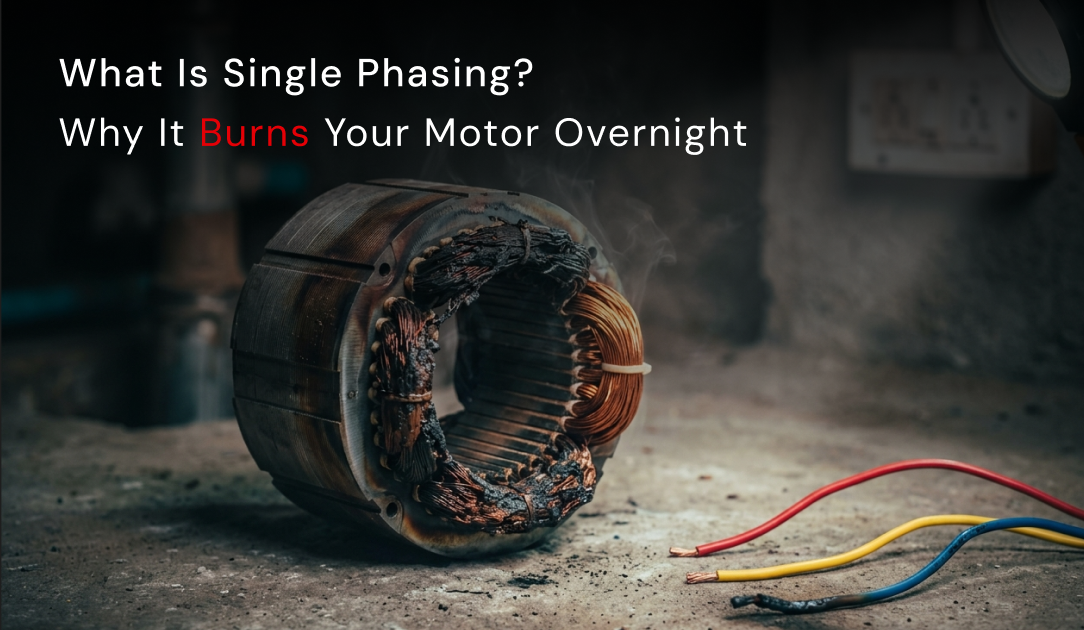
Why Agriculture Motors Burn More Than Industrial Motors in India And How Farmers Are Losing ₹30,000 – ₹80,000 Every Few Years Without Knowing Why
Ask any farmer in UP, Rajasthan, Punjab, or Maharashtra and they'll tell you the same story.
"Motor 2-3 saal mein jal jaati hai." (Motor burns out every 2-3 years.)
Then they spend ₹8,000 – ₹15,000 on rewinding. The rewound motor never performs as well as the original. It burns again. They buy a new motor. The cycle continues.
Meanwhile, the same HP motor running a factory machine in an industrial unit runs for 8–12 years without a single burnout.
Why does this happen? Is it the motor's fault? Is it bad luck?
No. The difference is not the motor, it's the operating environment and the protection system.
Agriculture motors face five brutal conditions that industrial motors don't. And most farmers have zero protection against any of them.
Reason 1: Voltage Fluctuation in Rural Areas Is 3x Worse Than Industrial Zones
Industrial areas in India are connected to dedicated feeders with relatively stable power supply. Most factories receive voltage in the range of 380V–420V for three-phase supply, with fluctuations managed by substations specifically designed for industrial load.
Agriculture feeders are a completely different story.
In rural India especially during peak irrigation seasons the voltage on agriculture feeders commonly drops to 180V–220V on three-phase supply. In some states like UP, MP, and Rajasthan, voltage as low as 150V has been recorded on agriculture feeders during summer months when demand peaks.
What does low voltage do to a motor? When voltage drops, the motor draws more current to maintain its output. More current means more heat. More heat means faster insulation breakdown. Faster insulation breakdown means the motor burns.
A motor running at 30% below rated voltage is working like a person trying to run a marathon while breathing through a straw. It can manage for a while but it will break down far sooner than it should.
Most basic motor starters used in agriculture have no under-voltage protection. The motor keeps running, overheating itself until the windings fail.
Subtech's Smart Motor Control Panel includes adjustable under-voltage cut-off protection. The moment supply drops below the set threshold, the motor stops automatically protecting the windings from heat damage.
Reason 2: Single Phasing Is More Common on Agriculture Feeders
Single phasing is one of the most dangerous and most common causes of motor burnout in India and it is dramatically more common on agriculture connections than industrial connections.
Single phasing occurs when one of the three phases in a three-phase supply gets disconnected due to a blown fuse, a loose connection, a broken wire, or a fault on the distribution line. The motor then tries to run on just two phases instead of three.
What happens next is devastating: the motor draws extremely high current on the remaining two phases, generating intense heat concentrated in specific windings. Within minutes sometimes within seconds the motor windings burn out completely.
In industrial areas, dedicated feeder lines, regular maintenance by the distribution company, and better electrical infrastructure mean single phasing events are relatively rare. When they do occur, industrial establishments often have automatic protection built into their panels.
In rural agriculture areas: single overhead lines strung across fields for kilometers, exposed to weather, birds, tree branches, and seasonal maintenance delays single phasing is not rare. It happens regularly, especially after storms and during peak load seasons.
And most agriculture motor starters sold in India particularly the cheap ones have no single phasing protection at all.
Subtech's MPU (Motor Protection Unit) detects single phasing within milliseconds and cuts off the motor automatically before any damage can occur to the windings.
Reason 3: Agriculture Motors Run Unattended for Hours Sometimes All Night
In a factory, a motor is almost always running near a human operator. If something goes wrong unusual noise, tripping, overheating someone notices. Action is taken.
In agriculture, the farmer starts the motor, goes home, and the motor runs unattended for 4, 6, 8 hours sometimes through the night. In many cases the farmer isn't even on the field. The motor is running at the tubewell, a kilometer or more from any house.
This means: if the voltage drops, nobody notices. If one phase goes, nobody notices. If the motor starts overheating due to a partially blocked pump or dry run condition, nobody notices. The motor keeps running until it can't.
Industrial motors have operators, control rooms, and monitoring systems. Agriculture motors have nobody watching them.
This is why automatic protection is not a luxury for agriculture motors it is a necessity.
Subtech's Smart Motor Control Panel operates in Auto Mode it monitors supply conditions continuously. If any fault is detected, it cuts the motor off immediately. When supply normalizes, it restarts automatically after a set delay. The farmer never even needs to be present.
Reason 4: Dry Run The Silent Motor Killer in Agriculture
Dry run occurs when a submersible pump motor runs without water either because the borewell water level has dropped, the pump intake is blocked, or there's an airlock in the system.
When a submersible motor runs dry, it loses the cooling effect of water flowing through the motor casing. The motor temperature rises rapidly. Within minutes, the motor windings can reach temperatures that destroy insulation permanently.
In industrial applications, this problem is far less common because industrial pumps typically have flow sensors, pressure switches, and control systems that detect no-flow conditions and stop the pump.
In agriculture especially submersible tubewells water levels can drop seasonally, hourly, or even more frequently depending on the aquifer conditions. Farmers often have no way of knowing the borewell has run dry until they go to check and by then, the motor has already burned.
A dry run event can destroy a motor in as little as 3–5 minutes. Rewinding costs ₹6,000–₹12,000. Replacing the motor entirely costs ₹15,000–₹40,000 depending on HP.
Subtech's motor protection panels include optional dry run protection using current monitoring to detect when the motor is running without load (which indicates no water flow) and cutting it off automatically before any damage occurs.
Reason 5: Poor Quality Starter with No Real Protection The Biggest Problem of All
Walk into any electrical shop in a rural market in India and you'll find motor starters priced at ₹800–₹2,000 for a 5 HP or 7.5 HP three-phase application. These starters are sold by the thousands to farmers every year.
What's inside them? A basic contactor, a thermal overload relay and nothing else.
The thermal overload relay is supposed to protect the motor from overload. In theory, it trips when the current exceeds the set value. In practice, it has two major problems.
First: thermal overload relays are calibrated for a specific ambient temperature. In Indian summers, temperatures in electrical panels mounted in open fields can reach 50°C–60°C. At these temperatures, the bimetallic strip inside the relay heats up even without any motor overload causing nuisance tripping. Farmers, frustrated by the motor stopping repeatedly, reset the trip setting to a higher value. Now the relay won't trip even when the motor is genuinely overloaded. Protection is effectively gone.
Second: thermal overload relays provide NO protection against single phasing, NO protection against voltage fluctuation, NO protection against dry run, and NO protection against phase unbalance. They only respond to overload slowly, imprecisely, and unreliably at high temperatures.
This is the core reason agriculture motors burn more than industrial motors. Industrial panels typically use microcontroller-based protection relays or motor protection units that monitor multiple parameters voltage, current on each phase, phase balance, temperature and respond instantly to any abnormality. Agriculture motors get a ₹500 thermal relay and nothing else.
Subtech's MPU (Motor Protection Unit) is a microcontroller-based system it monitors over-voltage, under-voltage, overload, single phasing, reverse phasing, and phase unbalance simultaneously, and responds within milliseconds. It is not affected by ambient temperature. It does not drift over time. It does not require manual recalibration.
The Real Cost of Not Having Protection
Let's calculate what a farmer with a 7.5 HP submersible motor actually spends over 10 years without proper protection:
Motor rewinding every 2–3 years: ₹10,000 × 4 times = ₹40,000
Lost crop due to irrigation failure during motor downtime: ₹5,000–₹20,000 per event × 4 events = ₹20,000–₹80,000
Electrician visit charges: ₹500–₹1,000 × 10+ visits = ₹10,000
Complete motor replacement at least once in 10 years: ₹20,000–₹35,000
Total loss over 10 years: ₹70,000–₹1,65,000
A Subtech Smart Motor Control Panel with full protection costs a fraction of this. It pays for itself in the first motor it saves.
What the Right Protection System Looks Like for Agriculture Motors
Any motor protection system used for agriculture applications in India must specifically address the conditions described above. It must handle wide voltage range (many agriculture feeders vary between 150V and 480V), detect single phasing instantly, operate reliably in high ambient temperatures, support auto-restart for unattended operation, and ideally include dry run protection for submersible pump applications.
Subtech has been manufacturing Smart Motor Control Panels specifically designed for Indian power conditions since 1998. Our panels are used across agricultural zones in UP, Rajasthan, Haryana, and Maharashtra designed from the ground up to handle the exact problems described in this article.
Our core design principle: "Na Motor Jale, Na Panel." No motor should burn. No panel should fail.
If you are using a basic starter for your agriculture motor or if your motor has burned out even once in the last five years it's time to upgrade to proper protection.
Contact Subtech to find the right motor protection solution for your HP rating and application.
Frequently Asked Questions
Why does my borewell motor burn out every 2 years?
The most common reasons are low voltage on agriculture feeders, single phasing events, and dry run conditions combined with a basic starter that has no protection against any of these. Without proper motor protection, these conditions will continue to burn out motors every 2–3 years.
Can a motor starter prevent motor burning in agriculture?
A basic motor starter cannot. Only a Smart Motor Control Panel with microcontroller-based protection covering voltage, single phasing, overload, and dry run can reliably prevent motor burnout in agriculture conditions.
What is single phasing and why is it dangerous for motors?
Single phasing occurs when one of the three phases in a three-phase supply gets cut. The motor tries to run on two phases, drawing extremely high current and generating intense heat that burns the windings within minutes.
Is Subtech's motor protection panel suitable for submersible pumps?
Yes. Subtech's Smart Motor Control Panels are specifically designed for submersible pump applications and include optional dry run protection, auto-restart, and wide voltage range operation all essential for agriculture use.
How much does motor rewinding cost versus buying a protection panel?
Motor rewinding costs ₹6,000–₹15,000 per event and reduces motor life each time. A Subtech protection panel is a one-time investment that prevents repeated rewinding and motor replacement costs over the motor's lifetime.
Suggested Posts
View all

Leave a Comment
Your email address will not be published.