
What Is Single Phasing? Why It Burns Your Motor Overnight
What Is Single Phasing? Why It Burns Your Motor Overnight
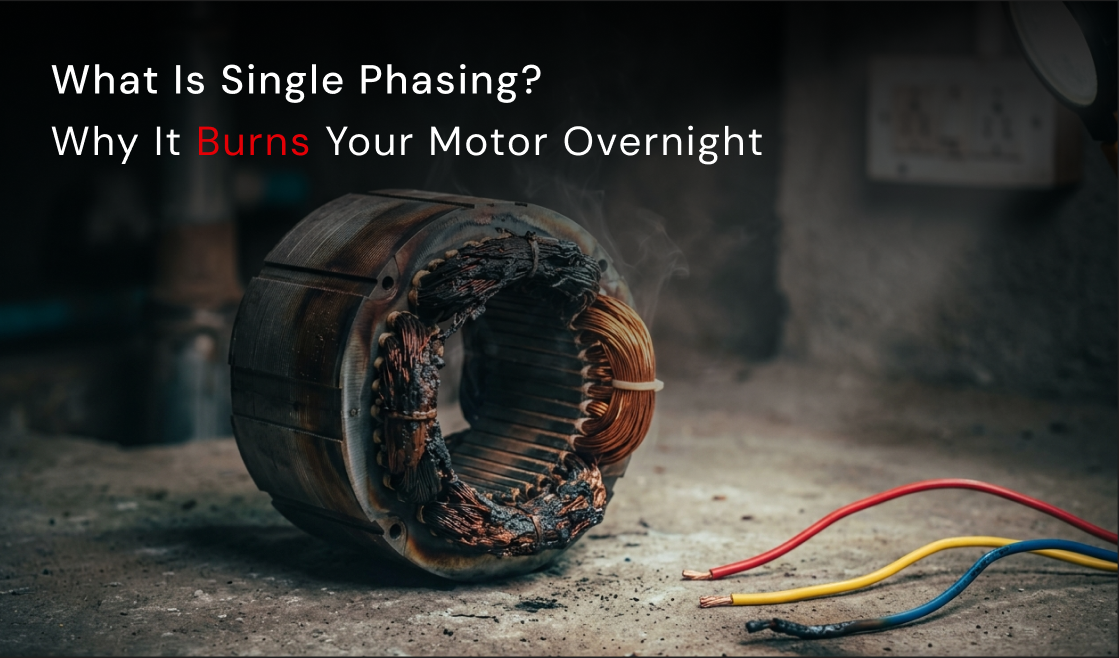
A factory manager in Ludhiana arrives at work on a Monday morning and finds his production line dead. A farmer in Uttar Pradesh goes to switch on his borewell at 5 AM during the wheat irrigation season and hears nothing. An electrician is called. The motor is opened. The winding is black, burned completely, smelling of charred copper and insulation. The diagnosis is always the same two words: single phasing. And the bill that follows is always the same kind of number: Rs 30,000 to Rs 65,000 gone, plus days or weeks of lost production, dead crops, and delayed deliveries.
In this post, you will learn exactly what single phasing is, why it is so dangerous and so common in India, how it destroys a motor in minutes without any visible warning, and what you can do right now to make sure it never happens to your motor again. This is the one explanation every motor owner in India needs to read.
What Is Single Phasing? A Simple Explanation
A standard three-phase motor runs on three separate power lines, called phases, usually labelled R, Y, and B. These three phases deliver power in a balanced rhythm, like three legs of a stool. The motor is designed to receive equal power from all three at all times. Single phasing happens when one of these three supply lines loses power completely. The motor is now trying to run on only two legs. Imagine trying to ride a three-wheeled auto-rickshaw with one wheel missing at highway speed. Something breaks very fast.
When one phase is lost, the remaining two windings try to carry the full load that three windings were designed to share. This causes the current in those two active windings to rise by 70 to 100% above their safe limit. At that current level, the insulation on the winding wire overheats and burns in 30 seconds to 5 minutes depending on the motor's load at the time. Once the insulation is gone, the winding short-circuits, and the motor is destroyed. Industry data shows that over 60% of three-phase motor failures in India are caused by single phasing or voltage imbalance between phases.
Why This Problem Is Bigger Than You Think
India has one of the most stressed rural and semi-urban power distribution networks in the world. Overhead lines run for tens of kilometres through fields, across trees, and through weather extremes. A single blown fuse on one phase at a distribution transformer serves an entire village's motors without warning. A storm-damaged conductor in one phase leaves dozens of motors running on two phases overnight if no one notices. According to electrical maintenance data from industrial plants in India, single phasing incidents account for up to 65% of all emergency motor replacement events in factories running on state electricity board supply.
The nightmare scenario is this: your motor starts on a normal evening when all three phases are healthy. At 2 AM, a fuse blows on one phase at the nearby transformer due to overload. Your motor, now on two phases, continues to hum, pull water, run the compressor, or drive the conveyor. No alarm goes off. No light flashes. The motor runs. And the winding silently cooks. By the time someone notices at 6 AM, the motor is finished. The cost of rewinding a 7.5HP motor is Rs 14,000 to Rs 22,000. Replacing it outright costs Rs 28,000 to Rs 50,000. Add installation labour of Rs 5,000 to Rs 12,000 and the production or irrigation lost during 5 to 15 days of downtime, and a single overnight single-phasing event costs Rs 40,000 to Rs 75,000 in total damage.
How Single Phasing Burns Your Motor: Step by Step
Here is exactly what happens inside your motor the moment single phasing begins:
Step 1: One phase drops to zero. A fuse blows, a connector loosens, an overhead wire breaks, or a contactor contact fails. The voltage on one of the three supply lines goes to zero. This happens silently, with no sound, no spark visible at the motor end, and no obvious sign.
Step 2: The motor keeps running. A three-phase motor already spinning continues to rotate for a while on two phases due to its own inertia and electromagnetic momentum. It does not stop immediately. It continues to draw power and do mechanical work, but now only two of its three windings are active.
Step 3: Current in two windings shoots up. Because only two windings are doing the work of three, the current in each rises by 70% to 100% above the motor's rated full-load current. For a 10HP motor rated at 14 amps per phase, single phasing pushes the current in the remaining two phases toward 24 to 28 amps. The motor's copper windings are not designed for this. They begin heating at a rate that triples the normal thermal rise.
Step 4: Insulation burns. The enamel coating on the winding wire, which keeps each winding electrically separate from its neighbour, begins to melt and char. Once the insulation breaks down, the winding short-circuits internally. This creates a direct fault current that destroys the winding completely and often damages the stator core.
Step 5: Motor is dead. The entire event, from single phasing to complete winding destruction, takes between 30 seconds and 8 minutes depending on the motor's load at the time. A lightly loaded motor takes a few minutes more. A fully loaded motor is dead in under a minute.
Types and Common Causes of Single Phasing in India
Understanding where single phasing comes from helps you know where to check and what to protect against. Here are the four most common causes in India:
| Cause | Where It Happens Most | How Often |
|---|---|---|
| Blown fuse on one phase at distribution transformer | Rural agricultural feeders, UP, Bihar, Rajasthan, MP | Very common, especially summer |
| Broken or fallen overhead line conductor | Rural areas during storms, high winds, or tree contact | Seasonal, post-monsoon common |
| Loose or corroded connection at panel or meter box | Industrial plants, old buildings, poorly maintained panels | Year-round, often undetected |
| Failed contactor contact inside the starter panel | Any motor starter using contactors, especially old units | Common in starters older than 3 years |
Key Benefits: What Proper Single Phasing Protection Gives You
1. Motor Trips in Milliseconds, Not Minutes
A proper single phasing protection relay or MPU detects the loss of one phase and trips the motor circuit in under 100 milliseconds. Compare this to a motor that burns completely in 30 to 90 seconds without protection. That 30-second difference is the difference between a Rs 500 relay replacement and a Rs 45,000 motor replacement. Subtech's Double Single-Phasing protection responds in under 30 milliseconds, faster than any thermal device can react.
2. Saves Rs 40,000 to Rs 75,000 Per Incident
One prevented single-phasing event saves more than the total cost of a good quality motor starter panel. A Subtech panel with built-in Double Single-Phasing protection costs Rs 8,000 to Rs 35,000 depending on motor HP. A single motor burnout from single phasing costs Rs 40,000 to Rs 75,000 in motor, rewinding, labour, and downtime. The panel pays for itself the very first time it prevents a failure, and most installations see that first save within the first 2 years.
3. Works 24x7 Even When No One Is Watching
Most single-phasing events happen at night, on weekends, or during holidays when no one is at the site. A thermal overload relay cannot detect single phasing reliably in these conditions. Subtech's MPU monitors all three phases continuously, 24 hours a day, 365 days a year, without needing anyone to be present. It trips the motor the instant a phase is lost, regardless of the time of day.
4. Displays a Fault Code So You Know Exactly What Happened
When a motor is tripped by Subtech's MPU, the digital display shows the specific fault code: phase failure, overload, under-voltage, or earth fault. This one feature alone resolves 90% of service calls over the phone. The electrician knows exactly what to check before leaving his workshop. Compared to a standard panel where the motor is simply "not starting" and no one knows why, this saves Rs 800 to Rs 2,000 per unnecessary site visit and cuts repair time by 2 to 5 days.
5. Protects Against All Related Voltage Problems
Single phasing protection in a quality MPU also covers the related problems that come from the same root causes: phase reversal, where phases are connected in the wrong order and the motor runs backwards; phase unbalance, where one phase has low voltage but not zero; and under-voltage, where all three phases are present but too weak to run the motor safely. These four problems often occur together in the same supply situation and are all covered by one device.
6. Remote Fault Alert Via the Soldier App
Subtech's motor starter panels connected to the Soldier App send an instant fault alert to the dealer and site manager the moment single phasing is detected and the motor is tripped. You know within seconds, not hours. The average time between single-phasing damage and discovery in unmonitored rural sites is 6 to 14 hours. The Soldier App cuts that to under 2 minutes. In an irrigation setup during summer, those hours are the difference between a saved crop and a dead one.
Which Indian Industries Are Most at Risk?
Agriculture is the highest-risk sector because rural power supply quality is the worst. Borewell pumps and submersible pumps in UP, Bihar, Rajasthan, Punjab, Haryana, and Gujarat run unattended for hours, often overnight. A blown fuse on the distribution transformer at 2 AM during rabi irrigation goes unnoticed until morning.
Textile mills in Surat, Ludhiana, and Tirupur run hundreds of motors on continuous shifts. A single-phasing event on one feeder can burn 5 to 10 motors before anyone isolates the fault. Water treatment plants in Delhi, Pune, and Chennai run critical supply pumps 24x7. Construction sites, rice mills, flour mills, and cold storage units across small-town India face the same risk, making fast, affordable single-phasing protection critical for MSMEs.
How to Choose the Right Single Phasing Protection for Your Motor
Use these five criteria before buying any motor protection device:
- Response time: The protection must trip in under 500 milliseconds maximum. Ask the supplier for the actual trip time, not just "fast protection" as a marketing claim.
- Integrated vs. separate relay: A standalone single-phasing relay is better than nothing. But an integrated MPU combining phase-failure, overload, under-voltage, and earth-fault in one unit is more reliable, cheaper to maintain, and easier to diagnose.
- Digital fault display: Any protection unit without a digital fault code display forces the electrician to do manual troubleshooting on every trip. This doubles service time and cost. Insist on a unit with a clear error code display.
- Ambient temperature rating: Phase failure relays using bimetallic strips or capacitor-based circuits fail above 45 degrees Celsius. In Indian environments, insist on solid-state detection rated to at least 50 degrees Celsius.
- Indian certification: Look for CPRI or ERTL test certificates on the protection device or the complete panel, confirming it was actually tested in an Indian accredited lab.
Common Mistakes That Cost You Money
Most motor owners in India make these four mistakes. Every one of them is avoidable:
- Relying on a thermal overload relay for single-phasing protection: A thermal overload relay does NOT reliably detect single phasing in time to save a motor. A lightly loaded motor on single phasing may not draw enough current to trip the thermal overload before the winding is already burned. Thousands of motors burn every year in India behind panels that appear to have overload protection but have zero single-phasing protection.
- Assuming someone will notice and switch off the motor: Most single-phasing burns happen overnight or when the site is unattended. An automated protection device is not optional. It is the only reliable safeguard.
- Buying a cheap phase-failure relay with no display: Low-cost relays trip the motor but give no diagnostic information. Every service visit costs Rs 800 to Rs 3,000 just to diagnose a fault the display would have identified instantly.
- Repairing the motor without fixing the root cause: Rewinding the motor and putting it back on the same unprotected panel means it burns again within 6 to 18 months. Always install proper single-phasing protection before energising a replacement motor.
Why Subtech's Solution Stands Apart
Subtech's MPU (Motor Protection Unit) was designed specifically to solve the single-phasing problem the way it actually occurs in India. In India, the more common scenario is a phase that does not drop to zero cleanly. It fluctuates, sags to 40V, disappears and returns, or sits at 80V while the other two phases are at 230V. Standard voltage-only relays often miss this. Subtech's Double Single-Phasing protection uses both voltage measurement and current imbalance detection simultaneously, catching every real-world single-phasing scenario including the partial and fluctuating cases that standard relays miss.
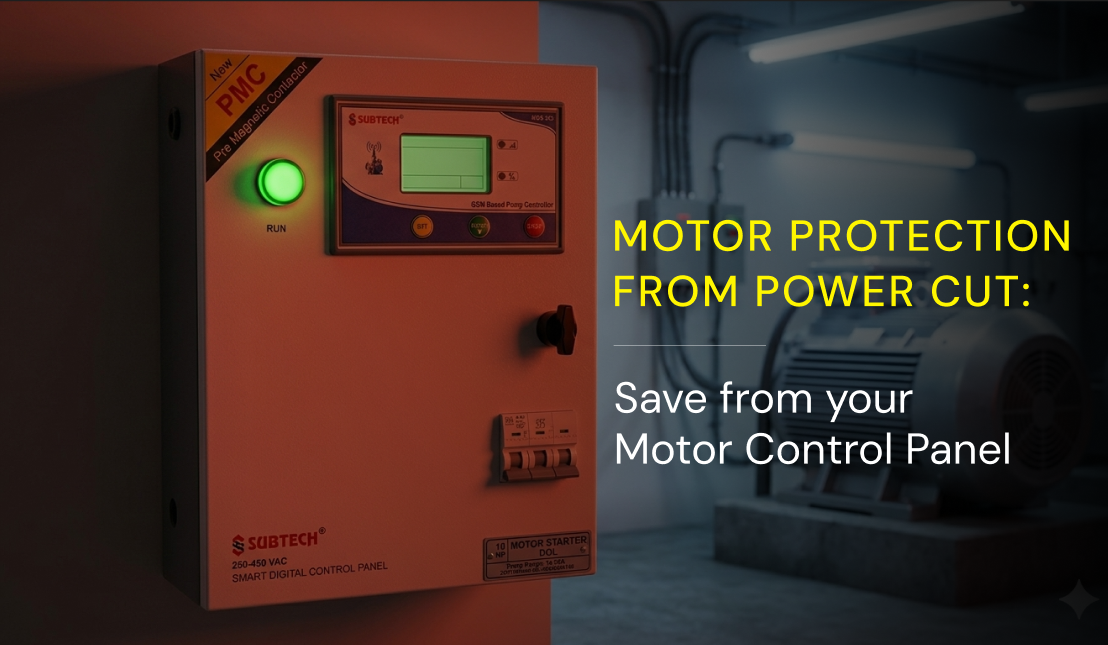
The MPU replaces 6 traditional components in one unit: thermal overload relay, phase-failure relay, under-voltage relay, over-voltage relay, earth-fault relay, and dry-run protection switch. Installation time drops from 4 hours to under 45 minutes. The Soldier App integration means dealers and site owners get fault alerts on their phones within seconds, cutting average fault-to-resolution time from 3 days to under 4 hours. S S Power System, the ISO 9001, ISO 14001, ISO 45001, and ISO 50001 certified firm behind Subtech, also holds ZED Silver, CE, CPRI, and ERTL certifications. Subtech panels protect motors for GAIL, NTPC, DMRC, Delhi Jal Board, Indian Railways, and the Indian Air Force, across 220-plus dealers nationwide.
A generic single-phasing relay costs Rs 400 to Rs 800. It does one thing, it does it slowly, and it does not tell you what happened. A Subtech MPU-equipped panel costs Rs 1,200 to Rs 3,500 more than a basic DOL starter. Over 5 years, a basic DOL starter with a cheap relay sees an average of 1.5 motor burnout events from single phasing, costing Rs 60,000 to Rs 1,12,000 in total damage. A Subtech panel with Double Single-Phasing protection sees zero. The maths is simple.
Call Subtech today for a free expert consultation: www.subtech.in/contact
Our engineers will tell you exactly which protection solution fits your motor, site, and budget.
Frequently Asked Questions
What is single phasing in a three-phase motor?
Single phasing occurs when one of the three supply phases to a three-phase motor loses power completely or drops significantly. The motor continues to run on only two phases, forcing those two windings to carry 70 to 100% more current than they are designed for. This overheats and burns the winding insulation within 30 seconds to 8 minutes. Single phasing is the most common cause of three-phase motor failure in India, responsible for over 60% of all emergency motor replacements.
How do I know if my motor burned due to single phasing?
When an electrician opens a motor that burned due to single phasing, they will find that exactly two of the three winding sets are burned or charred, while the third is untouched and clean. This is the identifying signature of single-phasing damage. A motor burned by general overload shows all three windings damaged. If your motor burned and two windings are black while one is clean, single phasing is the confirmed cause, and you must add proper phase-failure protection before starting the replacement motor.
What is the best protection against single phasing in India?
The most reliable protection against single phasing in India is an integrated MPU (Motor Protection Unit) that uses both voltage sensing and current imbalance detection simultaneously. This dual-method approach catches all types of single phasing including partial phase loss and fluctuating phase voltage, which basic voltage-only relays miss. Subtech's Double Single-Phasing protection trips the motor in under 30 milliseconds and shows a fault code on the display so the cause is immediately known. Contact Subtech at www.subtech.in for the right unit for your motor rating.
Can a thermal overload relay protect against single phasing?
No. A thermal overload relay is designed to protect against sustained overload current, not single phasing specifically. When single phasing occurs on a lightly loaded motor, the current in the two remaining phases may not rise high enough to trip the thermal overload before the winding insulation is already burned. This is the most dangerous and most common misconception in Indian motor protection. A thermal overload relay and a single-phasing relay are two different devices solving two different problems. Both are needed for complete motor protection.
Disclaimer: Always consult a licensed electrical engineer before installation. Product specifications should be verified with Subtech's official datasheet for your specific application and motor rating. Subtech is not responsible for damage arising from improper installation.
Suggested Posts
View all
Leave a Comment
Your email address will not be published.