
1317 min read0 commentsMar 27, 2026
5 Ways Power Cuts Burn Your Motor (And How to Stop It)
DN
Deepak Negi
Subtech

5 Ways Power Cuts Burn Your Motor (And How to Stop It)
Last season, a farmer in Hardoi, Uttar Pradesh, lost his 10 HP borewell motor at 2 AM during a power restoration surge. The pump stopped. The field went dry. By morning, half an acre of standing wheat had wilted beyond recovery. Replacing the motor cost Rs 28,000. Add the electrician's emergency charges, borewell service fees, and three weeks of crop water stress, and the total damage crossed Rs 75,000 from a single power cut. With India's electricity demand gap expected to reach 15 to 20 gigawatts in non-solar hours in 2026, this is not a rare story. It is happening every day, on farms in UP and Bihar, in pump houses in Rajasthan, in factories in Gujarat and Maharashtra.
In this post, you will learn exactly how power cuts damage your motor step by step, which five failure modes are destroying motors fastest across India right now, how much each failure actually costs, and the one protection technology that has already saved thousands of motors from an early death.
What Is Motor Burn Due to Power Cuts? A Simple Explanation
Think of your motor's copper windings like the wick of a candle. Under normal voltage, the wick burns evenly and lasts a long time. But when power fluctuates, drops sharply, or surges back suddenly, the current through those windings spikes far beyond their rated limit. The heat generated melts the insulation around the copper coils. Once that insulation is gone, the winding short-circuits and the motor is dead. This is what electricians call a "motor burn," and it is not a defect in the motor. It is a failure caused entirely by poor power quality.
According to electrical maintenance industry data, over 60% of motor failures in India are caused by power supply problems, not by mechanical wear or manufacturing defects. A standard 5 HP motor has copper windings worth Rs 4,000 to Rs 8,000. When those windings burn, rewinding costs Rs 5,000 to Rs 14,000 for small motors and Rs 18,000 to Rs 55,000 for larger ones. In most cases, it is cheaper to buy a new motor than to repair the old one.
Why This Problem Is Bigger Than You Think
The International Energy Agency released an emergency energy demand report in March 2026 noting that India's unmet electricity demand could reach 15 to 20 gigawatts during non-solar hours. This means grid voltage swings constantly, especially in rural feeder lines where voltage can drop to 160V on a 230V single-phase supply or to 330V on a 440V three-phase system. A drop of just 20% in voltage forces your motor to draw 40% more current to maintain its output. That extra current generates heat that attacks the winding insulation every single hour the motor runs at low voltage.
Now picture this. Your pump motor burns at 11 PM on a Tuesday night in April. You call three local electricians. None can reach you before 8 AM. By the time the motor is replaced and the pump runs again, two critical irrigation cycles have been missed. On a 5-acre wheat farm, missing irrigation at the grain-filling stage can reduce yield by 25 to 40%, wiping out Rs 40,000 to Rs 1,20,000 in crop income. In a factory running three shifts, one failed pump motor on a cooling circuit can halt an entire production line at a cost of Rs 15,000 to Rs 80,000 per hour of downtime.
The 5 Ways Power Cuts Burn Your Motor
Most motor owners think a power cut means the electricity is off and nothing can go wrong while it is off. That is wrong. The damage happens before the cut, during the cut, and at the moment power returns. Here are the five exact failure modes responsible for the majority of motor burns in India:
1. Single Phasing: When one of the three live wires in a three-phase supply goes dead, your motor tries to run on only two phases. The current in the remaining two phases climbs to 2 to 3 times its normal level within seconds. The windings overheat rapidly. A 15 HP motor running on single phase draws enough excess current to burn its insulation in 4 to 8 minutes. This is the single largest cause of three-phase motor failure in Indian agriculture and industry. Subtech's Smart Pump Panels include Double Single-Phasing protection, which detects this condition within milliseconds and trips the panel safely before the motor takes any damage.
2. Voltage Surge at Power Restoration: When electricity comes back after a cut, the grid does not restore voltage smoothly. For 2 to 5 seconds, the incoming voltage can be 10 to 25% higher than normal as the grid stabilises. An old-style Direct-On-Line (DOL) starter lets this surge pass directly into your motor. The surge current in a 7.5 HP motor during a restoration event can reach 6 to 8 times the normal running current. If this happens repeatedly, the winding insulation cracks and fails within weeks.
3. Sustained Under-Voltage (Low Voltage): In rural areas and small towns, evening peak load causes voltage to sag to 340V or lower on a 440V three-phase system. Your motor is designed to run within plus or minus 10% of its rated voltage. Below that range, it draws higher current to maintain its mechanical output. This slow, invisible overheating damages the winding insulation gradually over weeks. There are no obvious warning signs. The motor appears to work normally until one day it simply does not start again. Farmers often blame the motor brand when the real cause was consistently low supply voltage.
4. Rapid Restart Cycling: In areas with frequent load shedding, power may flicker on and off 5 to 10 times in a single hour. Every motor start draws 6 to 8 times the full-load current for 3 to 8 seconds. If a 10 HP motor starts 10 times in one hour due to power flickering, the thermal energy dumped into the windings is equivalent to running the motor under severe overload for 30 minutes. Traditional bimetallic overload relays do not account for this cumulative heating. They are designed for single-start scenarios. Repeated rapid starts kill motors in 6 to 18 months in high-load-shedding zones.
5. Phase Reversal: After a power outage, when supply is restored, the sequence of the three phases can sometimes reverse due to switching errors at the substation or local feeder level. A reversed phase sequence makes your motor spin backward. If the motor is connected to a centrifugal pump, the impeller spins in the wrong direction, building up pressure against closed valves. The resulting water hammer can destroy the impeller, shaft seal, and pump casing within seconds, turning a simple motor protection issue into a Rs 25,000 to Rs 80,000 pump replacement job. Subtech's Motor Protection Unit (MPU) monitors phase sequence continuously and prevents the motor from starting if reversal is detected.
Types of Motor Protection Available in India
Buyers in India often do not know that multiple levels of protection exist, and that the cheapest option provides almost no real protection against the five failure modes described above. Here is a clear comparison:
Protection Type Best For Approx. Cost (INR)
Bimetallic Overload Relay (Traditional) Basic overload only. Fails above 45 degrees C. No phase protection. Rs 800 to Rs 2,500
Electronic Overload Relay Better overload accuracy. Still no single-phasing or surge protection. Rs 2,500 to Rs 6,000
Subtech Motor Protection Unit (MPU) 6-in-1 protection: overload, single phasing, phase reversal, under-voltage, over-voltage, phase imbalance. Works in all temperatures. Rs 4,500 to Rs 12,000
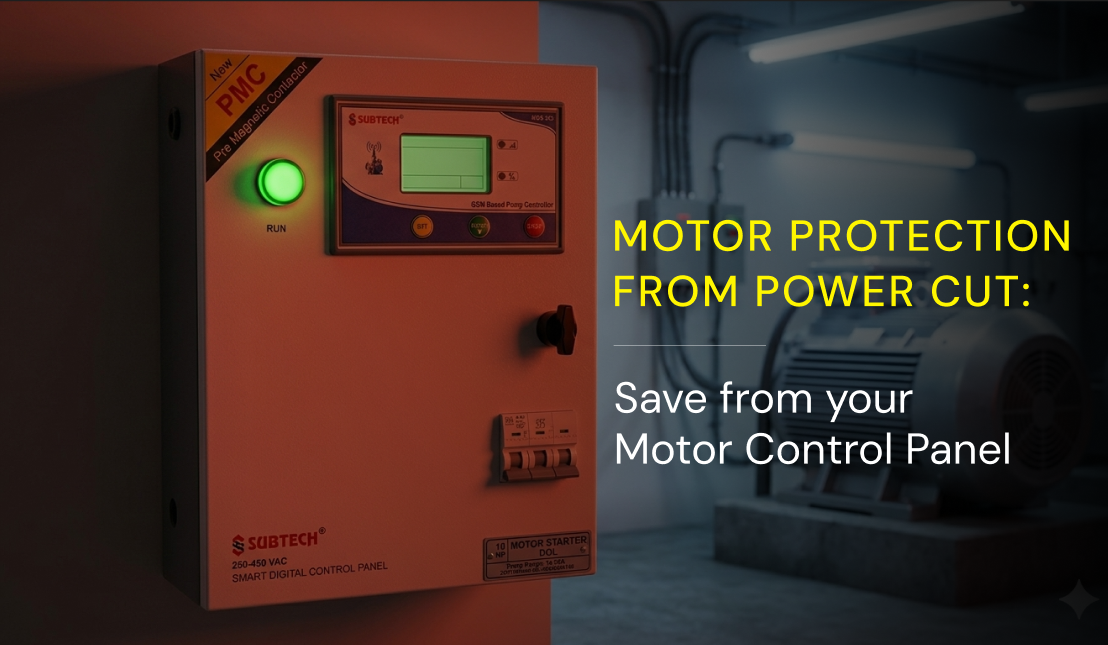
Subtech Smart Pump Panel (Complete) Farms, borewells, and industrial pumps needing full panel with wiring, protection, and display built in. Rs 8,000 to Rs 35,000
Key Benefits: What You Actually Gain
Motor Life Extends from 3 Years to 10 or More Years
An unprotected motor in a high-fluctuation zone in rural India burns out on average every 2 to 4 years. With proper six-point protection, the same motor regularly runs for 10 to 15 years without a winding failure. At an average motor replacement cost of Rs 22,000 for a 5 HP motor, the savings over a decade range from Rs 44,000 to Rs 88,000 from motor replacements alone, not counting labour and downtime.
Crop Loss Eliminated During Irrigation Season
For a farmer running a 7.5 HP borewell pump, a single motor failure during the critical grain-filling or flowering stage can destroy Rs 30,000 to Rs 80,000 in standing crop. Subtech's MPU trips the motor safely before damage occurs, preserving both the motor and the irrigation schedule. Across 220 plus Subtech dealer locations in India, farmers routinely report zero motor failures in seasons where previously they faced one to two burns per year.
Remote Diagnosis Without an Electrician Visit
Subtech's MPU includes a digital error code display that shows exactly what caused a trip. When a fault occurs, the farmer or plant operator reads the code, calls the local Subtech dealer or the Soldier App helpline, and the issue is identified and resolved over the phone in 90% of cases. Emergency electrician visit charges in rural India range from Rs 500 to Rs 2,500 per call, plus spare parts. Eliminating unnecessary visits saves Rs 3,000 to Rs 15,000 per year for a typical farm or small industrial unit.
Protection Works Round the Clock in Indian Summer Heat
A traditional bimetallic overload relay loses calibration accuracy above 45 degrees C, which is a standard afternoon temperature inside any Indian pump house or panel room from April to June. It trips too early in heat, causing nuisance trips, or too late in extreme heat, failing to protect. Subtech's electronic MPU operates accurately from minus 10 to plus 70 degrees C, delivering reliable protection 24 hours a day, including the hottest summer nights when power is most unstable.
Millisecond Trip Speed Instead of Minutes
A bimetallic relay takes anywhere from 10 to 90 seconds to trip under abnormal current conditions. During those seconds, your motor windings are cooking. Subtech's MPU detects abnormal conditions, including single phasing, phase reversal, and voltage surge, and trips the motor within 100 to 200 milliseconds. At that speed, no thermal damage reaches the windings. The motor is switched off before any insulation degradation begins.
One Certified Panel Replaces Six Separate Components
A complete motor protection system built manually requires a separate overload relay, single-phasing relay, voltage monitoring relay, phase sequence relay, timer relay, and multiple contactors, all wired individually. Each component is a potential failure point. Subtech's integrated Smart Pump Panel combines all six functions into one factory-tested, certified unit. Installation time drops by 60%, wiring errors are eliminated, and the panel carries ISO 9001, ISO 14001, ISO 45001, ISO 50001, CE, CPRI, and ERTL certifications so it passes any government project inspection.
Which Indian Industries Use This?
Motor protection from power fluctuations is not limited to farming. In agriculture, borewell operators across Uttar Pradesh, Bihar, Haryana, Punjab, Rajasthan, and Madhya Pradesh use Subtech pump panels to protect 5 HP to 50 HP submersible and surface motors. In manufacturing, textile mills in Surat and Bhilwara, auto component factories in Pune, and food processing plants in Ludhiana use motor protection panels on conveyor drives, cooling tower pumps, and compressor motors. In water treatment, municipal water supply plants in Delhi, Noida, and Lucknow use Subtech MCC and pump panels to ensure uninterrupted pumping to residential areas. In commercial buildings, fire pump panels in high-rises, hospitals, and hotels in NCR and Mumbai use phase and voltage protection because a failed fire pump in a high-rise is a legal and safety liability. Government clients including GAIL, NTPC, DMRC, DJB, Indian Railways, and the Indian Air Force have standardised on Subtech panels precisely because they need reliable motor protection across sites where power quality varies widely.
How to Choose the Right Motor Protection for Your Needs
Before you buy any motor protection panel or relay, check these five things to make sure you are buying the right level of protection for your specific situation:
Motor size and type: A 3 HP single-phase pump has different protection needs from a 50 HP three-phase motor. Always select a protection unit rated for at least the full-load current of your motor, not just the horsepower. Single-phase motors need under-voltage and over-voltage protection. Three-phase motors also need single-phasing, phase imbalance, and phase reversal protection.
Local power quality: If your area has frequent load shedding, voltage fluctuations below 340V on three-phase, or long power cuts followed by sudden restoration, you need full electronic protection, not a basic bimetallic relay. Ask your local electricity department for the monthly voltage log of your feeder to understand the real supply quality you face.
Application criticality: A farm pump that irrigates during a two-week critical crop window has very high criticality. A factory cooling pump that keeps a production line running has extreme criticality. Higher criticality means you need faster trip response, built-in restart delay to prevent surge restarts, and remote monitoring capability.
Certification requirements: For government tenders, municipal contracts, and industrial projects, the panel must carry BIS, CE, CPRI, or ERTL certification. Verify that the manufacturer holds these and can provide the certificates on demand. S S Power System holds all of these under the Subtech brand.
Dealer and service network: A protection panel is only as good as the support network behind it. Ask how many dealers the manufacturer has in your district, whether they have a service app or helpline, and what the maximum response time is. With 220 plus dealers across India and the Soldier App technician network, Subtech provides same-day support in most major districts.
Common Mistakes That Cost You Money
Most buyers in India make these mistakes. Each one costs money, often far more than the panel they were trying to save on.
Buying only an overload relay and calling it "motor protection": An overload relay protects against sustained mechanical overload. It does nothing against single phasing, phase reversal, or voltage surge. Farmers who install only a bimetallic overload relay are protected against maybe 15% of the failure scenarios they actually face. The other 85% of failures, caused by power quality, still happen. Cost impact: Rs 18,000 to Rs 55,000 per motor replacement event.
Using an undersized panel to save Rs 2,000 upfront: A panel rated for 10A on a motor drawing 14A full-load current will trip constantly under normal operation or, worse, will not trip fast enough under fault conditions. Correct sizing based on full-load current, service factor, and duty cycle is mandatory. An undersized or wrongly selected panel causes repeated nuisance trips, motor restarts, and accelerated winding failure. Cost impact: Rs 8,000 to Rs 25,000 in early motor replacement plus Rs 3,000 to Rs 8,000 in repeated service calls.
Installing the panel without a restart delay timer: After a power cut, multiple motors in an area restart simultaneously when power returns. This creates a local voltage dip that can cause additional motor stresses. A restart delay timer staggers restarts by 30 to 120 seconds per motor, allowing the grid to stabilise before each motor draws starting current. Without this, the same restoration surge that caused the original cut can burn motors all over again. Cost impact: Rs 5,000 to Rs 18,000 per motor affected by restoration surge.
Skipping annual panel servicing: Contactors develop pitting on their contacts after 50,000 to 100,000 operations. A pitted contactor causes arcing, voltage drops at the motor terminals, and erratic tripping. Annual panel servicing, which costs Rs 500 to Rs 2,000 per panel, extends the panel life by 5 to 8 years and prevents the contactor-related failures that cause motor damage. Most users never service their panels until the panel fails, by which time the motor has already burned.
Why Subtech's Solution Stands Apart
Subtech's Motor Protection Unit replaces six separate protection components in a single, factory-calibrated device. Unlike traditional thermal overload relays that lose accuracy above 45 degrees C, the MPU uses electronic current sensing that maintains accuracy from minus 10 to plus 70 degrees C. It detects single phasing, phase reversal, under-voltage, over-voltage, phase imbalance, and sustained overload, and trips the motor within 100 to 200 milliseconds of any fault condition. The digital display shows a specific error code, not just a tripped light, so 90% of service calls are resolved over the phone without an electrician visit. For pump applications, Subtech's Smart Pump Panels integrate the MPU with Double Single-Phasing protection, a tested contactor assembly, and a wiring-complete enclosure rated for outdoor and pump house installation.
Subtech panels carry ISO 9001 (Quality Management), ISO 14001 (Environmental Management), ISO 45001 (Occupational Safety), ISO 50001 (Energy Management), ZED Silver, CE, CPRI, and ERTL certifications, all held under the legal firm name S S Power System. Major clients who have standardised on Subtech protection panels include GAIL, NTPC, DMRC, Delhi Jal Board, Indian Railways, Indian Air Force, and multiple IITs. With over 220 dealers across India and a growing Soldier App technician network, support is available at local level in most major districts.
Here is the total cost of ownership calculation that matters most: A basic local-brand pump panel may cost Rs 4,500 less than a Subtech panel. But if it fails to protect against single phasing just once, the motor replacement costs Rs 22,000 to Rs 35,000. Add one crop loss event at Rs 50,000 and two emergency service calls at Rs 3,000 each. The total cost of that Rs 4,500 "saving" reaches Rs 80,000 over three years. Subtech's total cost of ownership over the same period, with zero motor failures and zero emergency calls, is Rs 0 in additional costs beyond the panel price. That is the real calculation every buyer should make before choosing a panel.
Ready to stop losing motors to power cuts?
Call Subtech today for a free expert consultation: www.subtech.in/contact
Our engineers will recommend the exact right protection panel for your motor size, application, and local power conditions.
Frequently Asked Questions
What causes motor burn due to power cuts in India?
Motor burn during power cut events is caused by five main factors: single phasing when one supply line fails, voltage surge when power restores after a cut, sustained low voltage forcing higher current draw, rapid restart cycling during frequent load shedding, and phase reversal after grid switching. Of these, single phasing is the most common cause of three-phase motor failure across Indian agriculture and industry. A proper motor protection unit like Subtech's MPU detects all five conditions and trips the motor before any damage occurs.
How much does a motor protection panel cost in India?
Motor protection costs vary by level of protection. A basic bimetallic overload relay costs Rs 800 to Rs 2,500 but protects against only one failure mode. A complete Subtech Motor Protection Unit with six-point electronic protection costs Rs 4,500 to Rs 12,000. A ready-to-install Subtech Smart Pump Panel with full wiring, certified enclosure, and protection built in costs Rs 8,000 to Rs 35,000 depending on motor rating. The panel typically pays for itself after preventing even one motor burn event.
Can a pump motor be protected from single phasing?
Yes, single phasing protection is available and essential for any three-phase pump motor in India. Subtech's Smart Pump Panels include Double Single-Phasing protection, which detects when one of the three supply phases is lost and trips the motor within milliseconds, before the remaining two phases can overheat the windings. Traditional overload relays do not provide this protection. Single phasing is estimated to be responsible for over 40% of three-phase motor failures in Indian agricultural applications.
How does Subtech's MPU work for motor protection?
Subtech's Motor Protection Unit continuously monitors the current and voltage on all three phases of the motor supply. When it detects any abnormal condition including single phasing, phase reversal, under-voltage below the set threshold, over-voltage above the set threshold, phase imbalance exceeding 10%, or sustained overload current, it sends an instant trip signal to the contactor within 100 to 200 milliseconds. A digital display then shows a specific error code so the operator knows exactly what fault occurred, enabling remote diagnosis without an electrician visit in 90% of cases.
Suggested Posts
View all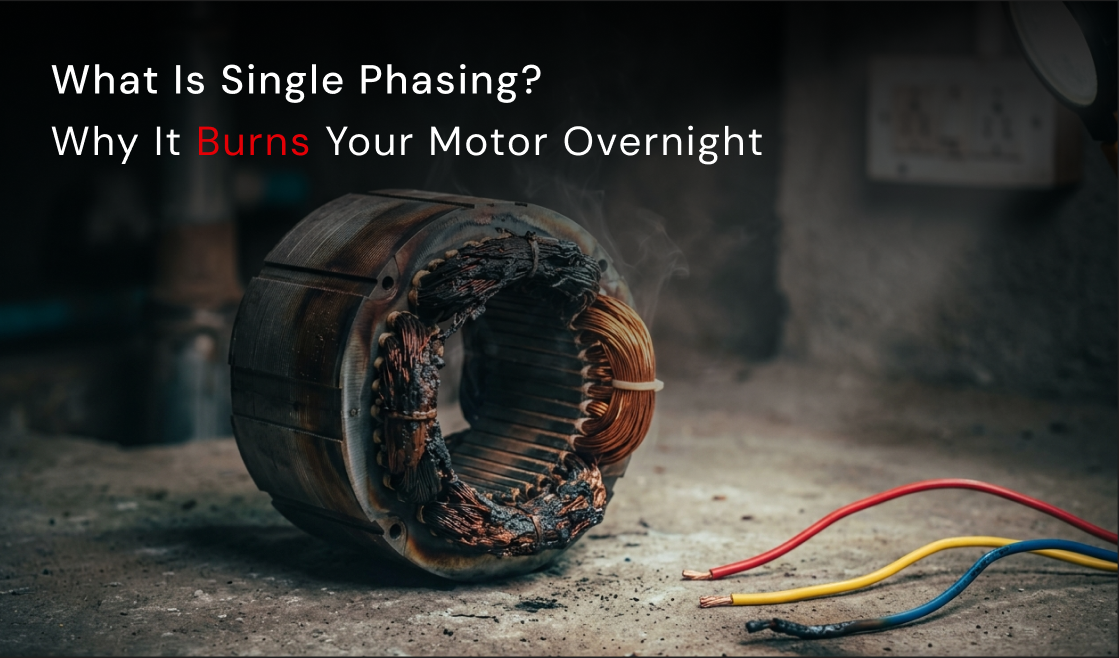
Leave a Comment
Your email address will not be published.