
VFD Panel for Pump Motor: Cut Electricity Bills by 50%
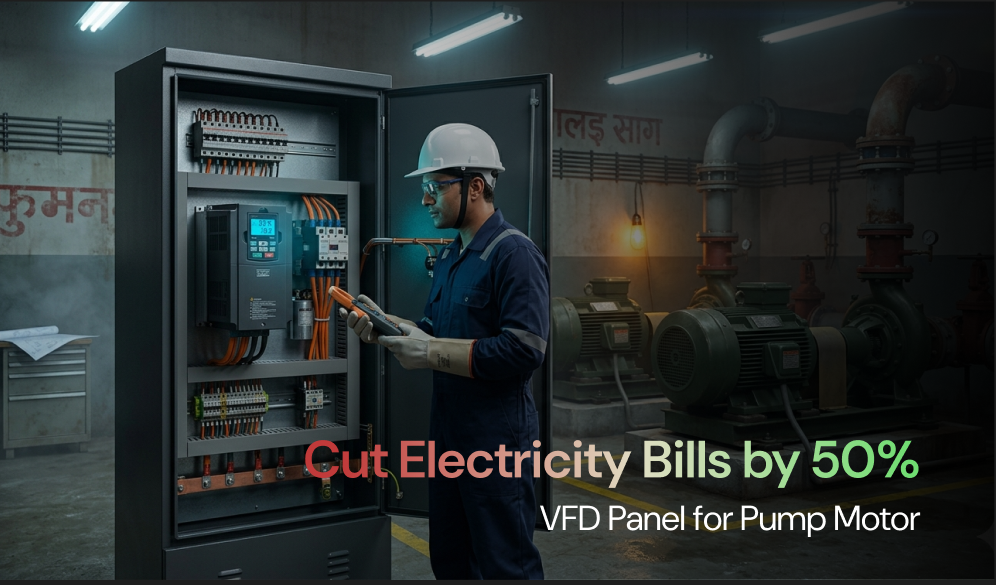
VFD Panel for Pump Motor: Cut Electricity Bills by 50%
Picture this: a factory manager in Pune opens his electricity bill in April and stares at Rs 1,40,000 for a single month. His five pump motors are running at full speed, all day, every day, even when the process only needs half the flow. Or think of a borewell operator in Uttar Pradesh whose 10HP submersible pump runs 10 hours a day, seven days a week, pushing his annual electricity bill past Rs 1,25,000 for just that one pump. The pain is real, it is growing, and most people do not know that a single device can cut that bill almost in half: a VFD panel.
In this post, you will learn exactly what a VFD panel is, how it works on pump motors, how much money it can realistically save you in Indian Rupees, which industries use it, how to choose the right one, and why the right VFD panel pays for itself in less than a year. Read every word before you pay your next electricity bill.
What Is a VFD Panel? A Simple Explanation
VFD stands for Variable Frequency Drive. Think of it like the accelerator pedal in your car. When you are on the highway, you press the pedal all the way down. When you are in city traffic, you press it only halfway. Without a VFD, your pump motor is like a car with the accelerator stuck to the floor at all times, running at 100% power even when you only need 40% flow. A VFD panel is an electrical panel that houses a Variable Frequency Drive along with protection components, circuit breakers, and control wiring. It controls the speed of your motor by changing the frequency and voltage of electricity sent to it. Slow the motor down by 30%, and your electricity consumption drops by over 65%.
This is not theory. The affinity laws of fluid mechanics prove it mathematically: power consumed by a pump varies with the cube of its speed. A motor running at 70% of full speed uses only 34% of the electricity it would use at full speed. For a 10HP pump running 8 hours a day, that translates to real savings of Rs 60,000 to Rs 85,000 every single year from one pump alone.
Why This Problem Is Bigger Than You Think
Electric motors consume approximately 60 to 70% of all electricity used in Indian factories and industrial facilities. Pumps and fans together account for nearly 40% of that motor electricity. Yet in the vast majority of Indian installations, pump motors still run at fixed full speed using a Direct Online (DOL) starter or a star-delta starter. These are starter panels, not speed controllers. They do nothing to reduce electricity consumption once the motor is running. According to industry data, a 10HP (7.5 kW) pump motor running 8 hours a day for 300 days a year consumes 18,000 kWh of electricity annually. At an average Indian industrial tariff of Rs 7 per unit, that is Rs 1,26,000 per year for one pump. A VFD panel set to run that same pump at 75% speed reduces consumption to approximately Rs 53,000 per year. That is a saving of Rs 73,000 in the very first year for a single pump.
Now imagine you have five pumps, or fifteen. The math becomes impossible to ignore. And with India's new Time-of-Day tariff rules rolling out in 2026, peak-hour electricity rates are rising even further. Every hour your pump runs at full speed during the 6 PM to 10 PM peak window costs you more than it did last year. The nightmare scenario is simple: factories and farms that do nothing will see their electricity bills rise 15 to 25% in the next two years. Those who install VFD panels will see their bills drop. The gap between the two outcomes is hundreds of thousands of rupees per year, and it widens every season.
How a VFD Panel Works: Step by Step
A VFD panel does its job in three clear stages. First, it takes the incoming three-phase AC power from the grid (typically 415V, 50Hz in India) and converts it to direct current (DC) inside the drive using a rectifier circuit. Second, the DC is stored in capacitors and then converted back to alternating current (AC) using an inverter section that produces AC at any frequency between 5Hz and 60Hz. Third, the output frequency determines the speed of the motor: lower frequency means lower speed means less electricity consumed. The pump only works as hard as the process actually requires.
Subtech's VFD Panels include integrated PMC (Programmable Motor Controller) technology that continuously monitors five critical parameters in real time: input voltage, output current, motor temperature, power factor, and system frequency. If any parameter goes out of range, the PMC automatically adjusts the drive settings or trips the circuit safely before any damage occurs. This is the key difference between a quality VFD panel and a basic drive: the protection intelligence built around it. Subtech's VFD Panels can also connect to the Command Center platform, giving you live energy consumption data, trip history, and performance graphs for every pump in your facility from your mobile phone, anywhere in India.
Types of VFD Panels Available in India
Not all VFD panels are the same. Here are the four main types used across Indian industries, with approximate price ranges and ideal applications.
| Type | Best For | Approx. Cost (INR) |
|---|---|---|
| Basic VFD Starter Panel (up to 5HP) | Small agriculture pumps, household borewells, small cooling towers | Rs 18,000 to Rs 35,000 |
| Standard VFD Panel with Bypass (5HP to 30HP) | Factory process pumps, HVAC, water treatment, commercial buildings | Rs 35,000 to Rs 95,000 |
| Heavy Duty VFD Panel with PLC (30HP to 100HP) | Large industrial pumps, compressors, irrigation systems, MCC integration | Rs 95,000 to Rs 2,60,000 |
| Solar-Compatible VFD Panel (PM-KUSUM) | Agricultural pumps under PM-KUSUM scheme, solar-powered borewells | Rs 45,000 to Rs 1,25,000 |
Key Benefits: What You Actually Gain
30 to 50% Reduction in Electricity Bills
This is the headline benefit, and it is backed by real Indian case studies. A pharmaceutical company in Chennai reported 37% energy savings after installing VFDs on its process pumps. For a factory running ten 15HP pumps, that level of saving equals approximately Rs 4,40,000 per year in reduced electricity costs. The payback period on the VFD panel investment is typically 8 to 14 months, after which every rupee saved goes straight to the bottom line.
Longer Motor Life Due to Soft Starting
Every time a motor starts with a DOL starter, it draws 6 to 8 times its full-load current in the first few seconds. This startup shock stresses motor windings, bearings, and shaft couplings. A VFD ramps the motor up gradually over 5 to 30 seconds, eliminating startup shock entirely. Studies show that motors controlled by VFDs last 2 to 3 times longer than those started with DOL starters. For a 15HP motor costing Rs 45,000, this means avoiding one replacement every 4 to 5 years: a saving of Rs 45,000 in motor cost alone, plus installation labour charges.
No More Water Hammer and Pipe Damage
Sudden starts and stops in pump systems cause a phenomenon called water hammer: a violent pressure surge that cracks pipes, damages valves, and breaks flanges. In large water treatment plants and industrial facilities across India, water hammer repairs cost Rs 20,000 to Rs 2,00,000 per incident. A VFD eliminates water hammer by starting and stopping the pump gradually. Many facilities report zero pipe repair costs in the years after VFD installation, compared to annual pipe maintenance bills of Rs 50,000 or more before.
Protection Against Voltage Fluctuations and Single Phasing
Indian power supply is notorious for voltage fluctuations, single-phase failures, and phase imbalance, especially in rural and semi-urban areas. A quality VFD panel includes built-in over-voltage, under-voltage, over-current, and phase-loss protection. When the supply voltage fluctuates between 340V and 480V (which is common in UP, Bihar, and Rajasthan agricultural zones), the VFD continues to deliver stable output to the motor instead of letting the fluctuations cause overheating and burnout. Motor replacement costs of Rs 18,000 to Rs 55,000 are avoided every time this protection activates.
Better Process Control and Product Quality
In industries where flow rate affects product quality, such as food processing, pharmaceuticals, textile dyeing, and chemical manufacturing, a VFD allows operators to set the exact flow rate required. This precise control reduces product wastage, chemical overdosing, and rework costs. One textile mill in Surat reported a 12% reduction in water and chemical usage after installing VFD panels on its dyeing process pumps, saving Rs 8 lakh per year in input costs.
Remote Monitoring with Subtech Command Center
Subtech's VFD Panels can integrate with the Command Center platform, an IoT-based energy and performance monitoring system. You can view real-time energy consumption, receive automatic alerts when a pump trips or draws excess current, and analyse historical data to identify inefficiencies. For facilities with pumps spread across multiple locations, such as water treatment plants in Delhi or irrigation systems across a 500-acre farm, Command Center replaces the need for a full-time operator at each pump point. This alone can save Rs 15,000 to Rs 30,000 per month in manpower costs.
Which Indian Industries Use VFD Panels?
VFD panels for pump motors are used across every major industry in India. In agriculture, farmers running borewell submersible pumps in UP, Bihar, Punjab, and Maharashtra use VFDs to reduce electricity bills and extend pump life, especially under PM-KUSUM solar pump systems where matched VFD panels optimise solar energy usage. In manufacturing, textile mills in Surat and Ludhiana, automotive plants in Pune and Chennai, and pharmaceutical factories across Gujarat use VFD panels on process water pumps, coolant pumps, and hydraulic systems. In commercial buildings and hotels, HVAC chilled water pumps and cooling tower fans running at variable loads see 35 to 50% energy savings with VFDs. In water treatment, Delhi Jal Board (DJB), a Subtech client, uses VFD-controlled pumps to match supply output to real-time demand, eliminating overflow waste and reducing pumping electricity costs by approximately 40%. In the oil and gas sector, refineries and pipeline stations use heavy-duty VFD panels on high-capacity transfer pumps where a 5% energy saving at large scale equals crores of rupees annually.
How to Choose the Right VFD Panel for Your Needs
Most buyers ask only one question: "What is the price?" That is the wrong question. Here are the five criteria that actually matter.
- Motor HP and voltage rating: Your VFD panel must be sized for the correct motor horsepower and voltage. Undersizing leads to frequent tripping and early failure of the drive. Always buy for 10 to 15% above your motor's rated current as a safety margin.
- Application type (constant torque vs. variable torque): Pumps and fans are variable torque loads, which means they benefit most from VFDs. Compressors and conveyors are constant torque loads and need a different drive configuration. Using the wrong type costs you efficiency and reliability.
- Protection class of the enclosure: For outdoor pump houses, agricultural fields, or dusty factory floors, you need an enclosure rated IP54 or higher. Indoor clean rooms can use IP32. Getting this wrong leads to drive failure within 12 to 18 months.
- Bypass option: For critical applications where the pump cannot stop under any circumstances (fire fighting, water supply, hospital HVAC), insist on a VFD panel with a manual bypass that allows DOL operation if the drive fails. This is non-negotiable for critical pumping applications.
- After-sales service and spare availability: A VFD panel is only as good as the service network behind it. Verify that the manufacturer has spare drive modules available in India and that service engineers can reach your facility within 24 to 48 hours. Subtech's 220-plus dealer network covers all major cities and industrial zones across India.
Common Mistakes That Cost You Money
Most buyers in India make these mistakes. Each one costs money.
- Running pumps at full speed 24 hours a day: The most expensive habit in any pump system. If your process only needs 70% flow for 14 hours and 100% for 10 hours, programming your VFD for variable speed during low-demand periods can save Rs 25,000 to Rs 55,000 per pump per year. Most facilities never bother to programme this and leave money on the table every single day.
- Buying an undersized or uncertified VFD: A cheap, uncertified VFD that fails in 18 months costs more than a quality certified panel that lasts 10 years. Replacement cost, downtime cost, and motor damage from an unreliable drive can easily total Rs 1,50,000. Always verify CE, CPRI, or BIS certification before purchasing.
- Ignoring harmonic distortion: VFDs generate electrical harmonics that can interfere with other equipment on the same power supply. Without proper harmonic filters (built into quality VFD panels), your PLC systems, energy meters, and control panels can malfunction. Repairs to affected equipment average Rs 30,000 to Rs 80,000 per incident.
- Skipping annual maintenance: VFD panels require annual cleaning of cooling fans, inspection of DC bus capacitors, and firmware checks. Neglecting this reduces efficiency by 8 to 12% per year and leads to capacitor failures that cost Rs 15,000 to Rs 40,000 to repair. A simple annual service contract with a certified technician costs Rs 3,000 to Rs 8,000 and prevents all of this.
Why Subtech's VFD Panel Stands Apart
Subtech's VFD Panels are built around the PMC (Programmable Motor Controller), a proprietary control module developed specifically for Indian power supply conditions. While standard VFDs operate reliably only within a narrow input voltage band, Subtech's PMC is engineered to handle the wide voltage swings of 340V to 480V common in Indian industrial and agricultural areas. The PMC also includes a digital fault code display that allows operators to identify and resolve 85% of all issues over a phone call without needing an on-site engineer visit, dramatically cutting downtime in remote pump installations.
Subtech (S S Power System) holds ISO 9001, ISO 14001, ISO 45001, ISO 50001, ZED Silver, CE, CPRI, and ERTL certifications, making it one of the most certified electrical panel manufacturers in the MSME sector in India. Subtech's client list includes GAIL, NTPC, DMRC, Delhi Jal Board (DJB), Indian Railways, Indian Air Force, and multiple IITs. These are organisations that conduct rigorous multi-stage technical evaluations before approving any vendor. Passing those evaluations is the strongest endorsement any panel manufacturer can receive. With 220-plus dealers across India and the Soldier App network for fast field service, Subtech provides the kind of post-installation support that protects your investment for years.
On total cost of ownership: a locally assembled VFD panel from an uncertified manufacturer may cost Rs 12,000 less upfront than a Subtech panel. But over three years, field data shows that uncertified panels incur an average of Rs 45,000 in repair costs, Rs 18,000 in motor damage from drive failures, and Rs 22,000 in lost production during downtime. That is Rs 85,000 in hidden costs against a Rs 12,000 initial saving. Subtech's total cost of ownership over three years is consistently Rs 70,000 to Rs 90,000 lower than the cheapest alternative. Buy once, buy right.
Call Subtech today for a free energy saving consultation: www.subtech.in/contact
Our engineers will calculate your exact annual savings in Rupees and recommend the right VFD panel for your motor size, application, and budget.
Frequently Asked Questions
What is a VFD panel for pump motor and how does it save electricity in India?
A VFD panel for pump motor controls the speed of your motor by adjusting the frequency of electricity supplied to it. Because pump power consumption follows the cube law, reducing motor speed by just 20% cuts electricity use by approximately 49%. In India, a standard 10HP pump motor running 8 hours a day can save Rs 50,000 to Rs 85,000 per year with a VFD panel installed.
How much does a VFD panel cost in India and what is the payback period?
VFD panel prices in India range from Rs 18,000 for a basic 3HP panel to Rs 2,60,000 for a heavy-duty 100HP panel with PLC controls. For most commercial and agricultural pump applications in the 5HP to 30HP range, the total investment is Rs 35,000 to Rs 95,000. Given energy savings of Rs 40,000 to Rs 90,000 per year for a single pump, the typical payback period is 8 to 14 months.
Can a VFD panel be used with a submersible pump in agriculture in India?
Yes. VFD panels are fully compatible with submersible pump motors used in borewell irrigation across UP, Punjab, Maharashtra, and other agricultural states. For farmers using the PM-KUSUM solar pump subsidy scheme, solar-compatible VFD panels are available that optimise solar energy usage and extend pump motor life. Subtech offers VFD panels designed specifically for agricultural submersible pump applications with IP54 weatherproof enclosures suitable for outdoor pump houses.
What is the difference between a VFD panel and a DOL starter for a pump motor?
A DOL (Direct Online) starter simply connects and disconnects the motor from the power supply. It provides no speed control and no energy saving. A VFD panel controls motor speed continuously, matching power consumption to actual process requirements. The result is 30 to 50% lower electricity bills, dramatically reduced startup stress on the motor, and built-in protection against voltage fluctuations, single phasing, and overcurrent. A VFD panel costs more upfront but saves far more in the first year alone.
Disclaimer: Always consult a licensed electrical engineer before installation. Product specifications should be verified with Subtech's official datasheet for your specific application and motor rating. Subtech is not responsible for damage arising from improper installation.
Suggested Posts
View all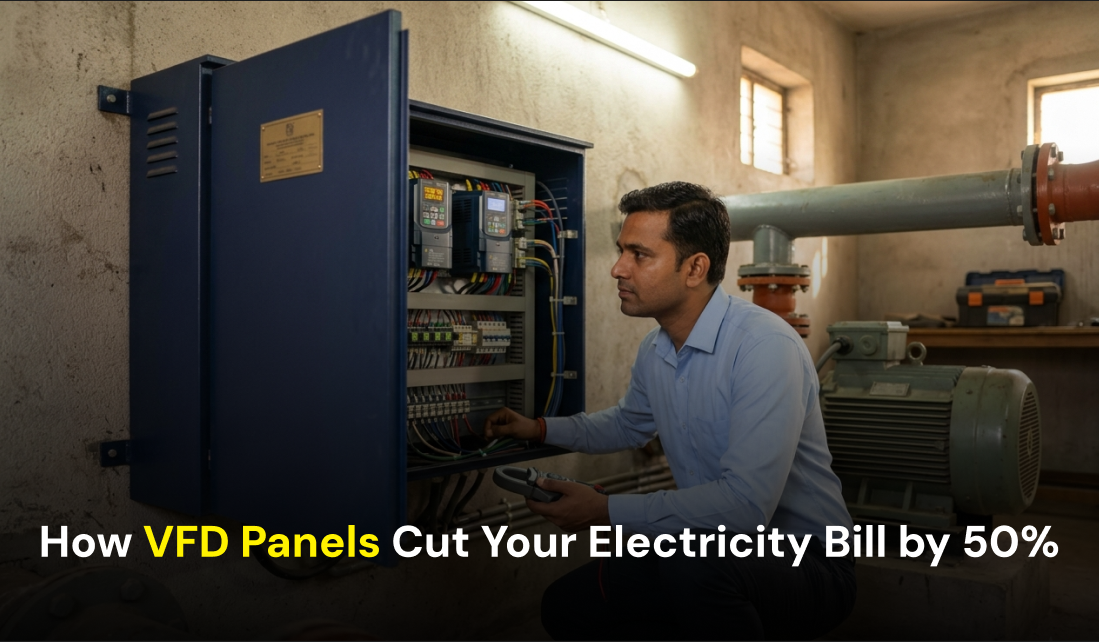
Leave a Comment
Your email address will not be published.