
How VFD Panels Cut Your Electricity Bill by 50%
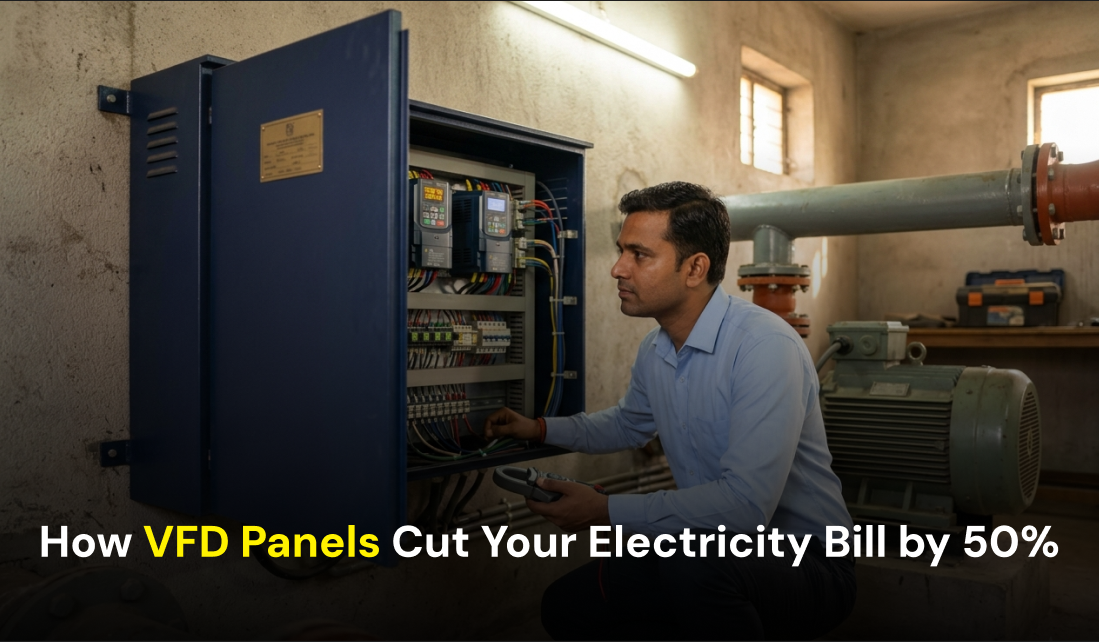
How VFD Panels Cut Your Electricity Bill by 50%
Imagine opening your factory's electricity bill and seeing Rs 1,40,000. Same machines. Same hours. Same production. But the number keeps climbing every single quarter. Here is why: your motors are running at full speed 24 hours a day, even when the actual load is only 30% or 40% of maximum capacity. You are paying for 100% power and using 40% of it. That is not a small inefficiency. That is a cash leak. And in March 2026, with India's energy crisis pushing industrial tariff rates higher and power cuts hitting Delhi, UP, Bihar, and Rajasthan on a daily basis, this problem is getting worse, not better.
In this post, you will learn exactly what a VFD panel is, how it works in plain language, how much money it can save in Indian factories and pump houses, which industries are already using it, and what mistakes to avoid before you buy. By the end, you will know whether a VFD panel is the right investment for your operation and how to choose the right one without overspending.
What Is a VFD Panel? A Simple Explanation
A VFD panel, or Variable Frequency Drive panel, is an electrical control panel that adjusts the speed of your AC motor in real time based on how much work actually needs to be done at that moment. Think of it like the accelerator pedal in your car. You do not drive at 100 km/h in a traffic jam. You slow down when traffic is slow and speed up on the highway. A VFD does exactly the same thing for your electric motor. Instead of running at full speed all the time, it runs at the speed the job demands, no more, no less.
The physics behind the savings is known as the Affinity Law. This is a real engineering principle: reducing motor speed by just 20% cuts its power consumption by nearly 49%. A 30% speed reduction cuts power consumption by almost 66%. This is not marketing language. It is mathematics. A 50 HP motor running at full speed consumes approximately 37 kW per hour. The same motor running at 70% speed through a VFD consumes roughly 18 kW per hour. At Rs 8 per unit (industrial tariff in 2026), that is a saving of Rs 1,52,000 per year on just one motor running two shifts.
Why This Problem Is Bigger Than You Think
India's electricity demand grew by 20% between 2023 and 2025, according to IEA data published in early 2026. In March 2026, a global energy supply disruption has pushed fuel prices and industrial power costs higher across multiple Indian states. Delhi's discoms have already scheduled distribution-level maintenance shutdowns. UP, Bihar, and Rajasthan are reporting 4 to 8 hours of load shedding in semi-urban and rural areas. For factories and pump operators, this creates two crises at once: electricity is more expensive, and power quality is worse. More voltage fluctuations. More phase loss events. More motor overheating.
Industry data shows that over 60% of motor failures in Indian factories are caused by electrical faults, including overvoltage, undervoltage, single phasing, and phase imbalance. The cost of replacing a motor in the 15 HP to 50 HP range runs between Rs 28,000 and Rs 95,000, excluding labour and downtime. For a medium-sized manufacturing unit or water treatment plant, a single unplanned motor failure can cost Rs 2,00,000 to Rs 5,00,000 when you factor in stopped production and emergency repair charges. If nothing changes, these costs will repeat every 18 to 24 months. A VFD panel solves both problems together: it cuts your electricity bill and protects your motor at the same time.
How a VFD Panel Works: Step by Step
Understanding the working principle helps you make a better buying decision. Here is how a VFD panel operates in a real Indian industrial setup:
Step 1: Incoming power enters the VFD panel. The panel receives your standard 415V, 50 Hz, three-phase AC supply from the mains.
Step 2: The VFD converts AC to DC. Inside the drive, a rectifier circuit converts the incoming AC to a smooth DC voltage using diodes or thyristors.
Step 3: The inverter reconstructs AC at a controlled frequency. IGBT switching components recreate AC power at any frequency from 0 to 60 Hz. Lower frequency means slower motor speed. Higher frequency means faster speed.
Step 4: A sensor or PID controller sends real-time demand signals. A pressure sensor on a water pipeline, a flow sensor in a process line, or a manual setpoint tells the VFD: "The pipeline pressure is already at 4 bar. Slow down." The drive reduces output frequency. The motor slows. Power consumption drops immediately.
Step 5: Subtech's PMC technology adds real-time monitoring. Subtech's VFD panels incorporate PMC (Panel Monitoring and Control) technology that continuously tracks voltage, current, load percentage, operating frequency, and temperature. If any parameter crosses safe limits, the panel trips and displays a fault code before the motor suffers damage. In many service cases, a technician can diagnose the fault and resolve it over the phone just by reading the digital display code, without a site visit.
Types and Options Available in India
VFD panels in India come in several configurations. Choosing the right type for your application is critical.
| Type | Best For | Approx. Cost (INR) |
|---|---|---|
| Standard VFD Panel (Open Loop) | Pumps, fans, compressors with variable load | Rs 18,000 to Rs 65,000 |
| Closed Loop PID VFD Panel | Water treatment, pressure-controlled systems, HVAC | Rs 30,000 to Rs 1,10,000 |
| Multi-Motor VFD MCC Panel | Large factories, textile mills, MCC-based plants | Rs 1,50,000 to Rs 8,00,000 |
| VFD Panel with Bypass | Critical processes where DOL backup is needed | Rs 35,000 to Rs 1,40,000 |
For agricultural borewell pumps and small industrial setups, a standard open-loop VFD panel in the 2 HP to 20 HP range is usually the right choice. For water treatment plants, cold storage, and process industries, a closed-loop PID panel with pressure or flow feedback delivers the best energy savings and consistency.
Key Benefits: What You Actually Gain
Cut Electricity Bills by 20 to 50%
This is the headline benefit and the numbers are real. A textile mill in Surat running 40 motors on fans and pumps installed VFD panels and reduced their monthly electricity bill by Rs 3,80,000 within the first three months. The payback period on the VFD investment was under 14 months. The Affinity Law guarantees these savings: every 10% speed reduction delivers approximately 27% power reduction. Over a 5-year motor life, the cumulative saving easily crosses Rs 20 lakhs per production line.
Extend Your Motor Life by 3 to 5 Years
One of the most damaging events for any motor is direct-on-line starting. At startup, a standard motor draws 6 to 8 times its rated full-load current for 2 to 4 seconds. This inrush current causes mechanical stress on windings, shafts, and couplings every single time the motor starts. A VFD panel provides a smooth, ramped start, bringing the motor from 0 to full speed gradually over 5 to 30 seconds. This eliminates inrush current spikes. Motor winding insulation life, which degrades with each thermal stress event, is extended by 3 to 5 years on average.
Eliminate Water Hammer and Pipeline Damage
In pump-based systems, the sudden starting and stopping of a pump creates pressure shocks in the pipeline, known as water hammer. These pressure surges can crack pipe joints, damage pressure gauges, and cause leaks in underground pipelines. The repair cost for a water hammer event in a municipal or agricultural distribution line ranges from Rs 15,000 to Rs 1,50,000 depending on pipe size and depth. A VFD panel eliminates water hammer completely by starting and stopping the pump gradually. Delhi Jal Board and several state irrigation departments now specify VFD panels in all new pump station tenders for exactly this reason.
Soft Start Cuts Peak Demand Charges
Industrial electricity tariffs in India include a maximum demand (MD) charge based on the highest power drawn in any 15-minute window during the billing cycle. Every time a large motor starts direct-on-line, it creates a current spike that can push up your MD reading for the entire month. A 30 HP motor starting direct-on-line can spike demand by 120 to 180 kVA for 3 seconds. Multiply that by 20 to 30 daily starts, and your MD charges alone can add Rs 15,000 to Rs 40,000 to your monthly bill. VFD soft start eliminates these spikes entirely.
Real-Time Monitoring with Command Center
Subtech's VFD panels can be integrated with the Subtech Command Center, which provides remote monitoring of all panel parameters through a web dashboard or mobile app. Factory managers and site engineers can view real-time motor speed, load percentage, energy consumption, fault history, and operating hours from anywhere in India. For operations with multiple pump stations or distributed manufacturing units, this single dashboard visibility prevents undetected faults that would otherwise result in expensive breakdowns. Command Center has been deployed across NTPC and Indian Railways sites, handling critical infrastructure monitoring reliably.
Meet BEE Energy Efficiency Norms
The Bureau of Energy Efficiency (BEE) under India's Ministry of Power is tightening energy efficiency norms for industrial motors and pump systems. Industries above a certain connected load threshold are required to report energy performance indicators and target annual reductions. VFD panels are one of the most direct ways to demonstrate compliance and avoid penalties. With India's Electricity Amendment Bill 2025 restructuring cross-subsidy tariffs and moving toward cost-reflective pricing, industries that do not invest in efficiency improvement will face significantly higher power costs starting in financial year 2027-28.
Which Indian Industries Use VFD Panels?
VFD panels are used across virtually every sector of the Indian economy that relies on rotating electrical machines. In agriculture, borewell submersible pump operators in Uttar Pradesh, Bihar, Punjab, and Rajasthan are the biggest growth segment, as they deal with the highest frequency of voltage fluctuations and motor burnouts in the country. In manufacturing, textile mills in Surat and Tirupur run hundreds of motors on looms, fans, and compressors; a single VFD retrofitting project in a mid-sized Surat mill covering 60 motors saved Rs 48 lakhs in the first year. Water treatment plants operated by DJB (Delhi Jal Board), Chennai Metropolitan Water Supply, and state irrigation departments across India specify VFD panels for all pump stations above 5 HP, because water hammer elimination and pressure regulation are as important as energy saving. In commercial buildings, HVAC chillers, cooling towers, and air handling units run on VFD-controlled motors to maintain energy efficiency certifications. Government infrastructure projects, including Indian Railways, Air Force technical bases, and NTPC power plants, use VFD-integrated MCC panels for critical motor control. Subtech supplies VFD panels to all of these sectors through its 220-plus dealer network across India.
How to Choose the Right VFD Panel for Your Needs
Before purchasing a VFD panel, evaluate these five factors carefully:
- Motor HP and kW rating: Always select a VFD rated for at least 10% above your motor's nameplate kW. A 15 HP (11 kW) motor needs a VFD rated for 15 kW minimum. Undersizing the VFD is the most common and most expensive mistake buyers make.
- Load type (constant torque vs. variable torque): Pumps and fans are variable torque loads, meaning torque requirement reduces as speed reduces. Conveyors, crushers, and mixers are constant torque loads that require full torque even at low speed. These need different VFD specifications and price points.
- Input voltage and phase availability: Most industrial sites in India have 415V three-phase supply. However, agricultural sites and small shops often have only single-phase 230V. Confirm your site supply before ordering, as single-phase input VFDs have a different design and cost.
- Environmental protection rating (IP rating): An outdoor pump house in Rajasthan with dust and heat requires an IP54 or IP65 enclosure. An air-conditioned server room or clean manufacturing floor can use IP20. Specifying the wrong IP rating results in premature drive failure.
- Control interface requirements: Simple speed control needs only a basic analog signal interface. PID pressure control needs a sensor input. Remote monitoring integration with Subtech Command Center needs an RS485 or Ethernet port. Specify your control requirements upfront so the panel is built correctly the first time.
Common Mistakes That Cost You Money
Most buyers in India make these mistakes. Each one costs money.
- Buying the cheapest unbranded VFD: An unbranded VFD panel imported without proper testing may cost Rs 8,000 less upfront but typically fails within 14 to 18 months in Indian conditions of heat, dust, and voltage fluctuation. Replacement and rewiring labour alone costs Rs 12,000 to Rs 20,000. Over 3 years, total cost of ownership on an unbranded unit is Rs 50,000 to Rs 75,000. A properly certified Subtech VFD panel's 3-year TCO is approximately Rs 8,000 to Rs 12,000 above purchase price. That is a 500% difference in favour of Subtech.
- No bypass option for critical pumps: If your pump feeds a production line or a water supply system that cannot stop, always specify a VFD panel with a DOL bypass switch. If the VFD trips on a fault, the bypass allows the motor to continue running on direct-on-line supply while the fault is diagnosed. Skipping the bypass to save Rs 4,000 can result in hours of production shutdown worth Rs 50,000 or more.
- Wrong IP rating for the installation location: Specifying an IP20 panel for an outdoor or dusty pump house is a guaranteed failure. Dust ingress into IGBT modules causes short circuits. Repair or replacement cost: Rs 18,000 to Rs 45,000 per incident. Always specify IP54 minimum for any pump house or outdoor installation.
- Skipping input line reactors or chokes: VFDs generate harmonic distortion back into the mains supply. Without input line reactors, these harmonics can cause other equipment in the same distribution panel to malfunction, blow fuses, and overheat transformers. Adding a line reactor at installation costs Rs 2,500 to Rs 8,000. Ignoring it can cause transformer damage worth Rs 80,000 to Rs 2,00,000.
Why Subtech's Solution Stands Apart
Subtech VFD panels are not assembled from off-the-shelf components and shipped without testing. Every panel is built in-house at Subtech's Greater Noida facility, tested under full load conditions, and certified before dispatch. The integrated PMC (Panel Monitoring and Control) system inside each Subtech VFD panel monitors voltage, current, frequency, temperature, and motor load simultaneously. It displays a digital fault code when a parameter is out of range, allowing 90% of service complaints to be resolved over the phone without a technician visit. This alone saves operators Rs 3,000 to Rs 8,000 per service call, multiplied across a year of operation.
Subtech holds ISO 9001 (Quality Management), ISO 14001 (Environmental Management), ISO 45001 (Safety Management), ISO 50001 (Energy Management), ZED Silver, CE, CPRI, and ERTL certifications. These are not just certificates on a wall. They represent the manufacturing discipline behind every panel that leaves the factory. Subtech's clients include GAIL, NTPC, DMRC, DJB, Indian Railways, Indian Air Force, and multiple IITs across India. When organizations that cannot afford to fail choose Subtech, it tells you everything about the product's reliability. Subtech's 220-plus dealer network across India ensures service support is available within 24 to 48 hours in virtually every state, backed by the Subtech Soldier App, which connects field service engineers directly to factory support in real time.
On total cost of ownership: a locally assembled panel may cost Rs 5,000 to Rs 8,000 less upfront. But over 3 years, replacement components, service visits, motor damage caused by poor protection, and production downtime on an unreliable panel typically total Rs 60,000 to Rs 85,000. Subtech's 3-year total cost of ownership for the same application typically runs Rs 10,000 to Rs 14,000 above initial purchase price. The net saving from choosing Subtech over the 3-year period: Rs 50,000 to Rs 70,000 per panel. Across a facility with 10 motors on VFDs, that is Rs 5,00,000 to Rs 7,00,000 in real savings.
Call Subtech today for a free expert consultation: www.subtech.in/contact
Our engineers will calculate your exact energy savings, recommend the right VFD panel for your application, and give you a clear payback period estimate with real numbers.
Frequently Asked Questions
What is the payback period for a VFD panel investment in India?
For most Indian industrial and agricultural applications, the payback period for a VFD panel is 10 to 18 months. A pump motor running 16 hours a day on a standard industrial tariff of Rs 7 to Rs 9 per unit typically saves Rs 80,000 to Rs 2,00,000 per year per motor after a VFD installation. Factories with multiple large motors on fans and pumps often recover the full investment in under 12 months.
Can a VFD panel work with single-phase power supply in India?
Yes. Single-phase input VFD panels are available in India for motors up to 2 HP (1.5 kW), which are common in residential borewell pumps and small agricultural setups. For motors above 2 HP, a three-phase supply is required for the VFD to function efficiently. If your site only has single-phase supply, a phase converter combined with a three-phase VFD is an option, though it adds cost and complexity.
Does a VFD panel protect my motor from voltage fluctuations in India?
Yes, this is one of the major advantages of a VFD panel in Indian conditions. The VFD's internal DC bus absorbs input voltage variations and delivers a clean, regulated output to the motor. Most quality VFD panels tolerate input voltage variations of plus or minus 15% from nominal (415V) without affecting motor performance. Subtech's VFD panels also include over-voltage, under-voltage, phase loss, and phase imbalance protection as standard features, which are critical in Indian rural and semi-urban electricity supply conditions.
What is the maximum motor HP size for a VFD panel in India?
VFD panels in India are available for motors from 0.5 HP up to 1000 HP and beyond for large industrial applications. The most common range for Indian SMEs is 1 HP to 100 HP. For very large motors above 200 HP, medium voltage VFDs operating at 3.3 kV or 6.6 kV are specified. Subtech supplies VFD panels for motors in the 1 HP to 200 HP range for standard low-voltage applications across agriculture, industry, and infrastructure.
Disclaimer: Always consult a licensed electrical engineer before installation. Product specifications should be verified with Subtech's official datasheet for your specific application and motor rating. Subtech is not responsible for damage arising from improper installation.
Suggested Posts
View all
Leave a Comment
Your email address will not be published.