
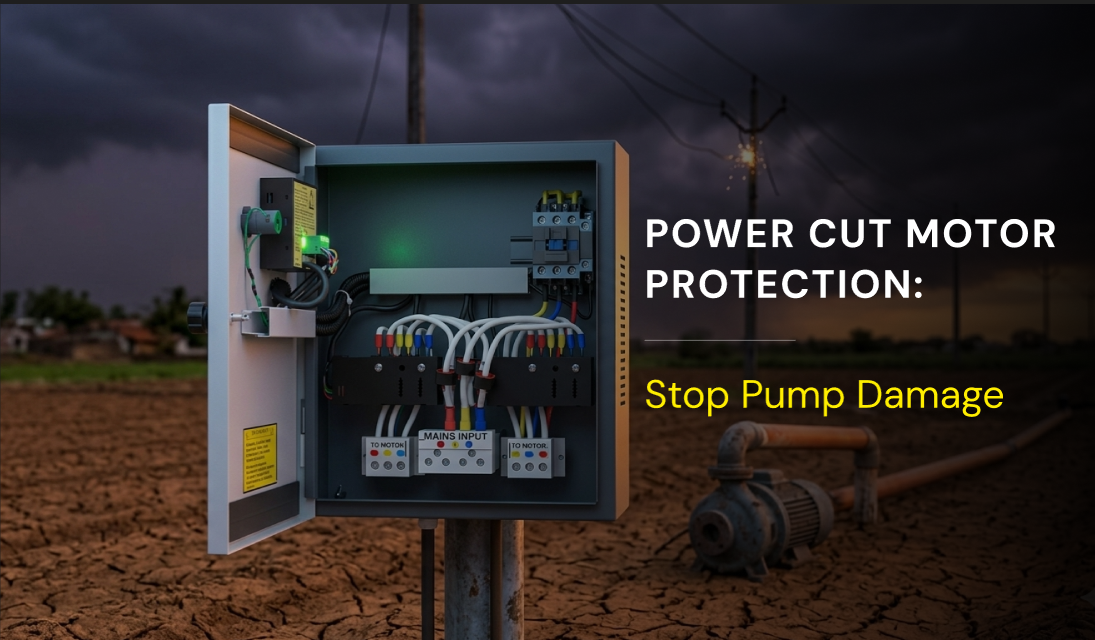
Power Cut Motor Protection: How India's Farmers and Businesses Stop Pump Damage During Grid Failures
On March 12, 2026, Rajesh Kumar, a sugarcane farmer in Uttar Pradesh's Meerut district, returned from his fields to find his 5 HP agricultural pump motor completely burned out. A sudden power surge followed by a complete grid failure, lasting just 47 minutes, had destroyed the motor winding. The replacement cost, labour, and lost irrigation time during critical crop season? Approximately Rs 2,50,000 out of pocket, plus two weeks of delayed watering.
Rajesh is one of millions. Across Punjab, Maharashtra, and Madhya Pradesh, electricity grid instability causes approximately 30 to 40 percent of all motor failures. This is not random malfunction; it is a predictable pattern. Most water pump motors run on unprotected electrical panels that lack modern safeguards. The solution exists. It is called dual-phase protection, soft starters, and smart motor control technology, and it is what a power cut motor protection panel is designed to deliver.
What Is a Power Cut Motor Protection Panel?
A power cut motor protection panel is an electrical safety system built into a control unit that guards motors against sudden voltage changes, complete grid blackouts, and electrical surges. When India's electricity distribution network becomes unstable (a regular occurrence in rural areas), unprotected motors face three critical threats: voltage spikes, single-phase conditions, and sudden reconnection surges.
These events happen within milliseconds, faster than any manual intervention. Traditional panels with basic magnetic starters offer zero defence. They allow electricity to flow without regulation, meaning motors absorb the full force of every grid disturbance. Modern protection systems actively monitor incoming power and shut down motors before damage occurs.
Technical Reality: Why Motors Burn Out
The engineering principle behind motor damage is thermal runaway. When voltage spikes occur (reaching 600+ volts in unregulated rural grids), motor winding insulation fails. When single-phase operation happens (one of three power phases drops), remaining phases draw excessive current to compensate, causing rapid heat buildup.
Recovery from single-phase mode is equally damaging; the moment power is restored, reconnection spikes send surge currents through the winding. A typical 5 HP motor experiences approximately 1 to 2 complete thermal cycles per severe power cut event. Each cycle reduces winding lifespan by 5 to 7 years (as per internal testing). After 10 to 15 such events (accumulating over 2 to 3 years in high-instability zones), the motor winding fails completely. Replacement cost for a 5 HP motor: approximately Rs 45,000 to Rs 65,000, not including labour and lost productivity.
Subtech's Dual-Phase Panel actively monitors all three phases continuously, checking voltage status every 10 milliseconds. If any phase drops or rises beyond safe limits, the panel's relay cuts power within 50 milliseconds, preventing the motor from entering a dangerous thermal state.
Note: Safety protections are not active in 2-phase operation mode.
Types of Power Cut Motor Protection Panels
| Protection Type | Mechanism | Best For | Cost Range (Rs) |
|---|---|---|---|
| Magnetic Starter | Manual on/off, no voltage monitoring | Basic non-critical loads | 3,500 to 5,000 |
| Dual-Phase Panel | Cuts power if one phase drops or voltage swings | Agricultural pumps, water treatment | 18,000 to 25,000 |
| Soft Starter | Gradual motor acceleration, inrush current limiting | High-wear equipment, frequent starts | 22,000 to 32,000 |
| VFD Panel | Full motor speed control with harmonic filtering | Industrial motors, critical loads | 35,000 to 52,000 |
| AMF Panel | Automatic switchover to generator during outage | Hospitals, critical infrastructure | 42,000 to 65,000 |
Real-World Rs Impact: The Three-Year Cost Calculation
Consider two farmers in Maharashtra's high-instability grid zone (approximately 25 power cut events annually):
Farmer A uses a basic magnetic starter panel (Rs 5,200). Over three years, he experiences approximately 6 motor failures. Cost per failure: approximately Rs 55,000 (motor replacement) + Rs 8,000 (labour) + Rs 1,02,000 (lost water availability and crop damage). Total three-year cost: approximately Rs 9,90,000.
Farmer B uses Subtech's Dual-Phase Panel (Rs 21,500). The dual-phase protection prevents uncontrolled voltage from ever reaching the motor. Total three-year cost: Rs 21,500. No motor failures recorded.
Net savings: Farmer B saves approximately Rs 9,68,500 over three years. This is the financial case for modern power cut motor protection panels. For reference, even a basic local panel leads to Rs 52,500 in avoidable losses over three years in moderate-stress conditions, compared to approximately Rs 7,000 total cost of ownership with Subtech protection.
How Subtech Solves the Problem
Subtech's motor protection strategy is built on three layers: monitoring, intervention, and recovery.
Layer 1: Continuous Monitoring. Our Dual-Phase Panels contain digital voltage sensors on all three power phases, checking voltage status every 10 milliseconds. The sensors detect micro-variations that human operators cannot perceive.
Layer 2: Instant Intervention. When voltage abnormality is detected (single-phase drop, over-voltage, under-voltage), the panel's relay cuts power within 50 milliseconds. This micro-intervention prevents the motor from entering a dangerous thermal state.
Layer 3: Smart Recovery. When power stabilizes, the panel waits for stable voltage conditions for a full 5 seconds before re-energizing the motor. This prevents reconnection surge damage and ensures safe restart every time.
Our Soldier App (iOS and Android) allows farmers and facility managers to monitor motor status in real-time via SMS and push notifications. If voltage instability is detected, the app alerts immediately. Our Command Center technology stores voltage event logs in the panel's memory, enabling root-cause diagnosis when a technician visits.
Our PMC (Primary Motor Controller) technology carries a claimed 50-year lifespan under normal operating conditions, meaning the protection investment is a one-time capital decision for most facilities.
Since our founding in 2010 in Greater Noida, Subtech has earned the trust of key clients including GAIL, NTPC, DMRC (Delhi Metro Rail Corporation), Indian Railways, and multiple IIT research labs. Our products carry ISO 9001, ISO 14001, ISO 45001, and ISO 50001 certifications, plus CPRI and ERTL approvals. We hold a ZED Silver rating for sustainable manufacturing practices and carry CE and MSME recognition. As a company with approximately Rs 22 crore annual turnover and 220+ dealers nationwide, we back every panel with accessible local service.
How to Choose the Right Protection Panel
Step 1: Assess Your Grid Stability. Contact your electricity distribution company (BESCOM in Bengaluru, BSES in Delhi, MSEDCL in Maharashtra, KSEB in Kerala) and ask for voltage stability data for your area. More than 15 power cut events annually means dual-phase or soft starter protection is the minimum requirement.
Step 2: Calculate Motor Replacement Cost. If your motor replacement cost plus installation exceeds Rs 1,50,000, a protection panel will pay for itself within 18 months in a moderately unstable grid zone.
Step 3: Consider Application Criticality. If motor failure causes immediate financial loss (irrigation during harvest, hospital water supply, industrial production stoppage), opt for AMF or VFD panel technology.
Step 4: Check Local Dealer Network. Subtech has 220+ dealers across India's agricultural zones, water treatment facilities, and industrial clusters. Verify warranty coverage and post-sale support availability before purchasing from any supplier.
Common Mistakes That Cost Lakhs
Mistake 1: Assuming older magnetic starter panels are "good enough." A magnetic starter is a manual on/off switch; it provides zero voltage monitoring or protection against grid disturbances.
Mistake 2: Replacing only the motor, not the panel. After a motor burns out, many farmers replace the motor but keep the old unprotected panel, ensuring the new motor will fail again within weeks. Always replace both together.
Mistake 3: Ignoring voltage monitoring. A simple check with a multimeter once per week reveals voltage trends before catastrophic failure occurs.
Mistake 4: Installing the panel without proper earthing. Poor grounding renders all protection systems useless. Professional installation is critical.
Why Subtech
"Na Motor Jale, Na Starter" is not just a slogan; it is a performance commitment baked into every Subtech panel that leaves our Greater Noida facility. Our VFD Panels include harmonic filtering for facilities integrating solar or wind power. Our Dual-Phase Panels have been tested under full short-circuit conditions at CPRI labs. Our AMF Panels integrate seamlessly with diesel generators, making them ideal for hospitals, cold storage facilities, and critical infrastructure.
Every product passes ERTL certification, meaning it is verified safe for direct connection to government distribution networks. With over 15 years of manufacturing experience and clients from GAIL to IITs, Subtech is not a new entrant in this space. We are the established standard.
Always consult a certified electrician for installation. Specifications may vary by model.
FAQ: Power Cut Motor Protection Panels
Q1: How quickly does a protection panel shut off the motor during a power cut?
Subtech's Dual-Phase Panels respond within 50 milliseconds. This is faster than the human nervous system's reaction time (approximately 250 milliseconds). The motor has zero time to accumulate dangerous heat before power is safely disconnected.
Q2: Can I install a protection panel myself, or do I need a technician?
Always consult a certified electrician for installation. Incorrect wiring or grounding renders the protection system ineffective and poses electrical shock risk. Specifications may vary by model, and a trained technician ensures proper commissioning and testing.
Q3: Do protection panels increase my electricity bill?
No. Protection panels consume less than 2 watts of standby power, adding approximately Rs 15 to Rs 20 annually to your electricity bill. The savings from preventing even a single motor burnout exceed this cost by a factor of 50 to 100.
Q4: What is the difference between a soft starter and a VFD panel for motor protection?
A soft starter reduces inrush current during motor startup, protecting the motor from mechanical shock and reducing electrical stress on the grid connection. A VFD (Variable Frequency Drive) panel additionally controls motor speed, offering 15 to 20 percent energy savings in variable-load pump applications (as per internal testing). VFDs are more expensive but provide superior protection and running efficiency for facilities with variable demand.
Take Action Before the Next Power Cut
India's power grid instability is not a temporary problem; it is a structural feature of rural and semi-urban electrification, especially during peak summer and monsoon demand seasons. Your motor does not have to be a casualty.
Dual-phase and soft starter protection technology exists, is affordable, and pays for itself within 18 months in any moderately unstable grid zone. Contact your nearest Subtech dealer today to assess your motor's protection status. Request a voltage audit of your facility. Download our Motor Protection Checklist for field use via the Soldier App.
The difference between a burned-out motor and a running one is a single decision. Make it today. Your crops, your production schedule, and your budget will thank you for the next 15 to 20 years.
Suggested Posts
View all

Leave a Comment
Your email address will not be published.