
APFC Panels9 min read0 commentsMay 22, 2026
APFC Panel: How to Stop Paying Power Factor Penalty in 2026
AB
Ananya Bajpai
Subtech
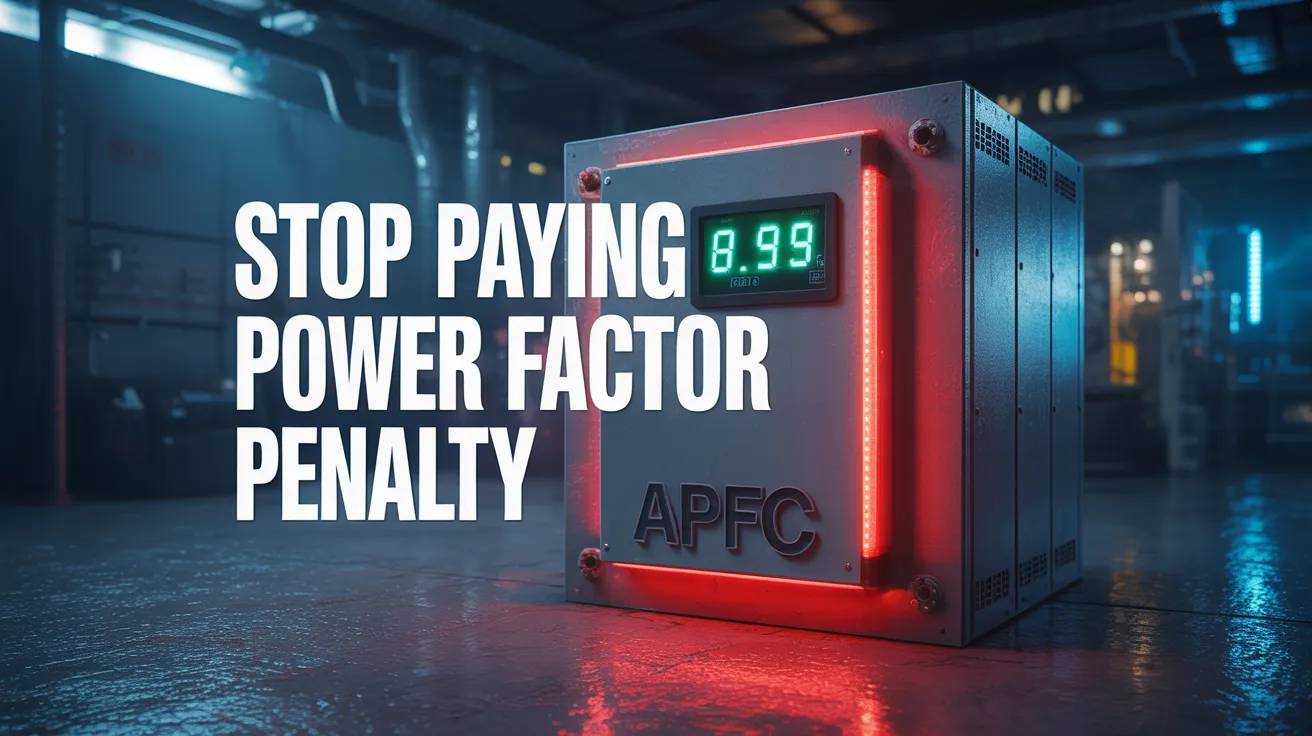
Indian industries are quietly losing thousands to lakhs of rupees every single month on their electricity bills. Not to rising tariffs. Not to equipment inefficiency. To a line item on the DISCOM bill called "power factor surcharge." Most plant managers see it. Few understand it. Almost none have eliminated it permanently.
An APFC panel (Automatic Power Factor Correction panel) is the device that solves this problem. In 2025, with electricity tariffs rising across every major state and DISCOMs enforcing penalty clauses more strictly than ever before, installing an APFC panel has moved from a "nice to have" to a financial necessity. This guide covers everything you need to know: what power factor is, how the penalty works, what an APFC panel costs, and how to choose the right one for your plant.
What Is Power Factor and Why Does It Cost You Money?
Power factor is the ratio of useful power (kW) that actually does work to the total apparent power (kVA) your plant draws from the grid. A power factor of 1.0 means every unit of electricity drawn is being used productively. A power factor of 0.75 means 25% of the power your transformer, cables, and meters are carrying is wasted as reactive power that does no useful work.
Industrial loads including motors, compressors, pumps, cranes, and welding machines are inductive in nature. This means they naturally draw reactive current in addition to the working current. The more motors you run, the lower your power factor tends to be without correction.
DISCOMs across India mandate a minimum power factor of 0.90 for HT and LT industrial consumers. If your monthly average power factor falls below this threshold, you are charged a penalty surcharge on your total assessed bill.
For a factory in Uttar Pradesh running a monthly electricity bill of Rs 6 lakhs with a power factor of 0.76, the monthly penalty at 1% per 0.01 below 0.90 works out to Rs 84,000. That is over Rs 10 lakhs per year. Lost. Not invested. Lost.
What Is an APFC Panel?
An APFC panel is an electrical panel that continuously monitors your system power factor and automatically switches capacitor banks in or out to maintain the power factor above the required level. The word "automatic" is what separates it from a basic fixed capacitor installation, which requires manual switching and is almost never optimally tuned.
The key components inside a standard APFC panel are:
- Power factor controller relay (the brain of the system)
- Capacitor banks in switchable steps
- Capacitor-duty contactors or thyristors for switching
- Current transformers (CT) for live measurement
- MCCBs for short circuit protection
- Surge protection module
- Display showing real-time power factor, kVAR, and alarm status
How Does an APFC Panel Work?
The power factor relay measures current and voltage continuously using CTs installed on the incomer. When the power factor drops below the target (typically set at 0.97 to 0.99 for a comfortable buffer above the 0.90 DISCOM limit), the relay signals a capacitor step to switch in. As the load changes throughout the day, steps switch in or out automatically. The result is a power factor maintained near unity without any manual intervention.
Modern APFC panels include RS-485 Modbus communication, allowing integration with plant SCADA systems and remote monitoring platforms. Your energy manager can view real-time power factor data, kVAR injected, and alarm notifications from any browser or mobile device without a site visit.
What Does the Penalty Structure Look Like in 2025?
Penalty slabs vary by state DISCOM. The table below gives a general picture for major industrial states. Always verify with your specific DISCOM tariff order, as slabs are revised annually.
State | Minimum Required PF | Penalty Structure
Uttar Pradesh | 0.90 | 1% of assessed bill per 0.01 below target
Delhi | 0.90 | 1.5% of assessed bill per 0.01 below target
Maharashtra | 0.95 | 1% of total bill per 0.01 below target
Gujarat | 0.90 | 1% surcharge per step below target
Rajasthan | 0.90 | 1% of energy charges per step
Tamil Nadu | 0.85 | 1% of energy charges per step
Most DISCOMs also offer a power factor incentive when your monthly average exceeds 0.95. In UP, maintaining above 0.95 earns a 0.5% discount on the total bill. For a Rs 6 lakh monthly bill, that is Rs 36,000 per year in bonus savings, on top of penalty avoidance.
Subtech engineers can audit your last six months of electricity bills and give you an exact penalty calculation before you decide on panel size.
Types of APFC Panels: Which One Is Right for Your Plant?
1. Fixed Capacitor Bank Panels
For stable, predictable loads. Simpler design and lower cost. Suitable for small pump houses and factories with consistent load patterns.
2. Automatic Multi-Step Panels (Standard)
4 to 12 switchable capacitor steps with contactor switching. The most common type for manufacturing plants, hospitals, commercial complexes, and water treatment stations.
3. Thyristor-Switched APFC Panels
For fast-changing loads such as welding machines, arc furnaces, and press machines. Thyristors switch in microseconds versus 40 to 60 milliseconds for contactors, preventing switching transients that damage capacitors under rapidly fluctuating loads.
4. Detuned (Harmonic Filter) APFC Panels
For plants running VFD panels, servo drives, UPS systems, or large rectifiers. If your plant has variable frequency drives and you install a standard APFC panel without harmonic detuning, the capacitor bank can resonate with 5th and 7th harmonic currents. This causes capacitor failure within weeks to months.
A detuned APFC panel includes series reactors (7% or 14% detuning) that shift the resonant frequency away from dominant harmonics. Subtech's engineering team conducts a basic harmonic assessment before recommending the correct configuration for your load profile.
What Is the Return on Investment?
The payback calculation is direct.
Example: A medium-scale factory in Greater Noida runs a monthly electricity bill of Rs 8 lakhs. Current power factor: 0.79. DISCOM requirement: 0.90. Monthly penalty: 11 steps x 1% x Rs 8 lakhs = Rs 88,000 per month.
Annual penalty avoided: Rs 10.56 lakhs.
Additional energy savings from reduced system losses: approximately 4 to 6% of reactive kVA billed.
Cost of a 100 kVAR automatic APFC panel installed: Rs 1.8 lakhs to Rs 2.5 lakhs.
Payback period: 2 to 3 months.
This is why energy auditors consistently recommend APFC panels as the first investment in any energy efficiency project. The ROI is faster than LED retrofits, motor rewinding, or VFD installation in most standard cases.
How to Select the Right APFC Panel: 6 Key Criteria
1. Total kVAR required: Rule of thumb is 30 to 40% of total connected kVA for a mixed industrial load. Get this calculated with a proper site survey.
2. Number of steps: More steps give finer control. Minimum 4 steps recommended for industrial loads.
3. Harmonic environment: If VFDs, servo drives, or rectifiers are present, always specify a detuned panel.
4. Switching technology: Contactors for stable loads. Thyristors for fast-changing loads.
5. Capacitor type: Specify dry-type self-healing capacitors. Safer, longer service life, no oil monitoring required.
6. Communication: If SCADA integration or remote monitoring is required, specify Modbus RTU output.
Always get a site survey done before ordering. The actual kVAR requirement depends on your load pattern, not just transformer nameplate ratings.
Common Mistakes That Cost Plants Money
Mistake 1: Buying undersized APFC panels.
Many buyers calculate on peak load only and miss the full daily load cycle. Always add 20% headroom to the calculated kVAR.
Mistake 2: Standard APFC panel in a VFD plant.
Resonance with harmonic currents causes rapid capacitor failure. Always specify detuning when VFDs are present.
Mistake 3: Skipping surge protection.
Capacitor switching generates transients. Without a surge protection module, these transients damage the relay and capacitors. This protection is non-optional, especially in areas with poor grid quality.
Mistake 4: Not commissioning properly.
An APFC panel must be commissioned with the correct CT ratio, step size, and target PF programmed into the relay. A panel installed but not commissioned sits idle while you continue paying the penalty.
Mistake 5: Ignoring annual maintenance.
Capacitors degrade over time. An annual capacitance measurement check identifies degraded units before failure. A maintained APFC panel lasts 10 to 15 years. An unmaintained one fails in 3 to 5.
Why Choose Subtech for Your APFC Panel?
Subtech has supplied APFC panels to clients including GAIL, NTPC, DMRC, Delhi Jal Board, Indian Railways, and UP Jal Nigam. These are organizations that cannot afford power quality failures or non-compliant equipment. Every Subtech APFC panel is built to this standard.
What you get with a Subtech APFC panel:
- ISI-marked, dry-type self-healing capacitors
- Microprocessor-based power factor relay with digital display
- Powder-coated MS enclosure (2mm sheet, IP42 minimum)
- Full factory testing with documented test report before dispatch
- Optional Modbus RTU for SCADA and remote monitoring integration
- ISO 9001, 14001, and 45001 certified manufacturing process
- CPRI-tested components throughout
Subtech also offers a free APFC requirement assessment for qualified industrial buyers. Our engineering team reviews your electricity bills, calculates the penalty you are currently paying, recommends the correct panel size and type, and provides an ROI projection before you spend a rupee.
Conclusion
An APFC panel is the highest-ROI electrical investment most Indian industrial plants can make today. In 2025, with state DISCOMs enforcing power factor penalty clauses and tariffs rising across the board, every month without an APFC panel is a month of voluntary overpayment on your electricity bill. The payback period is typically under three months. The lifetime penalty savings can exceed 10 times the panel cost over a 10-year period.
If your plant does not have an APFC panel today, or if your existing one is undersized or not suited to your current load profile, this is the year to correct it.
Contact Subtech for a free APFC site assessment. Visit www.subtech.in or reach out to our panel division team today.
Note: Consult a qualified electrical engineer before specifying or installing any power correction equipment. DISCOM penalty slabs vary by state and tariff order. Verify your applicable tariff with your DISCOM before calculating ROI.
Frequently Asked Questions
Q: What is the minimum power factor required by DISCOMs in India?
A: Most state DISCOMs require a monthly average power factor of 0.90 for industrial consumers. Maharashtra requires 0.95. Always check your specific state DISCOM tariff order for the exact threshold applicable to your connection type.
Q: How much does an APFC panel cost in India?
A: A standard automatic APFC panel for a small to medium industrial unit typically costs Rs 80,000 to Rs 3,00,000 installed, depending on kVAR rating, number of steps, and switching technology. The payback period through penalty savings is typically 2 to 4 months.
Q: Can an APFC panel work alongside VFD panels?
A: Yes, but the APFC panel must be specified as a detuned harmonic filter type with 7% or 14% series reactors. Standard APFC panels can resonate with harmonic currents from VFDs and fail quickly. A detuned APFC panel is safe and effective in plants with multiple VFD panels installed.
Q: How often does an APFC panel need maintenance?
A: An APFC panel should be inspected and serviced annually. Key tasks include capacitance measurement of each bank, contact inspection on capacitor-duty contactors, relay calibration check, and surge protection module inspection. A well-maintained panel has a service life of 10 to 15 years.
Suggested Posts
View all


Leave a Comment
Your email address will not be published.