
Standards & Compliance10 min read0 commentsMay 14, 2026
What the Air Force Checks Before Buying Electrical Panels
AB
Ananya Bajpai
Subtech
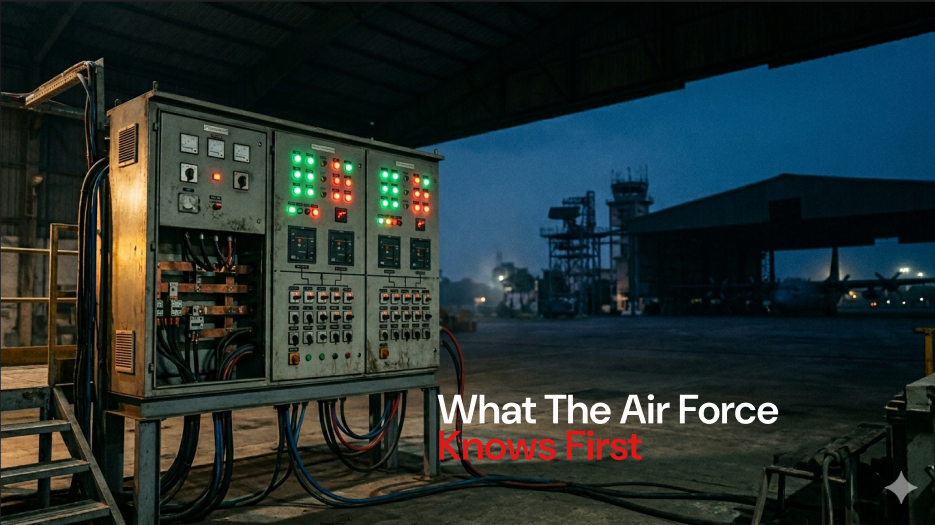
When the Indian Air Force, DMRC, NTPC, or GAIL needs to approve an electrical panel manufacturer, they do not pick the cheapest quotation. They do not pick the most famous brand. They follow a structured 7-point evaluation refined over decades of running mission-critical operations where panel failure is not an option.
Most private factory owners and SME buyers do not know this checklist exists. They compare three quotations, pick the lowest, and discover the real cost six months later when the panel starts tripping or the contactor coil burns. This blog reveals exactly what government and PSU buyers look for, and why following the same checklist can save your factory lakhs of rupees over a 10-year period.
Why Government Buyers Are the Best Teachers
Government buyers have three constraints that private buyers usually do not:
1. Zero tolerance for failure. A DMRC metro tunnel ventilation panel cannot fail. An Air Force radar facility cannot lose power. A NTPC power plant auxiliary panel must run 24/7 for years.
2. Auditable decision-making. Every vendor approval has to be defended in writing, with documentation, certifications, and test reports. There is no "I trusted the salesman" excuse.
3. 10-year horizon thinking. Government infrastructure is meant to last decades. The procurement process is optimized for total cost of ownership, not initial price.
The result is a buying process that filters out unreliable manufacturers ruthlessly. If you adopt even half of this checklist for your factory's panel purchase, you will end up with significantly better panels than 90 percent of Indian SME buyers.
The 7-Point Checklist Government Buyers Use
Step 1: ISO Certifications (And the Right Ones)
Every government and PSU procurement asks for ISO certifications. But not all ISO certificates are equal. Here is what they actually check:
ISO 9001 (Quality Management): Basic requirement. Anyone without this is rejected at the first stage.
ISO 14001 (Environmental Management): Increasingly mandatory for government projects, especially metros and clean industries.
ISO 45001 (Occupational Health and Safety): Critical for projects involving worker safety like railways, defence, and large industrial sites.
ISO 50001 (Energy Management): Required for energy-intensive industries and projects with green building targets.
A manufacturer with all four ISO certifications has invested significantly in process discipline. Subtech holds all four, which is one reason GAIL, NTPC, DMRC, Delhi Jal Board, UP Jal Nigam, Indian Railways, and the Indian Air Force have approved Subtech as a vendor.
Step 2: CPRI and ERTL Test Reports
This is where most government tenders eliminate cheap manufacturers. A test report from Central Power Research Institute (CPRI) or Electronics Regional Test Laboratory (ERTL) proves that the actual product design has been independently tested for short-circuit withstand, temperature rise, dielectric strength, and IP protection.
Many manufacturers claim "CPRI tested" verbally but cannot produce a current test report when asked. A genuine CPRI report contains:
Specific panel model and rating tested
Test date and validity period
Detailed test parameters and pass/fail results
CPRI letterhead with signatures and seal
Action for any buyer: Ask your shortlisted vendors to email you a copy of their CPRI test report. Watch how many cannot produce one within 24 hours. That single question filters out half the market.
Step 3: Component Quality Audit (The Step Most Buyers Skip)
This is the step that separates serious procurement from amateur buying. Government engineers physically inspect what is inside the panel. They do not just trust the catalog. They check:
Contactor brand and rating: Is it a named brand (Schneider, ABB, L&T, Siemens) or unnamed local stock? Is the rating actually matching the panel's specified current?
Copper cross-section of busbars: Is the copper thickness adequate for the rated current? Thin copper is one of the 4 Inside Secrets of why cheap panels fail in summer load conditions.
Wire gauge and quality: Are the internal wires the correct gauge with proper insulation rating?
Sheet metal thickness: Is the enclosure made from 14-16 SWG or thinner sheet that will rust within 2 years?
Powder coating quality: Is it 7-tank pretreatment with proper coating thickness, or quick spray that flakes off?
Earthing and bonding: Is the earthing properly designed with adequate cross-section?
Private SME buyers almost never do this inspection. They look at the panel from outside, see it looks "nice," and approve the purchase. Six months later, the panel rusts, the contactor coil burns, or the copper overheats. Government buyers refuse to skip this step, which is why their panels last 15-20 years instead of 3-5.
Step 4: Past Client References (Verifiable, Not Just Listed)
Government tenders require a verified list of similar projects executed. Not just names on a brochure. Buyers actually call or visit two or three reference clients to confirm:
The panel was delivered on time
It has been running reliably
The vendor responded promptly to service calls
No major component failures in the warranty period
When a manufacturer can point to GAIL, NTPC, DMRC, DJB, UP Jal Nigam, Indian Railways, and Indian Air Force as active clients with running installations, it is a credibility marker that takes 25+ years to build. This is exactly why Subtech invests in maintaining these relationships even when private orders pay better margins. The references are the moat.
Step 5: Manufacturing Facility Inspection
For high-value tenders, government engineers physically visit the manufacturing facility before final approval. They check:
Production capacity and workshop organization
Testing equipment available in-house (high-voltage testing, current injection, IR meters)
Quality control documentation and stage inspection records
Skilled workforce and supervisor qualifications
Raw material storage and traceability
Compliance with safety norms inside the factory itself
This visit cannot be faked with a clean reception area. Government engineers walk into the production floor, talk to shop-floor staff, and assess whether the operation is genuinely capable of consistent quality output. Subtech's Greater Noida facility has been inspected and approved by dozens of government buyers over the years.
Step 6: After-Sales Service Network
This is where many fancy brand-name vendors quietly fail. A panel installed at a remote Indian Air Force base in Jaisalmer needs service support that can reach the site. A NTPC power plant in Madhya Pradesh needs a vendor whose service engineer can respond within 24 hours.
Government buyers verify:
Number of service centers or authorized service partners
Geographic coverage across India
Response time commitments in writing
Spare parts availability and stocking policy
Service engineer qualifications and training records
This is where Subtech's 220+ dealer network and Soldier electrician network across India become a competitive advantage. Most premium MNC brands have city-level dealers. Subtech has district-level reach with trained electricians who can attend complaints faster than any imported brand can.
Step 7: Documentation and Compliance Paperwork
This sounds boring, but it is non-negotiable. Government and PSU buyers will reject a vendor at the last stage if the paperwork is incomplete. They require:
GST registration and tax compliance certificate
MSME certificate (for tender benefits)
GeM seller registration
EPF and ESIC compliance certificates
Type test reports for each rated product
Drawings, single line diagrams, and bill of materials
Operation and maintenance manuals
Warranty and AMC terms in writing
Subtech maintains this entire documentation suite as standard operating practice. Many cheaper local manufacturers cannot produce even half of these documents, which is why they are restricted to small private contracts and never grow into serious B2B vendors.
What This Means For Private Factory Owners
You do not have to run a full government-style procurement for every panel you buy. But you can borrow the most valuable steps and apply them to your next purchase:
Always ask for the CPRI test report. Demand a copy by email. This single filter removes most low-quality vendors.
Ask to see component brands inside. Specifically check contactor, MCCB, MPCB, and capacitor brands. Reject unnamed local stock.
Verify two real customers. Ask for two factory references in your region and actually call them.
Confirm service response time in writing. If the vendor cannot commit to a 48-hour service response, look elsewhere.
Get warranty terms in writing. Not verbal promises. A signed warranty document, with clear coverage and exclusions.
Following just these five points will put your factory ahead of 80 percent of Indian SME buyers in panel selection discipline.
Why Subtech Has Earned These Approvals
Subtech is not a household consumer brand. We do not advertise on television. What we have built over 28 years from our Greater Noida facility is something more valuable in the B2B world: a reputation among engineering teams at India's most demanding buyers.
The trust list speaks for itself:
GAIL India Limited
NTPC Limited
Delhi Metro Rail Corporation (DMRC)
Delhi Jal Board (DJB)
UP Jal Nigam
Indian Railways
Indian Air Force
Indian Institutes of Technology (IITs)
Behind these approvals are full ISO 9001, 14001, 45001, 50001 certifications, CE marking, CPRI and ERTL test reports, ZED Silver certification, MSME registration, and active GeM listing. The same engineering discipline that satisfies an Air Force radar facility also goes into a private factory's MCC panel or APFC installation.
Our brand tagline reflects what we have committed to over decades: Na Motor Jale, Na Starter. Whether the panel is going into a Delhi Metro station or a small textile unit in Surat, the engineering standard is the same.
Common Mistakes Private Buyers Make
Treating panel purchase as a commodity buy. A panel is not a commodity. It is a 10-year capital investment with safety implications. Treat it that way.
Comparing only initial price. Cheap panels cost roughly Rs 52,500 in repairs and motor losses over 3 years versus Rs 7,000 for a properly engineered panel. The math is one-sided.
Trusting verbal certifications. Get every certificate in writing. Verify validity dates. CPRI reports expire and must be current.
Ignoring service network reach. A great panel from a brand with no service in your district is not a great panel for you.
Skipping the factory visit option. If you are spending more than Rs 5 lakh on panels, visit the manufacturer's facility. Most serious manufacturers welcome buyer visits.
Conclusion
The Indian Air Force does not pick electrical panel vendors by tossing a coin. NTPC does not select based on the cheapest quotation. DMRC does not approve a manufacturer because the salesman was charming. They follow a 7-point checklist that has been validated by decades of running critical infrastructure where failure is not acceptable.
Your factory deserves the same discipline. The next time you receive panel quotations, do not just compare price columns. Run the 7-point check. Most vendors will fail at step 2 or step 3. The ones that pass are the ones worth your money over the next 10 years.
Want a panel that has been approved by India's most demanding buyers? Request a quotation and technical proposal from Subtech. We will share our CPRI reports, ISO certificates, and verified client references upfront. Contact your nearest dealer or reach the engineering team at subtech.in.
Frequently Asked Questions
Q1. Is a CPRI test report mandatory for private factory panel purchases?
Not legally mandatory for private use, but strongly recommended. CPRI testing proves the panel design has been independently validated for short-circuit and thermal performance. Without it, you are trusting the manufacturer's word alone. For any panel above 100A rating, insist on a CPRI report.
Q2. How can I verify that a manufacturer's claimed ISO certifications are genuine?
Ask for the certification number and the issuing body name. Then visit the issuing body's website and verify the certificate online. Most ISO certification bodies maintain a public registry. If the manufacturer hesitates to share the certificate number, that is a red flag.
Q3. What is the typical lifespan of a well-engineered panel versus a cheap one?
A panel built to government and PSU standards typically lasts 15-20 years with routine maintenance. A cheap unbranded panel often fails within 3-5 years due to rusting enclosures, undersized copper, low-quality contactors, and inadequate protection components.
Q4. Do private factory buyers have access to the same panels Subtech supplies to government clients?
Yes. The engineering standard is the same across all Subtech panels regardless of buyer category. Private SME customers receive the same component quality, the same testing rigor, and the same after-sales service. The only difference is order size and customization level.
Disclaimer: All certifications, test reports, and client references mentioned should be verified directly with Subtech at the time of purchase. Specific tender requirements vary by buyer organization and project type. This blog provides general guidance and is not a substitute for project-specific procurement consultation.
Suggested Posts
View all

Leave a Comment
Your email address will not be published.