
65 min read0 commentsFeb 06, 2026
How to Select a Soft Starter for a 10 HP Motor - Complete Guide 2025
AB
Ananya Bajpai
Subtech
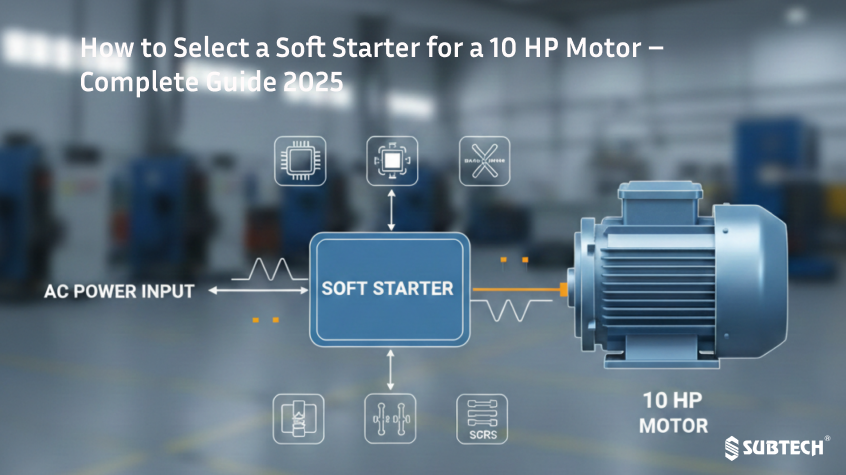
How to Select a Soft Starter for a 10 HP Motor - Complete Guide 2025
Starting a motor directly can cause high inrush current, mechanical stress, and voltage drops in your electrical system. A soft starter solves this by gradually ramping up voltage, ensuring smooth motor starts and longer equipment life.
But how do you select the right soft starter for a 10 HP motor? It's not just about matching the horsepower. You need to consider voltage, load type, duty cycle, and protection features.
In this guide, we'll walk you through the 7-step process to choose the perfect soft starter for your 10 HP motor.
What is a Soft Starter and Why Do You Need One?
A soft starter is an electrical device that controls the voltage supplied to a motor during startup. It reduces the starting current (typically 3-8 times the normal current) and prevents:
Mechanical shocks on belts, couplings, and gearboxes
Voltage dips that affect other equipment
Thermal stress on motor windings
High electricity demand charges
Common uses for 10 HP motors:
Pumps (bore wells, water treatment)
Conveyors in factories
Compressors
Mixers and blowers
Crushers in small industries
Step 1: Check Motor Nameplate Data
Before selecting a soft starter, collect this information from your motor's nameplate:
| Parameter | Example for 10 HP Motor |
| Rated Power | 10 HP (7.5 kW) |
| Voltage | 415V (3-phase) |
| Full Load Amps (FLA) | ~16-18 Amps |
| Frequency | 50 Hz |
| Duty Cycle | S1 (Continuous) |
Why this matters:
The soft starter must match your motor's voltage and handle its full load current comfortably. Always choose a soft starter rated 10-15% above the motor's FLA.
Step 2: Classify Your Application Type
Soft starters are rated by application class based on load demand:
| Class | Application | Examples |
| Class 10 | Light loads, infrequent starts | Fans, blowers, centrifugal pumps |
| Class 20 | Medium loads, moderate starts | Compressors, loaded conveyors, mixers |
| Class 30 | Heavy loads, frequent starts | Crushers, shredders, piston pumps, ball mills |
For a 10 HP motor:
Running a water pump? ->Class 10
Running a compressor? -> Class 20
Running a crusher? -> Class 30
Choosing the wrong class can cause overheating or premature failure of the soft starter.
Step 3: Consider Starting Current and Duty Cycle
Starting Current:
A 10 HP motor at 415V typically draws 16-18 Amps during normal operation. At startup, it can pull 80-100 Amps without a soft starter.
Your soft starter must:
Handle the starting current without tripping
Allow adjustable ramp-up time (usually 5-30 seconds)
Duty Cycle:
How often does the motor start and stop per hour?
Low duty (1-2 starts/hour): Standard soft starter works fine
High duty (10+ starts/hour): Choose a heavy-duty model with better cooling
Step 4: Environmental and Installation Conditions
Ambient Temperature:
Soft starters have a maximum operating temperature (usually 40-50°C). If your installation is in a hot environment (boiler room, outdoor enclosure), you may need:
De-rating the soft starter
Adding cooling fans
Choosing a higher-rated model
Altitude:
If your site is above 1000 meters, air cooling is less effective. De-rate the soft starter by 5-10%.
Enclosure Type:
IP20: Indoor, dust-free areas
IP54: Dusty environments (factories, warehouses)
IP65: Outdoor or high-moisture areas
Step 5: Connection Type and Control Features
Motor Connection:
Star (Wye) connection: More common for 10 HP motors in India
Delta connection: Less common, but requires inside-delta soft starter wiring
Control Features to Look For:
Voltage ramp start: Smooth acceleration
Current limiting: Caps the starting current
Torque control: For conveyors and crushers
Soft stop: Gradual deceleration to prevent water hammer (pumps)
Programmable settings: Adjust ramp time, current limit, etc.
Step 6: Select a Soft Starter with Appropriate Ratings
For a 10 HP (7.5 kW) motor at 415V, 3-phase:
| Parameter | Recommended Soft Starter Rating |
| Current Rating | 18-25 Amps (depending on class) |
| Voltage | 380-440V AC |
| Control Voltage | 220V or 110V AC |
| Starting Mode | Voltage ramp or current limiting |
Example models (common in India):
Siemens 3RW40 series (18-25A)
Schneider Altistart 01 (7.5 kW)
ABB PSR series (18A)
L&T or C&S soft starters (budget options)
Pro Tip: Always size the soft starter based on motor current, not just HP. A 10 HP motor with high starting torque may need a 25A soft starter instead of 18A.
Step 7: Additional Protection Features
A good soft starter should include built-in protections:
- Overload protection - Prevents motor burnout
- Phase loss/imbalance protection - Detects missing or unbalanced phases
- Under-voltage and over-voltage protection - Protects against supply fluctuations
- Short circuit protection - Fast trip on fault
- Thermal overload relay - Monitors motor temperature
These features reduce downtime and extend motor life, especially in areas with unstable power supply.
Example Selection: 10 HP Pump Motor
Application: Borewell pump, 10 HP, 415V, 3-phase
Starting: 2-3 times per day
Environment: Outdoor pumphouse, IP54 enclosure
Recommended Soft Starter:
Rating: 18-22 Amps, Class 10
Features: Voltage ramp start, soft stop (prevents water hammer), phase protection
Enclosure: IP54 or NEMA 12
Brands: Schneider Altistart 01, ABB PSR18, or equivalent
Common Mistakes to Avoid
Selecting based only on HP - Always check FLA and application class
Ignoring duty cycle - Frequent starts need heavy-duty models
Undersizing for heavy loads - Crushers and loaded conveyors need Class 30
Skipping environmental factors - Hot or high-altitude sites need de-rating
Not checking protection features - Phase loss can destroy motors without protection
Why Choose Subtech Soft Starters?
At Subtech, we design soft starters built for Indian industrial conditions:
Voltage fluctuation tolerance - Works reliably even with unstable mains supply
IP54/IP65 enclosures - Suitable for dusty and outdoor installations
Class 10/20/30 options - For light to heavy-duty applications
Built-in protections - Overload, phase loss, under/over voltage, thermal protection
Programmable ramp settings - Customize start time and current limit
Competitive pricing - Cost-effective solutions for SMEs and factories
Our soft starters are tested in real-world conditions across manufacturing units, agriculture, and water treatment plants in Tier 2 and Tier 3 cities.
Conclusion
Selecting the right soft starter for a 10 HP motor is not complicated if you follow these 7 steps:
Check motor nameplate data (voltage, FLA)
Classify your application (Class 10/20/30)
Consider starting current and duty cycle
Account for environmental conditions
Choose connection type and control features
Select appropriate current rating (18-25A)
Ensure built-in protection features
Key Takeaway:
Always size based on motor current and application type, not just horsepower. A properly selected soft starter reduces energy costs, prevents mechanical damage, and extends motor life.
Need help selecting the right soft starter for your setup? Contact Subtech for expert guidance and custom panel solutions.
Suggested Posts
View all
Leave a Comment
Your email address will not be published.